
Call us
301-363-4651 (Available 9 a.m. to 5 p.m. CST from Monday to Friday)

| Code | CSB-RA761624MA1HU |
| Size | $49.9 |
| Order now | |
| Promotion |

|
| Image |
|
| Have Questions? | Leave a Message or Start an on-line Chat |
| Application | Recommended Dilution |
|---|---|
| IHC | 1:50-1:200 |
| FC | 1:50-1:200 |
ADAMTSL5, also known as thrombospondin type-1 domain-containing protein 6, belongs to the ADAMTS-like protein family that plays important roles in extracellular matrix organization and tissue homeostasis. While structurally related to ADAMTS proteases, ADAMTSL proteins lack catalytic domains and instead function as regulatory molecules influencing matrix assembly and growth factor signaling. Research into ADAMTSL5 has gained particular interest in dermatology and oncology contexts, making reliable detection tools essential for advancing our understanding of this secreted glycoprotein.
This recombinant monoclonal antibody, clone 20H10, offers the reproducibility and consistency that demanding research applications require. Generated against recombinant human ADAMTSL5 protein and produced using recombinant technology, this antibody provides sequence-defined specificity with minimal lot-to-lot variation, ensuring your experimental results remain comparable across extended studies. The human IgG1 isotype format and affinity-chromatography purification deliver a high-quality reagent suitable for quantitative workflows.
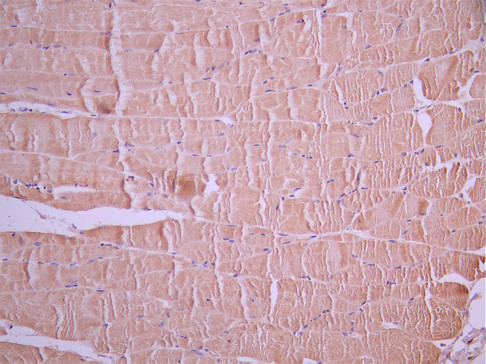
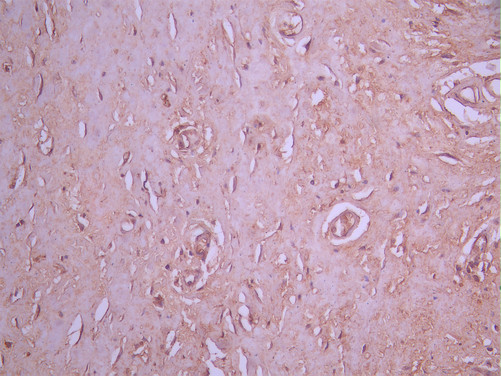
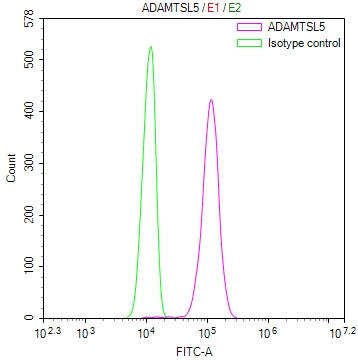
Validation studies demonstrate robust performance across multiple platforms. Immunohistochemistry testing confirms effective staining in both human breast cancer tissue and mouse skeletal muscle sections at 1:50 dilution using citrate buffer antigen retrieval, supporting the antibody's cross-species reactivity with human and mouse samples. Flow cytometry analysis using HeLa cells shows clear positive signal separation from isotype control, with intracellular staining performed following formaldehyde fixation and Triton X-100 permeabilization.
Whether investigating extracellular matrix biology, exploring ADAMTSL5 expression patterns in cancer research, or characterizing tissue-specific distribution, this antibody provides the flexibility to move between ELISA, immunohistochemistry, and flow cytometry applications within a single research program.
There are currently no reviews for this product.





