
Call us
301-363-4651 (Available 9 a.m. to 5 p.m. CST from Monday to Friday)

| Code | CSB-RA204247A0HU |
| Size | US$210 |
| Order now | |
| Image |
|
| Have Questions? | Leave a Message or Start an on-line Chat |
| Application | Recommended Dilution |
|---|---|
| FC | 1:50-1:200 |
Apolipoprotein C-I plays a central role in lipid metabolism, functioning as a key regulator of lipoprotein lipase and hepatic lipase activity while influencing cholesterol ester transfer protein function. As the smallest of the exchangeable apolipoproteins, APOC1 participates in the remodeling of high-density and very-low-density lipoproteins, making it a significant target for researchers investigating cardiovascular disease mechanisms, lipid disorders, and metabolic syndrome pathways.
This recombinant monoclonal antibody, clone 5C9, offers the reproducibility and consistency that demanding experimental workflows require. Developed using recombinant technology in a rabbit host system, each lot delivers sequence-defined specificity against human APOC1, eliminating the batch-to-batch variability that can compromise longitudinal studies or multi-site collaborations. The antibody was raised against a synthetic peptide derived from human APOC1, ensuring targeted recognition of this clinically relevant apolipoprotein.
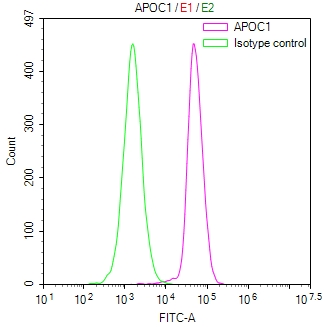
Validation studies confirm robust performance in flow cytometry applications, with recommended dilutions ranging from 1:50 to 1:200. Testing in HepG2 cells, a well-established hepatocyte model known for active lipoprotein synthesis, demonstrated clear positive signal separation from isotype control when cells were fixed and permeabilized, indicating reliable detection of intracellular APOC1. The antibody has also been validated for ELISA applications, providing flexibility for researchers working across different experimental platforms.
Supplied in a stabilized liquid format with glycerol for convenient long-term storage, this antibody serves investigators exploring lipid metabolism, hepatocyte biology, atherosclerosis mechanisms, and apolipoprotein-mediated disease processes. Its defined specificity for human APOC1 makes it particularly valuable for translational research connecting basic lipoprotein biology to cardiovascular disease outcomes.
There are currently no reviews for this product.





