
Call us
301-363-4651 (Available 9 a.m. to 5 p.m. CST from Monday to Friday)

| Code | CSB-RA944847A0HU |
| Size | US$210 |
| Order now | |
| Image |
|
| Have Questions? | Leave a Message or Start an on-line Chat |
| Application | Recommended Dilution |
|---|---|
| WB | 1:500-1:2000 |
| IF | 1:50-1:200 |
| FC | 1:50-1:200 |
ARPC2, also known as p34-Arc, is a critical component of the Arp2/3 complex that drives actin filament nucleation and branching at the leading edge of motile cells. This 34 kDa subunit plays essential roles in cell migration, endocytosis, and intracellular trafficking, making it a key target for researchers investigating cytoskeletal dynamics, cancer metastasis, and cellular morphogenesis.
This recombinant monoclonal antibody, generated from clone 12C10 in rabbit host, offers the reproducibility and consistency that demanding experimental workflows require. Because recombinant antibodies are produced from defined sequences rather than traditional hybridoma methods, researchers benefit from lot-to-lot uniformity that supports reliable data across long-term studies and multi-site collaborations.
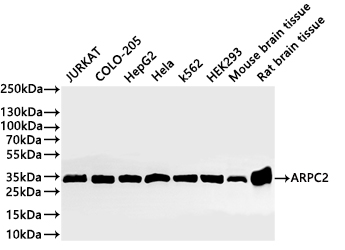
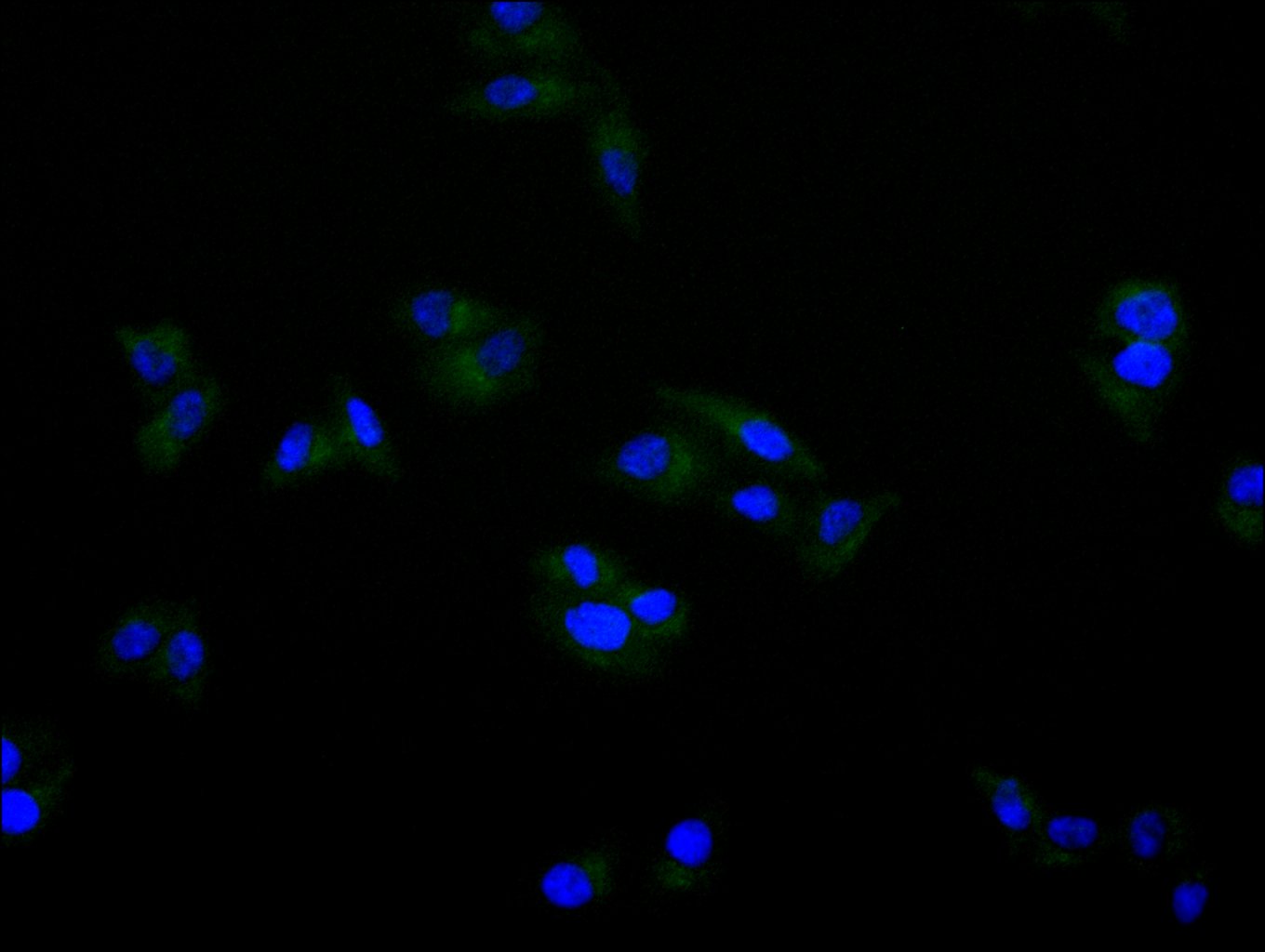
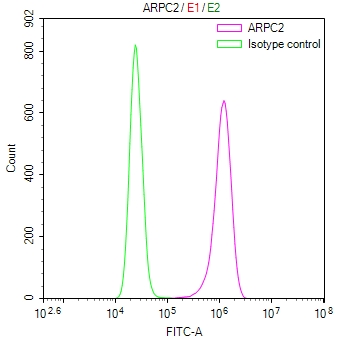
Validation testing demonstrates robust performance across multiple applications and sample types. Western blot analysis detects a clean 34 kDa band matching the predicted molecular weight across a diverse panel of human cell lines including Jurkat, COLO-205, HepG2, HeLa, K562, and HEK293, with effective detection at 1:1000 dilution. Cross-species reactivity extends to rodent samples, with confirmed detection in both mouse and rat brain tissue lysates, supporting translational research using animal models. Immunofluorescence staining in HeLa cells reveals characteristic cytoplasmic localization patterns consistent with ARPC2's role in actin network organization. Flow cytometry validation further demonstrates utility for quantitative single-cell analysis of ARPC2 expression levels.
This antibody serves researchers studying actin cytoskeleton regulation, cell motility mechanisms, and related processes in cancer biology, neuroscience, and developmental biology, providing a reliable tool for interrogating Arp2/3 complex function across experimental platforms.
There are currently no reviews for this product.





