
Call us
301-363-4651 (Available 9 a.m. to 5 p.m. CST from Monday to Friday)

| Code | CSB-RA255012A0HU |
| Size | US$210 |
| Order now | |
| Image |
|
| Have Questions? | Leave a Message or Start an on-line Chat |
| Application | Recommended Dilution |
|---|---|
| FC | 1:50-1:200 |
BCL2L12 belongs to the BCL-2 family of apoptosis regulators, playing a distinctive role in modulating programmed cell death pathways. Unlike classical anti-apoptotic BCL-2 family members, BCL2L12 has garnered significant research attention for its involvement in glioblastoma and other malignancies, where its overexpression contributes to therapeutic resistance by inhibiting effector caspases. Understanding BCL2L12 expression and function provides valuable insights into cancer cell survival mechanisms and potential therapeutic vulnerabilities.
This recombinant monoclonal antibody, clone 8B10, offers researchers the reproducibility essential for longitudinal studies and multi-site collaborations. Produced using recombinant technology with a defined sequence, each lot delivers consistent performance, eliminating the variability that can compromise experimental comparisons over time. The rabbit host and monoclonal nature ensure high specificity for human BCL2L12, with affinity chromatography purification providing a clean reagent suitable for sensitive detection methods.
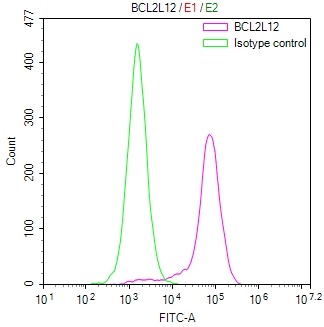
Validation for flow cytometry applications demonstrates reliable intracellular detection of BCL2L12 in HepG2 hepatocellular carcinoma cells, with recommended dilutions ranging from 1:50 to 1:200 providing flexibility to optimize signal-to-noise ratios in your specific experimental system. The flow cytometry protocol employing formaldehyde fixation and Triton X-100 permeabilization confirms robust detection of this cytoplasmic target. Additional ELISA compatibility extends the antibody's utility across different experimental platforms.
Researchers investigating apoptosis regulation, cancer biology, or therapeutic resistance mechanisms will find this antibody particularly valuable for characterizing BCL2L12 expression patterns in human cancer cell models and exploring its functional significance in cell survival pathways.
There are currently no reviews for this product.





