
Call us
301-363-4651 (Available 9 a.m. to 5 p.m. CST from Monday to Friday)

| Code | CSB-RA909912A0HU |
| Size | US$210 |
| Order now | |
| Image |
|
| Have Questions? | Leave a Message or Start an on-line Chat |
| Application | Recommended Dilution |
|---|---|
| FC | 1:50-1:200 |
CAD represents a fascinating example of metabolic efficiency in mammalian cells, encoding a large trifunctional enzyme that catalyzes the first three steps of de novo pyrimidine biosynthesis. This multidomain protein combines glutamine-dependent carbamoyl-phosphate synthase, aspartate carbamoyltransferase, and dihydroorotase activities within a single polypeptide chain. Given pyrimidine nucleotides' essential roles in DNA and RNA synthesis, CAD activity is particularly elevated in rapidly proliferating cells, making it a compelling target for researchers investigating cell cycle regulation, cancer metabolism, and nucleotide biosynthesis pathways.
This recombinant monoclonal antibody, clone 9E8, offers the reproducibility and consistency that demanding experimental workflows require. Developed using recombinant technology with a defined sequence, this rabbit IgG eliminates the lot-to-lot variability that can compromise longitudinal studies or multi-site collaborations. The antibody was raised against a synthesized peptide derived from human CAD protein, ensuring precise epitope targeting.
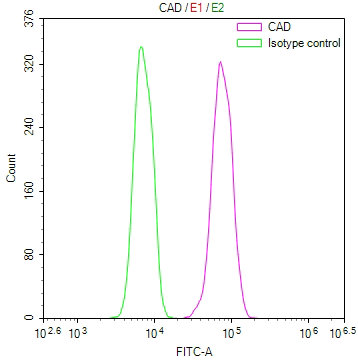
Flow cytometry validation demonstrates clear performance in detecting intracellular CAD in HeLa cells. Using fixed and permeabilized cells, the antibody produces a distinct positive shift compared to isotype control, confirming specific detection of endogenous CAD protein. The validated protocol employed formaldehyde fixation with Triton X-100 permeabilization, providing researchers with an established starting point for their own intracellular staining experiments.
For investigators studying metabolic reprogramming in cancer, nucleotide pool regulation, or the molecular mechanisms governing cell proliferation, this antibody provides a reliable tool for flow cytometric analysis of CAD expression at the single-cell level. The unconjugated format allows flexibility in secondary antibody selection to accommodate various instrument configurations and experimental designs.
There are currently no reviews for this product.





