
Call us
301-363-4651 (Available 9 a.m. to 5 p.m. CST from Monday to Friday)

| Code | CSB-RA791902A0HU |
| Size | US$210 |
| Order now | |
| Image |
|
| Have Questions? | Leave a Message or Start an on-line Chat |
| Application | Recommended Dilution |
|---|---|
| WB | 1:500-1:2000 |
| IHC | 1:50-1:200 |
Adenylyl cyclase-associated protein 1 (CAP1) plays a central role in actin cytoskeleton dynamics, regulating cell morphology, motility, and endocytosis. As a key modulator of cofilin-mediated actin turnover, CAP1 has emerged as a protein of significant interest in cancer research, where its dysregulation has been linked to tumor cell migration and metastatic potential. Understanding CAP1 expression and localization provides valuable insights into cellular processes underlying both normal physiology and disease states.
This recombinant monoclonal antibody, generated against a synthetic peptide derived from human CAP1, offers the consistency and reproducibility that demanding research applications require. As a sequence-defined reagent produced through recombinant technology, it eliminates the lot-to-lot variability inherent in traditional hybridoma-derived antibodies, ensuring your experimental results remain comparable across extended studies.
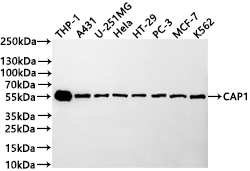
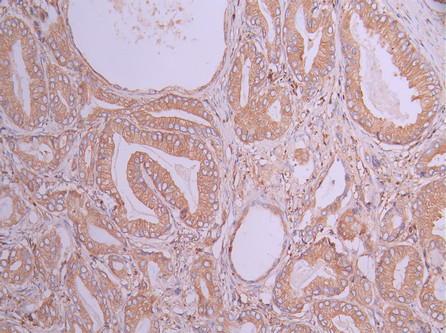
Validation across multiple applications demonstrates this antibody's versatility in your workflow. Western blot analysis confirms robust detection in diverse human cell lines, including THP-1 monocytes, A431 epidermoid carcinoma, U-251MG glioblastoma, HeLa cervical carcinoma, HT-29 colorectal adenocarcinoma, PC-3 prostate cancer, MCF-7 breast cancer, and K562 leukemia cells. The observed band at approximately 55 kDa, slightly higher than the predicted 52 kDa molecular weight, likely reflects post-translational modifications such as phosphorylation or acetylation known to occur on CAP1. Immunohistochemistry validation in paraffin-embedded human prostate cancer tissue further extends its utility for tissue-based studies examining CAP1 expression patterns in clinical specimens.
This antibody serves researchers investigating cytoskeletal regulation, cell migration mechanisms, and cancer biology where reliable CAP1 detection is essential for advancing their work.
There are currently no reviews for this product.





