CASQ1 Recombinant Monoclonal Antibody

Code CSB-RA166562A0HU
Size US$210
Order now
Image
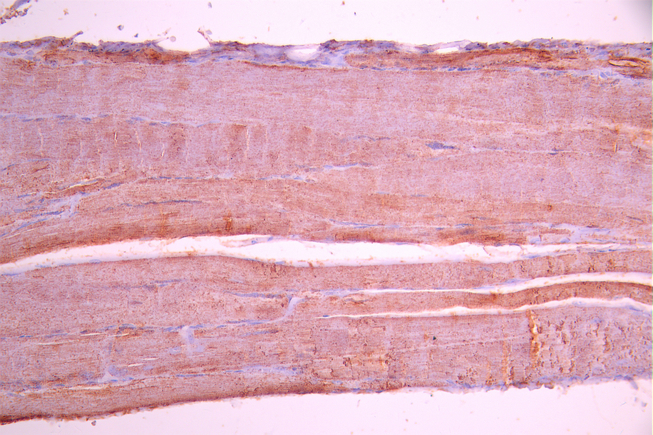
  • IHC image of CSB-RA166562A0HU diluted at 1:100 and staining in paraffin-embedded human skeletal muscle tissue performed on a Leica BondTM system. After dewaxing and hydration, antigen retrieval was mediated by high pressure in a citrate buffer (pH 6.0). Section was blocked with 10% normal goat serum 30min at RT. Then primary antibody (1% BSA) was incubated at 4°C overnight. The primary is detected by a Goat anti-rabbit polymer IgG labeled by HRP and visualized using 0.05% DAB.
  • Overlay Peak curve showing Raji cells stained with CSB-RA166562A0HU (red line) at 1:100. The cells were fixed in 4% formaldehyde and permeated by 0.2% TritonX-100 for 10min. Then 10% normal goat serum to block non-specific protein-protein interactions followed by the antibody (1ug/1*106cells) for 45min at 4℃. The secondary antibody used was FITC-conjugated goat anti-rabbit IgG (H+L) at 1/200 dilution for 35min at 4℃.Control antibody (green line) was Rabbit IgG (1ug/1*106cells) used under the same conditions. Acquisition of >10,000 events was performed.
Have Questions? Leave a Message or Start an on-line Chat

Product Details

Uniprot No.
Target Names
CASQ1
Alternative Names
Calsequestrin-1 (Calmitine) (Calsequestrin, skeletal muscle isoform), CASQ1, CASQ
Species Reactivity
Human
Immunogen
A synthesized peptide derived from Human CASQ1 protein
Immunogen Species
Homo sapiens (Human)
Conjugate
Non-conjugated
Clonality
Monoclonal
Isotype
Rabbit IgG
Clone No.
19D7
Purification Method
Affinity-chromatography
Concentration
It differs from different batches. Please contact us to confirm it.
Buffer
Rabbit IgG in 10mM phosphate buffered saline , pH 7.4, 150mM sodium chloride, 0.05% BSA, 0.02% sodium azide and 50% glycerol.
Form
Liquid
Tested Applications
ELISA, IHC, FC
Recommended Dilution
Application Recommended Dilution
IHC 1:50-1:200
FC 1:20-1:200
Troubleshooting and FAQs
Storage
Upon receipt, store at -20°C or -80°C. Avoid repeated freeze.
Lead Time
Basically, we can dispatch the products out in 1-3 working days after receiving your orders. Delivery time maybe differs from different purchasing way or location, please kindly consult your local distributors for specific delivery time.
Usage
For Research Use Only. Not for use in diagnostic or therapeutic procedures.
Customer Reviews and Q&A

 Customer Reviews

There are currently no reviews for this product.

Submit a Review here

Target Background

Function
Calsequestrin is a high-capacity, moderate affinity, calcium-binding protein and thus acts as an internal calcium store in muscle. Calcium ions are bound by clusters of acidic residues at the protein surface, often at the interface between subunits. Can bind around 80 Ca(2+) ions. Regulates the release of lumenal Ca(2+) via the calcium release channel RYR1; this plays an important role in triggering muscle contraction. Negatively regulates store-operated Ca(2+) entry (SOCE) activity.
Gene References into Functions
  1. These results widen the spectrum of skeletal muscle diseases associated with CASQ1 and indicate that these mutations affect properties critical for correct Ca(2+) handling in skeletal muscle fibers. PMID: 28895244
  2. the p.D244G variant in CASQ1 is associated with a skeletal muscle disease and alters sarcoplasmic calcium release PMID: 27196359
  3. Calsequestrin-1 monomers suppress Store-Operated Ca2+ Entry by interacting with STIM1 and attenuating STIM1 aggregation via its C-terminal amino acid 362-396. PMID: 27185316
  4. the protein aggregate myopathy with benign evolution and muscle inclusions composed of excess CASQ1 due to the D244G heterozygous missense mutation in the CASQ1 gene PMID: 26136523
  5. Equilibrium dialysis and turbidity measurements showed that D244G and, to a lesser extent, M87T partially lose Ca(2+) binding exhibited by wild type calsequestrin 1 at high Ca(2+) concentrations. PMID: 26416891
  6. Missense mutation in CASQ1 gene causes the formation of abnormal sarcoplasmic reticulum (SR) vacuoles containing aggregates of CASQ1 results in altered Ca2+ release, and vacuolar myopathy patients phenotype. PMID: 25116801
  7. There is a significant association between SNP A175G and heat stroke. PMID: 24887214
  8. The sarcoplasmic reticulum calcium content in human type II fibres is primarily determined by the CSQ1 abundance, and in type I fibres, by the combined amounts of both CSQ1 and CSQ2. PMID: 24127619
  9. a direct interaction of dysferlin with Trim72/MG53, AHNAK, cytoplasmic dynein, myomesin-2 and calsequestrin-1, but not with caveolin-3 or dystrophin, is reported. PMID: 23792176
  10. CASQ1 is not a major malignant hyperthermia susceptibility locus in the North American population PMID: 23460944
  11. Downregulation of CSQ-1 in diabetic platelets and impairment of CSQ-1 in normal cells leads to disturbed Ca(2+) release, demonstrating a potential role for CSQ-1 in the regulation of the platelet Ca(2+) release process PMID: 22060633
  12. a mechanism for the observed in vitro and in vivo dynamic high-capacity and low-affinity Ca(2+)-binding activity of calsequestrin PMID: 22337878
  13. Single nucleotide polymorphisms within CASQ1 were genotyped in Amish subjects with type 2 diabetes, glucose intolerance and normals. PMID: 15561962
  14. Noncoding single nucleotide polymorphisms in CASQ1 alter diabetes susceptibility, either by a direct effect on CASQ1 gene expression or perhaps by regulating a nearby gene. PMID: 15561963
  15. CASQ1 polymorphism is not associated with type 2 diabetes PMID: 17681849

Show More

Hide All

Involvement in disease
Myopathy, vacuolar, with CASQ1 aggregates (VMCQA); Myopathy, tubular aggregate, 1 (TAM1)
Subcellular Location
Endoplasmic reticulum. Sarcoplasmic reticulum. Sarcoplasmic reticulum lumen. Sarcoplasmic reticulum membrane; Peripheral membrane protein; Lumenal side. Mitochondrion matrix.
Protein Families
Calsequestrin family
Tissue Specificity
Expressed in myoblasts (at protein level).
Database Links

HGNC: 1512

OMIM: 114250

KEGG: hsa:844

STRING: 9606.ENSP00000357057

UniGene: Hs.632476

icon of phone
Call us
301-363-4651 (Available 9 a.m. to 5 p.m. CST from Monday to Friday)
icon of address
Address
7505 Fannin St., Ste 610, Room 7 (CUBIO Innovation Center), Houston, TX 77054, USA
icon of social media
Join us with

Subscribe newsletter

Leave a message

* To protect against spam, please pass the CAPTCHA test below.
CAPTCHA verification
© 2007-2026 CUSABIO TECHNOLOGY LLC All rights reserved. 鄂ICP备15011166号-1
Place an order now

I. Product details

*
*
*
*

II. Contact details

*
*

III. Ship To

*
*
*
*
*
*
*

IV. Bill To

*
*
*
*
*
*
*
*



