
Call us
301-363-4651 (Available 9 a.m. to 5 p.m. CST from Monday to Friday)

| Code | CSB-RA199041A0HU |
| Size | US$210 |
| Order now | |
| Image |
|
| Have Questions? | Leave a Message or Start an on-line Chat |
| Application | Recommended Dilution |
|---|---|
| IF | 1:50-1:200 |
| FC | 1:50-1:200 |
CDC34, also known as UBE2R1, is a ubiquitin-conjugating enzyme that plays a fundamental role in cell cycle progression and protein homeostasis. As an E2 enzyme, CDC34 works in concert with E3 ligases to catalyze the transfer of ubiquitin to substrate proteins, marking them for proteasomal degradation. This activity is particularly critical for regulating the levels of cell cycle proteins, making CDC34 an important target for researchers investigating ubiquitin-proteasome pathways, cell division control, and the molecular mechanisms underlying proliferative disorders.
This recombinant monoclonal antibody, clone 17H10, offers researchers the consistency and reliability that comes with sequence-defined production. Unlike traditional hybridoma-derived antibodies, recombinant technology ensures that every lot performs identically to the last, eliminating the variability that can compromise longitudinal studies or require repeated optimization. The antibody was raised in rabbit against a synthetic peptide derived from human CDC34 and has been validated for human sample detection.
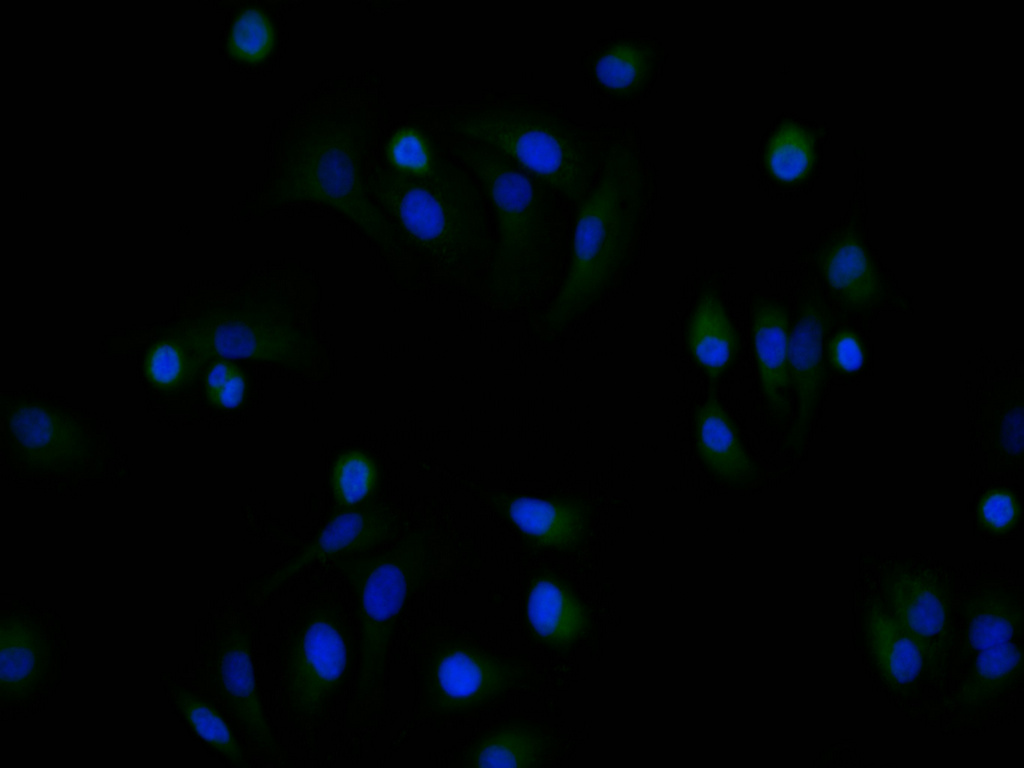
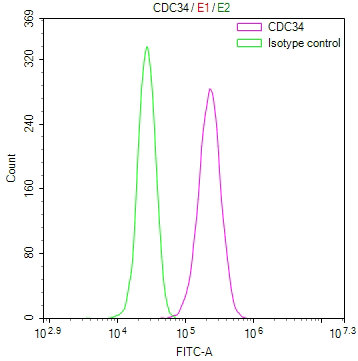
Experimental validation demonstrates robust performance across multiple detection platforms. Immunofluorescence studies in A549 cells reveal clear cytoplasmic staining patterns at dilutions ranging from 1:50 to 1:200, with DAPI counterstaining confirming cellular localization. Flow cytometry analysis using HepG2 cells shows distinct positive population shifts compared to isotype controls, confirming specific detection of CDC34-expressing cells at 1:100 dilution. These validated applications provide researchers with flexibility for both imaging-based and quantitative single-cell analyses.
This antibody serves as a valuable tool for investigators exploring epigenetics, nuclear signaling, and ubiquitin biology, supporting studies that examine how protein turnover mechanisms influence cellular fate decisions and disease pathogenesis.
There are currently no reviews for this product.





