
Call us
301-363-4651 (Available 9 a.m. to 5 p.m. CST from Monday to Friday)

| Code | CSB-RA089295A0HU |
| Size | US$210 |
| Order now | |
| Image |
|
| Have Questions? | Leave a Message or Start an on-line Chat |
| Application | Recommended Dilution |
|---|---|
| IHC | 1:50-1:200 |
| IF | 1:50-1:200 |
| FC | 1:50-1:200 |
CDC6 (Cell Division Cycle 6) serves as a critical regulator of DNA replication initiation, functioning as an essential component of the pre-replicative complex that licenses origins of replication during the G1 phase of the cell cycle. This protein's precise temporal regulation ensures that DNA replication occurs exactly once per cell cycle, making it a key subject of investigation in cell cycle control, cancer biology, and genomic stability research. Dysregulation of CDC6 has been implicated in various malignancies, where its overexpression can drive uncontrolled proliferation.
This recombinant monoclonal antibody, clone 14H8, offers researchers the reproducibility advantages inherent to recombinant technology. Because the antibody sequence is defined and produced from a stable expression system, you can expect consistent performance across experiments and over time, eliminating the lot-to-lot variability that can complicate long-term studies or multi-site collaborations. The antibody is raised in rabbit against a synthesized peptide from human CDC6 protein and purified by affinity chromatography.
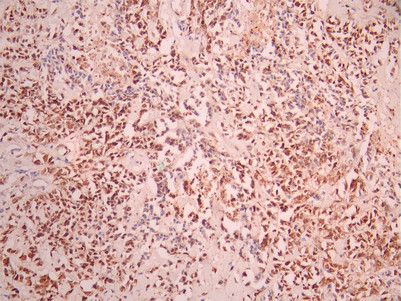
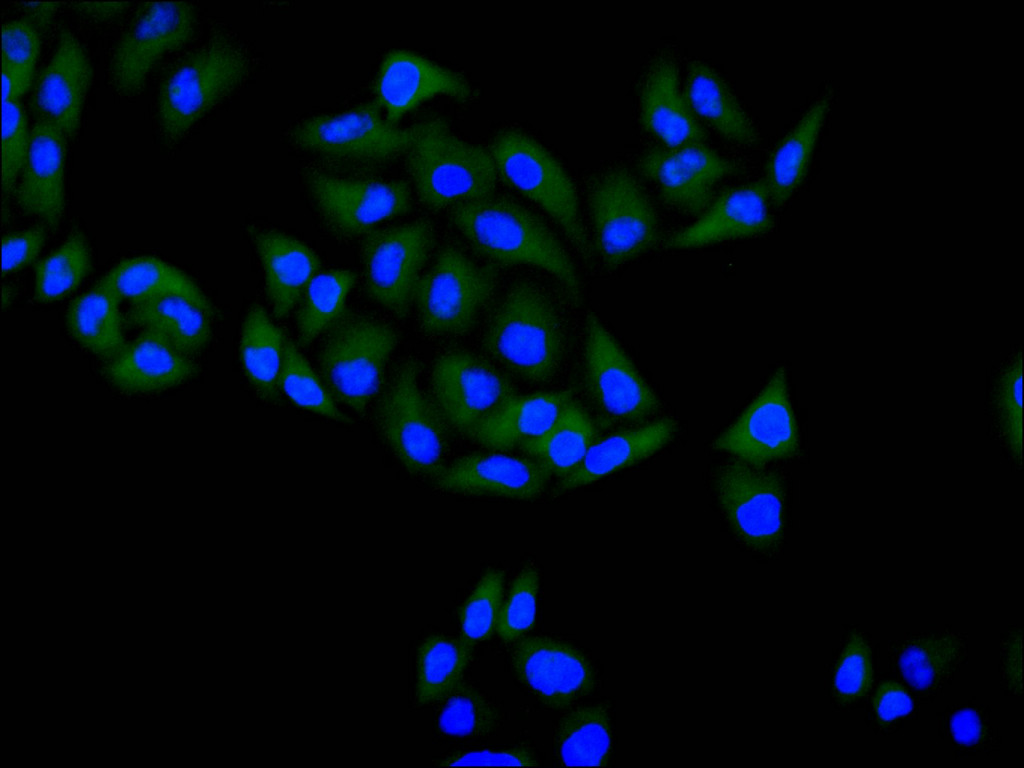
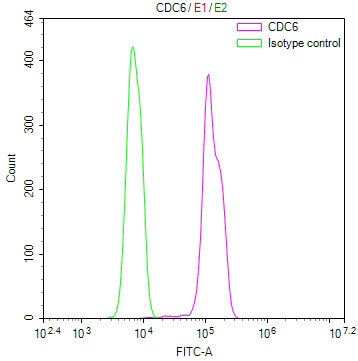
Validation studies demonstrate this antibody's versatility across multiple experimental platforms. Immunohistochemistry performed on paraffin-embedded human breast cancer tissue using a Leica Bond system shows clear target detection at 1:100 dilution with citrate buffer antigen retrieval. Immunofluorescence staining in HeLa cells reveals the expected nuclear localization pattern when counterstained with DAPI. Flow cytometry analysis, also conducted in HeLa cells, demonstrates a distinct positive shift compared to isotype control, confirming specific detection of intracellular CDC6.
This antibody supports investigations into epigenetics and nuclear signaling, particularly studies examining replication licensing, cell cycle checkpoint mechanisms, and proliferative disorders where CDC6 expression patterns may serve as informative markers.
There are currently no reviews for this product.





