
Call us
301-363-4651 (Available 9 a.m. to 5 p.m. CST from Monday to Friday)

| Code | CSB-RA163914A0HU |
| Size | US$210 |
| Order now | |
| Image |
|
| Have Questions? | Leave a Message or Start an on-line Chat |
| Application | Recommended Dilution |
|---|---|
| IHC | 1:50-1:200 |
CDK9 serves as the catalytic subunit of the positive transcription elongation factor b complex, playing a central role in regulating RNA polymerase II-mediated transcription. This kinase phosphorylates the C-terminal domain of RNA polymerase II, releasing it from promoter-proximal pausing and enabling productive transcript elongation. Beyond its fundamental role in gene expression, CDK9 has emerged as a compelling target in cancer research, where its dysregulation contributes to aberrant transcriptional programs that drive tumor progression and therapeutic resistance.
This recombinant monoclonal antibody, clone 12D3, offers researchers the reproducibility and consistency that recombinant technology provides. Because the antibody sequence is defined and produced from a stable expression system, you can expect uniform performance across experiments and over time, eliminating the lot-to-lot variability that can complicate long-term studies or multi-site collaborations.
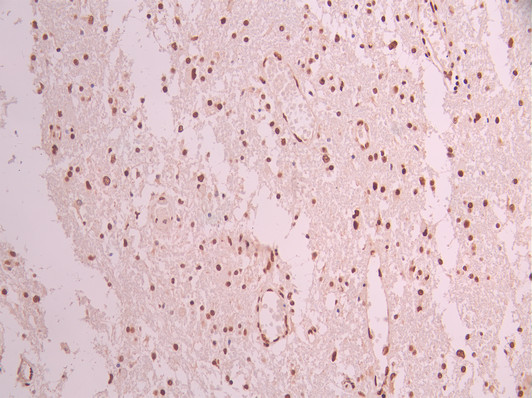
Validation in immunohistochemistry demonstrates reliable nuclear detection in human glioma tissue sections, with optimal staining achieved at 1:100 dilution using citrate buffer antigen retrieval. The clear nuclear localization pattern observed aligns with CDK9's established function as a transcriptional regulator, confirming specific target recognition in formalin-fixed, paraffin-embedded samples. The antibody is also validated for ELISA applications, providing flexibility for researchers requiring both tissue-based and quantitative detection approaches.
Raised against a synthetic peptide derived from human CDK9 and affinity-purified for enhanced specificity, this antibody supports investigations into transcriptional regulation, cell cycle control, and oncogenic mechanisms. It represents a valuable tool for researchers studying CDK9 biology in contexts ranging from basic transcription studies to translational cancer research exploring CDK9 as a therapeutic target.
There are currently no reviews for this product.





