
Call us
301-363-4651 (Available 9 a.m. to 5 p.m. CST from Monday to Friday)

| Code | CSB-RA580611A0HU |
| Size | US$210 |
| Order now | |
| Image |
|
| Have Questions? | Leave a Message or Start an on-line Chat |
| Application | Recommended Dilution |
|---|---|
| FC | 1:50-1:200 |
CDKN2C, also known as p18-INK4c, functions as a critical regulator of cell cycle progression by specifically inhibiting cyclin-dependent kinases 4 and 6. This tumor suppressor protein plays an essential role in controlling the G1-to-S phase transition, making it a significant target for researchers investigating cell cycle dysregulation, cancer biology, and cellular senescence mechanisms. Understanding CDKN2C expression patterns and function provides valuable insights into how cells maintain proliferative control and how this control becomes compromised in malignancy.
This recombinant monoclonal antibody, generated against a synthesized peptide derived from human CDKN2C, offers the reproducibility and consistency that demanding experimental workflows require. As a sequence-defined reagent produced through recombinant technology, it eliminates the lot-to-lot variability that can complicate longitudinal studies or multi-site collaborations. The rabbit IgG format, purified by affinity chromatography, ensures high specificity for your target while minimizing background interference.
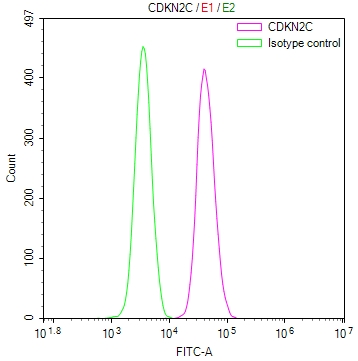
Validation studies confirm reliable performance in flow cytometry applications, with recommended dilutions ranging from 1:50 to 1:200. Testing in Jurkat cells, a human T lymphocyte line commonly used in cell cycle and apoptosis research, demonstrated clear positive signal separation from isotype control when cells were fixed and permeabilized, indicating effective detection of intracellular CDKN2C. The antibody has also been validated for ELISA, providing flexibility across different experimental platforms.
This antibody serves researchers exploring CDK inhibitor biology, tumor suppressor mechanisms, hematopoietic cell differentiation, and therapeutic strategies targeting cell cycle regulators. Its validated performance in human samples makes it particularly suitable for oncology research and studies examining proliferative disorders.
There are currently no reviews for this product.





