CLPP Recombinant Monoclonal Antibody

Code CSB-RA128888A0HU
Size US$210
Order now
Image
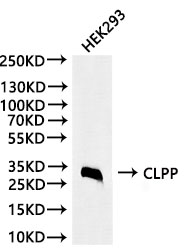
  • Western Blot
    Positive WB detected in: HEK293 whole cell lysate(30µg)
    All lanes: CLPP antibody at 1:1000
    Secondary
    Goat polyclonal to rabbit IgG at 1/40000 dilution
    Predicted band size: 30 kDa
    Observed band size: 30 kDa
    Exposure time:2min
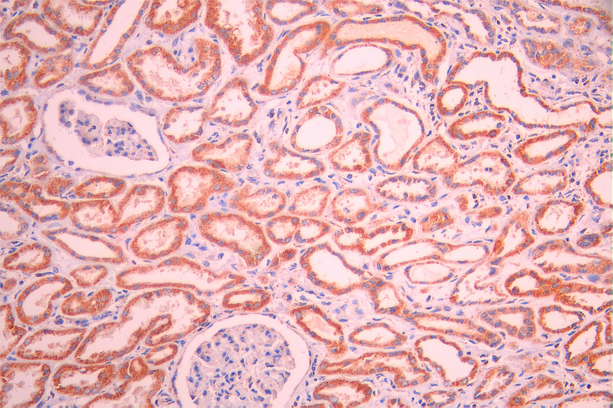
  • IHC image of CSB-RA128888A0HU diluted at 1:100 and staining in paraffin-embedded human kidney tissue performed on a Leica BondTM system. After dewaxing and hydration, antigen retrieval was mediated by high pressure in a citrate buffer (pH 6.0). Section was blocked with 10% normal goat serum 30min at RT. Then primary antibody (1% BSA) was incubated at 4°C overnight. The primary is detected by a Goat anti-rabbit polymer IgG labeled by HRP and visualized using 0.05% DAB.
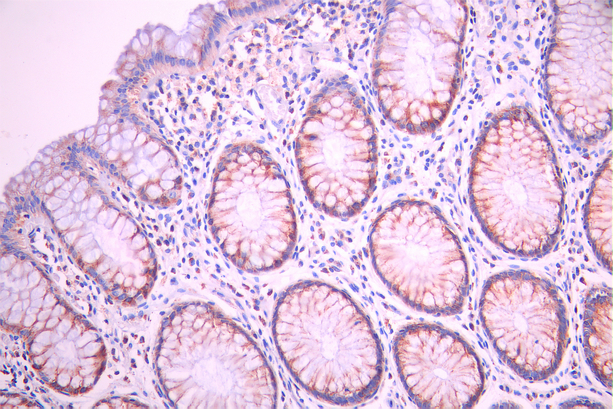
  • IHC image of CSB-RA128888A0HU diluted at 1:100 and staining in paraffin-embedded human colorectal cancer performed on a Leica BondTM system. After dewaxing and hydration, antigen retrieval was mediated by high pressure in a citrate buffer (pH 6.0). Section was blocked with 10% normal goat serum 30min at RT. Then primary antibody (1% BSA) was incubated at 4°C overnight. The primary is detected by a Goat anti-rabbit polymer IgG labeled by HRP and visualized using 0.05% DAB.
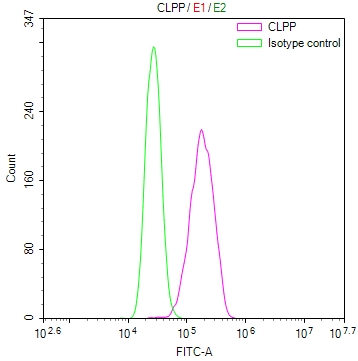
  • Overlay Peak curve showing Raji cells stained with CSB-RA128888A0HU (red line) at 1:100. The cells were fixed in 4% formaldehyde and permeated by 0.2% TritonX-100 for 10min. Then 10% normal goat serum to block non-specific protein-protein interactions followed by the antibody (1ug/1*106cells) for 45min at 4℃. The secondary antibody used was FITC-conjugated goat anti-rabbit IgG (H+L) at 1/200 dilution for 35min at 4℃.Control antibody (green line) was Rabbit IgG (1ug/1*106cells) used under the same conditions. Acquisition of >10,000 events was performed.
Have Questions? Leave a Message or Start an on-line Chat

Product Details

Uniprot No.
Target Names
CLPP
Alternative Names
ATP-dependent Clp protease proteolytic subunit, mitochondrial (EC 3.4.21.92) (Endopeptidase Clp), CLPP
Species Reactivity
Human
Immunogen
A synthesized peptide derived from Human CLPP protein
Immunogen Species
Homo sapiens (Human)
Conjugate
Non-conjugated
Clonality
Monoclonal
Isotype
Rabbit IgG
Clone No.
19F6
Purification Method
Affinity-chromatography
Concentration
It differs from different batches. Please contact us to confirm it.
Buffer
Rabbit IgG in 10mM phosphate buffered saline , pH 7.4, 150mM sodium chloride, 0.05% BSA, 0.02% sodium azide and 50% glycerol.
Form
Liquid
Tested Applications
ELISA, WB, IHC, FC
Recommended Dilution
Application Recommended Dilution
WB 1:500-1:5000
IHC 1:50-1:200
FC 1:20-1:200
Troubleshooting and FAQs
Storage
Upon receipt, store at -20°C or -80°C. Avoid repeated freeze.
Lead Time
Basically, we can dispatch the products out in 1-3 working days after receiving your orders. Delivery time maybe differs from different purchasing way or location, please kindly consult your local distributors for specific delivery time.
Usage
For Research Use Only. Not for use in diagnostic or therapeutic procedures.
Customer Reviews and Q&A

 Customer Reviews

There are currently no reviews for this product.

Submit a Review here

Target Background

Function
Protease component of the Clp complex that cleaves peptides and various proteins in an ATP-dependent process. Has low peptidase activity in the absence of CLPX. The Clp complex can degrade CSN1S1, CSN2 and CSN3, as well as synthetic peptides (in vitro) and may be responsible for a fairly general and central housekeeping function rather than for the degradation of specific substrates. Cleaves PINK1 in the mitochondrion.
Gene References into Functions
  1. Autophagy compensates impaired energy metabolism in CLPXP-deficient Podospora anserina strains and extends healthspan. PMID: 28449241
  2. we demonstrate that a strong mitochondrial cardiomyopathy and diminished respiration due to DARS2 deficiency can be alleviated by the loss of CLPP, leading to an increased de novo synthesis of individual OXPHOS subunits. PMID: 27154400
  3. ere we present eight families affected by Perrault syndrome. In five families we identified novel or previously reported variants in HSD17B4, LARS2, CLPP and C10orf2 PMID: 26970254
  4. Data suggest that tumors exploit ClpXP-directed proteostasis to maintain mitochondrial bioenergetics, buffer oxidative stress, and enable metastatic competence. PMID: 27389535
  5. Data indicate endopeptidase Clp (ClpP) mutation identified in two patients with Perrault syndrome type 3 in a Turkish family. PMID: 27087618
  6. ClpP proteases from E. coli, S. aureus, and human mitochondria exhibit preferences for certain amino acids in the P1, P2, and P3 positions . PMID: 26606371
  7. Optical trapping to assay single-molecule ClpXP unfolding and translocation of substrates consisting of domains with varying stabilities and sequences; find that ClpXP unfolds most domains by a single pathway, with kinetics that depend on the native fold and structural stability. PMID: 25083874
  8. Deletion of PaClpP, leads to an unexpected healthy phenotype and increased lifespan of the fungal ageing model organism Podospora anserina and This phenotype can be reverted by expression of human ClpP. PMID: 23360988
  9. Perrault syndrome is caused by recessive mutations in CLPP. PMID: 23541340
  10. the N-terminal peptide of ClpP is a structural component of the substrate translocation channel and may play an important functional role as well PMID: 15522782
  11. hClpX can regulate the appearance of hClpP peptidase activity in mitochondria and might affect the nature of the degradation products released during ATP-dependent proteolytic cycles PMID: 16115876
  12. We propose that decreased levels of mitochondrial proteases Lon and ClpP may allow heat shock protein 60 substrate proteins to go through more folding attempts PMID: 18378094

Show More

Hide All

Involvement in disease
Perrault syndrome 3 (PRLTS3)
Subcellular Location
Mitochondrion matrix.
Protein Families
Peptidase S14 family
Tissue Specificity
Detected in liver (at protein level). Predominantly expressed in skeletal muscle. Intermediate levels in heart, liver and pancreas. Low in brain, placenta, lung and kidney.
Database Links

HGNC: 2084

OMIM: 601119

KEGG: hsa:8192

STRING: 9606.ENSP00000245816

UniGene: Hs.515092

icon of phone
Call us
301-363-4651 (Available 9 a.m. to 5 p.m. CST from Monday to Friday)
icon of address
Address
7505 Fannin St., Ste 610, Room 7 (CUBIO Innovation Center), Houston, TX 77054, USA
icon of social media
Join us with

Subscribe newsletter

Leave a message

* To protect against spam, please pass the CAPTCHA test below.
CAPTCHA verification
© 2007-2026 CUSABIO TECHNOLOGY LLC All rights reserved. 鄂ICP备15011166号-1
Place an order now

I. Product details

*
*
*
*

II. Contact details

*
*

III. Ship To

*
*
*
*
*
*
*

IV. Bill To

*
*
*
*
*
*
*
*