CPSF3 Recombinant Monoclonal Antibody

Code CSB-RA072907A0HU
Size US$210
Order now
Image
  • Western Blot
    Positive WB detected in: HEK293 whole cell lysate(30µg), HepG2 whole cell lysate(30µg), Hela whole cell lysate(30µg), Jurkat whole cell lysate(30µg), NIH/3T3 whole cell lysate(30µg)
    All lanes: CPSF73 antibody at 1:1000
    Secondary
    Goat polyclonal to rabbit IgG at 1/40000 dilution
    Predicted band size: 77 kDa
    Observed band size: 77 kDa
    Exposure time:3min
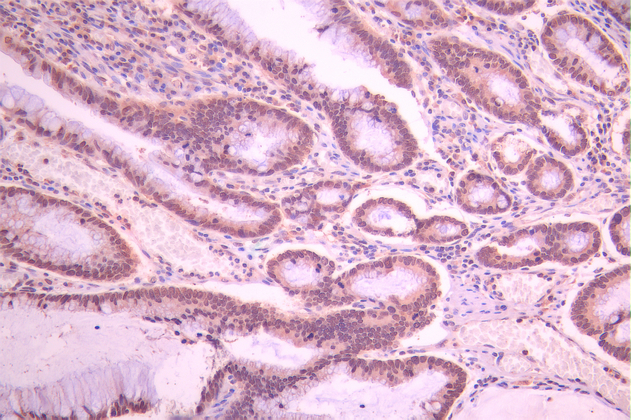
  • IHC image of CSB-RA072907A0HU diluted at 1:100 and staining in paraffin-embedded human gastric cancer performed on a Leica BondTM system. After dewaxing and hydration, antigen retrieval was mediated by high pressure in a citrate buffer (pH 6.0). Section was blocked with 10% normal goat serum 30min at RT. Then primary antibody (1% BSA) was incubated at 4°C overnight. The primary is detected by a Goat anti-rabbit polymer IgG labeled by HRP and visualized using 0.05% DAB.
Have Questions? Leave a Message or Start an on-line Chat

Product Details

Uniprot No.
Target Names
CPSF3
Alternative Names
Cleavage and polyadenylation specificity factor subunit 3 (EC 3.1.27.-) (Cleavage and polyadenylation specificity factor 73 kDa subunit) (CPSF 73 kDa subunit) (mRNA 3'-end-processing endonuclease CPSF-73), CPSF3, CPSF73
Species Reactivity
Human, Mouse
Immunogen
A synthesized peptide derived from Human CPSF3 protein
Immunogen Species
Homo sapiens (Human)
Conjugate
Non-conjugated
Clonality
Monoclonal
Isotype
Rabbit IgG
Clone No.
7B8
Purification Method
Affinity-chromatography
Concentration
It differs from different batches. Please contact us to confirm it.
Buffer
Rabbit IgG in 10mM phosphate buffered saline , pH 7.4, 150mM sodium chloride, 0.05% BSA, 0.02% sodium azide and 50% glycerol.
Form
Liquid
Tested Applications
ELISA, WB, IHC
Recommended Dilution
Application Recommended Dilution
WB 1:500-1:5000
IHC 1:50-1:200
Troubleshooting and FAQs
Storage
Upon receipt, store at -20°C or -80°C. Avoid repeated freeze.
Lead Time
Basically, we can dispatch the products out in 1-3 working days after receiving your orders. Delivery time maybe differs from different purchasing way or location, please kindly consult your local distributors for specific delivery time.
Usage
For Research Use Only. Not for use in diagnostic or therapeutic procedures.

Customer Reviews and Q&A

 Customer Reviews

There are currently no reviews for this product.

Submit a Review here

Target Background

Function
Component of the cleavage and polyadenylation specificity factor (CPSF) complex that plays a key role in pre-mRNA 3'-end formation, recognizing the AAUAAA signal sequence and interacting with poly(A) polymerase and other factors to bring about cleavage and poly(A) addition. Has endonuclease activity, and functions as mRNA 3'-end-processing endonuclease. Also involved in the histone 3'-end pre-mRNA processing. U7 snRNP-dependent protein that induces both the 3'-endoribonucleolytic cleavage of histone pre-mRNAs and acts as a 5' to 3' exonuclease for degrading the subsequent downstream cleavage product (DCP) of mature histone mRNAs. Cleavage occurs after the 5'-ACCCA-3' sequence in the histone pre-mRNA leaving a 3'hydroxyl group on the upstream fragment containing the stem loop (SL) and 5' phosphate on the downstream cleavage product (DCP) starting with CU nucleotides. The U7-dependent 5' to 3' exonuclease activity is processive and degrades the DCP RNA substrate even after complete removal of the U7-binding site. Binds to the downstream cleavage product (DCP) of histone pre-mRNAs and the cleaved DCP RNA substrate in a U7 snRNP dependent manner. Required for entering/progressing through S-phase of the cell cycle. Required for the selective processing of microRNAs (miRNAs) during embryonic stem cell differentiation via its interaction with ISY1. Required for the biogenesis of all miRNAs from the pri-miR-17-92 primary transcript except miR-92a. Only required for the biogenesis of miR-290 and miR-96 from the pri-miR-290-295 and pri-miR-96-183 primary transcripts, respectively.
Gene References into Functions
  1. the molecular mechanism that recruits the CPSF73 endonuclease to histone pre-mRNAs PMID: 23071092
  2. The data support a model where Star-PAP binds to the pre-mRNA, recruits the CPSF complex to the 3'-end of pre-mRNA and then defines cleavage by CPSF 73 and subsequent polyadenylation of its target mRNAs. PMID: 21102410
  3. up-regulated by HIV-1 TAT protein; this could represent a novel mechanism by which HIV increases mRNA processing, causing an increase in both cell and viral gene expression. PMID: 15194760
  4. crystal structures of human CPSF-73 at 2.1 A resolution, complexed with zinc ions and a sulphate that might mimic the phosphate group of the substrate; CPSF-73 is the pre-mRNA 3'-end-processing endonuclease PMID: 17128255
  5. this study identifies CPSF-73 as an important regulatory protein that represses the basal transcriptional activity of the HIV-1 LTR promoter PMID: 17669424
  6. Conserved residues in CPSF-73 and CPSF2 are required for assembly of the endonuclease activity that cleaves histone pre-mRNAs. PMID: 18688255
  7. The tumor suppressor Cdc73 functionally associates with CPSF and CstF 3' mRNA processing factors. PMID: 19136632

Show More

Hide All

Subcellular Location
Nucleus.
Protein Families
Metallo-beta-lactamase superfamily, RNA-metabolizing metallo-beta-lactamase-like family, CPSF3 subfamily
Database Links

HGNC: 2326

OMIM: 606029

KEGG: hsa:51692

STRING: 9606.ENSP00000238112

UniGene: Hs.515972

icon of phone
Call us
301-363-4651 (Available 9 a.m. to 5 p.m. CST from Monday to Friday)
icon of address
Address
7505 Fannin St., Ste 610, Room 7 (CUBIO Innovation Center), Houston, TX 77054, USA
icon of social media
Join us with

Subscribe newsletter

Leave a message

* To protect against spam, please pass the CAPTCHA test below.
CAPTCHA verification
© 2007-2026 CUSABIO TECHNOLOGY LLC All rights reserved. 鄂ICP备15011166号-1
Place an order now

I. Product details

*
*
*
*

II. Contact details

*
*

III. Ship To

*
*
*
*
*
*
*

IV. Bill To

*
*
*
*
*
*
*
*



