
Call us
301-363-4651 (Available 9 a.m. to 5 p.m. CST from Monday to Friday)

| Code | CSB-RA901089A0HU |
| Size | US$210 |
| Order now | |
| Image |
|
| Have Questions? | Leave a Message or Start an on-line Chat |
| Application | Recommended Dilution |
|---|---|
| IHC | 1:50-1:200 |
| IF | 1:50-1:200 |
| FC | 1:50-1:200 |
CSE1L, also known as Exportin-2 or Cellular Apoptosis Susceptibility protein, plays a central role in nucleocytoplasmic transport by mediating the re-export of importin-alpha from the nucleus back to the cytoplasm. This function is essential for maintaining the nuclear transport cycle that governs protein localization and cellular homeostasis. Beyond its transport role, CSE1L has garnered significant research attention for its involvement in chromosome segregation, cell proliferation, and apoptosis regulation, making it a compelling target in cancer biology and cell cycle research.
This recombinant monoclonal antibody, clone 5D10, offers the consistency and reliability that demanding experimental workflows require. Produced using recombinant technology with a sequence-defined approach, it eliminates the lot-to-lot variability often encountered with traditional hybridoma-derived antibodies, ensuring reproducible results across long-term studies and multi-site collaborations.
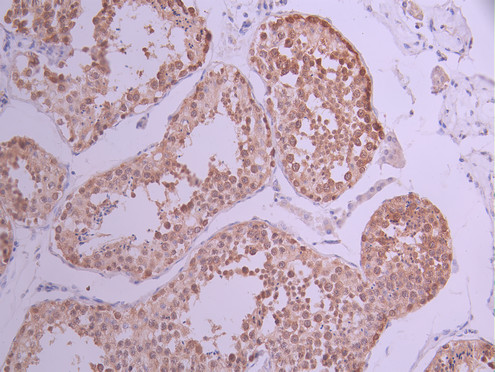
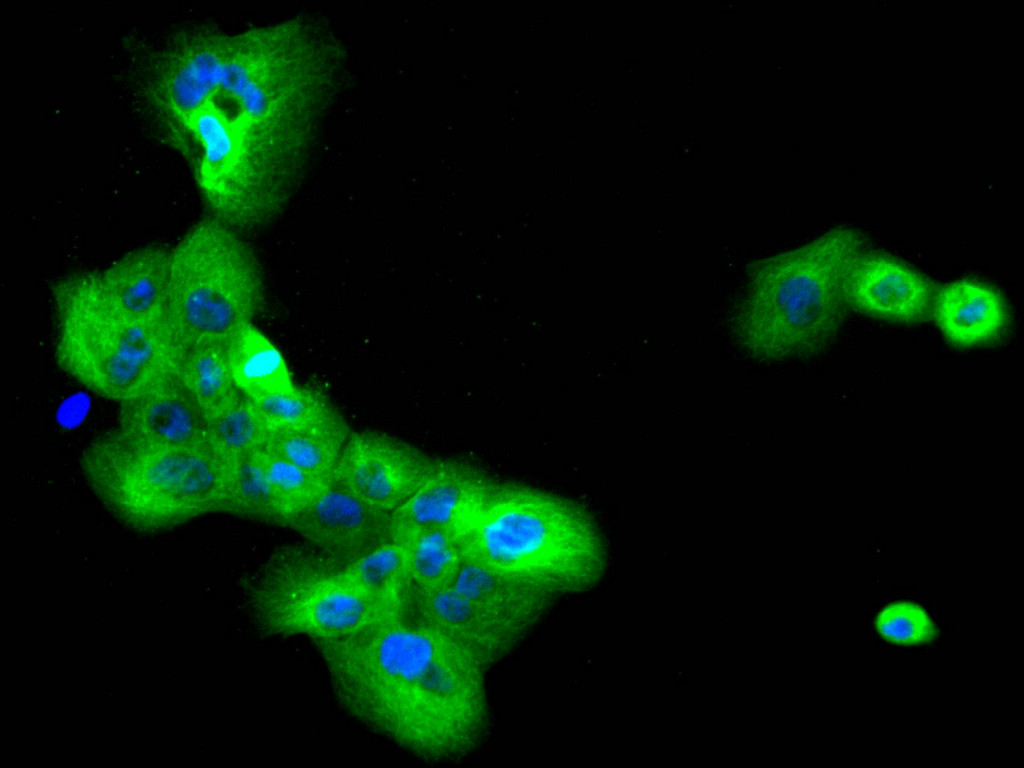
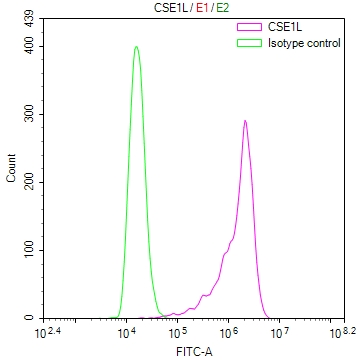
Validation data demonstrate robust performance across multiple applications. In immunohistochemistry, the antibody produces clear staining in paraffin-embedded human testis tissue at dilutions of 1:50–1:200, with antigen retrieval in citrate buffer at pH 6.0. Immunofluorescence studies in A431 cells reveal distinct signal when counterstained with DAPI, while flow cytometry analysis of BxPC-3 cells shows a clear positive shift compared to isotype control, confirming specific detection of intracellular CSE1L.
The antibody's versatility across IHC, immunofluorescence, and flow cytometry provides researchers with flexibility to investigate CSE1L expression and localization using complementary techniques. Whether exploring nuclear transport mechanisms, examining CSE1L's role in tumor progression, or investigating its contribution to apoptotic pathways, this antibody delivers the specificity and reproducibility essential for meaningful experimental outcomes.
There are currently no reviews for this product.





