
Call us
301-363-4651 (Available 9 a.m. to 5 p.m. CST from Monday to Friday)

| Code | CSB-RA196762A0HU |
| Size | US$210 |
| Order now | |
| Image |
|
| Have Questions? | Leave a Message or Start an on-line Chat |
| Application | Recommended Dilution |
|---|---|
| WB | 1:500-1:2000 |
| FC | 1:50-1:200 |
EGR2, also known as Krox-20, is a zinc finger transcription factor that plays essential roles in peripheral nerve myelination, hindbrain development, and immune cell differentiation. As a key regulator of Schwann cell development and myelin gene expression, EGR2 has become an important target for researchers investigating peripheral neuropathies, neurodevelopmental processes, and the molecular mechanisms underlying myelination disorders. Beyond neuroscience, EGR2 functions as an E3 SUMO-protein ligase and participates in epigenetic regulatory networks, making it relevant to studies of transcriptional control and cellular differentiation.
This recombinant monoclonal antibody, generated against a synthetic peptide derived from human EGR2, offers the reproducibility and consistency that demanding experimental workflows require. Because the antibody sequence is defined and produced recombinantly, researchers can expect minimal lot-to-lot variation, ensuring reliable results across extended studies and collaborative projects.
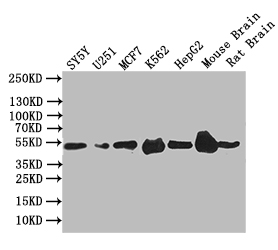
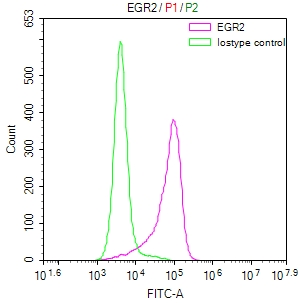
Validation data demonstrates robust performance across multiple applications. In western blot experiments, the antibody detects a band at the predicted molecular weight of 50 kDa across diverse sample types, including human neuroblastoma cells (SH-SY5Y), glioblastoma cells (U251), breast cancer cells (MCF-7), leukemia cells (K562), and mouse brain tissue lysates. This cross-species reactivity between human and mouse samples provides flexibility for researchers working with different model systems. Flow cytometry validation in SH-SY5Y cells confirms utility for intracellular protein detection, with clear signal separation from isotype controls.
Whether investigating Schwann cell biology, characterizing transcription factor networks, or exploring EGR2's role in neurological disease models, this antibody provides a dependable tool for epigenetics, nuclear signaling, and neuroscience research applications.
There are currently no reviews for this product.





