
Call us
301-363-4651 (Available 9 a.m. to 5 p.m. CST from Monday to Friday)

| Code | CSB-RA007759MA1HU |
| Size | $49.9 |
| Order now | |
| Promotion |

|
| Image |
|
| Have Questions? | Leave a Message or Start an on-line Chat |
| Application | Recommended Dilution |
|---|---|
| IHC | 1:50-1:200 |
ERAL1, also known as GTPase Era, is a mitochondrial GTP-binding protein that plays an essential role in mitochondrial ribosome assembly and cellular energy metabolism. As a highly conserved homolog of the bacterial Era protein, ERAL1 functions as a critical regulator of mitochondrial 12S rRNA maturation, making it an important target for researchers investigating mitochondrial biogenesis, cellular stress responses, and signal transduction pathways.
This recombinant monoclonal antibody against human ERAL1 offers the reproducibility and consistency that demanding experimental workflows require. Generated using recombinant technology with clone 27A9, this antibody provides a sequence-defined binding profile that eliminates the lot-to-lot variability often encountered with traditional hybridoma-derived antibodies. The human IgG1 isotype format and affinity-chromatography purification ensure high specificity for your target while minimizing background interference.
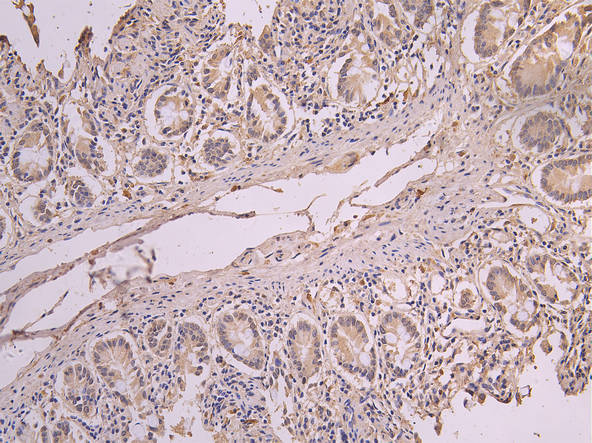
Validation studies confirm reliable performance in immunohistochemistry applications, with successful staining demonstrated in paraffin-embedded human small intestine tissue at dilutions ranging from 1:50 to 1:200. The validation protocol employed citrate buffer antigen retrieval under high pressure conditions, followed by overnight primary antibody incubation at 4°C, yielding clear and specific signal detection using HRP-polymer visualization with DAB chromogen. This antibody is also validated for ELISA applications, providing flexibility across different experimental platforms.
For researchers exploring mitochondrial function, GTPase signaling networks, or cellular energy homeostasis, this ERAL1 antibody delivers the technical reliability needed to generate meaningful data. The unconjugated format allows compatibility with your preferred detection systems, while the glycerol-based formulation in PBS supports long-term storage stability at -20°C or -80°C.
There are currently no reviews for this product.





