
Call us
301-363-4651 (Available 9 a.m. to 5 p.m. CST from Monday to Friday)

| Code | CSB-RA796544A0HU |
| Size | US$210 |
| Order now | |
| Image |
|
| Have Questions? | Leave a Message or Start an on-line Chat |
| Application | Recommended Dilution |
|---|---|
| WB | 1:500-1:2000 |
| IHC | 1:50-1:200 |
| IF | 1:50-1:200 |
| FC | 1:50-1:200 |
FUS (Fused in Sarcoma) is a multifunctional RNA-binding protein that plays essential roles in transcriptional regulation, RNA processing, and DNA damage repair. Originally identified as part of a chromosomal translocation in liposarcoma, FUS has gained significant research attention due to its involvement in neurodegenerative diseases, particularly amyotrophic lateral sclerosis (ALS) and frontotemporal dementia, where mutations lead to aberrant cytoplasmic aggregation. Understanding FUS localization, expression levels, and protein interactions is fundamental to advancing research in oncology and neurodegeneration.
This recombinant monoclonal antibody, clone 9E7, offers the consistency and reproducibility that demanding experimental workflows require. Because it is generated from a defined sequence and produced recombinantly in rabbit, researchers benefit from lot-to-lot uniformity that traditional hybridoma-derived antibodies cannot guarantee. This reliability is particularly valuable for longitudinal studies or when comparing results across multiple experiments.
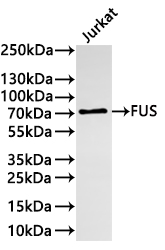
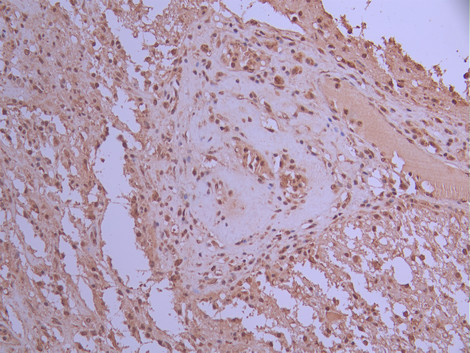
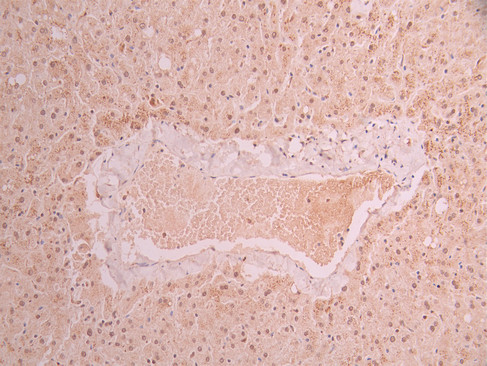
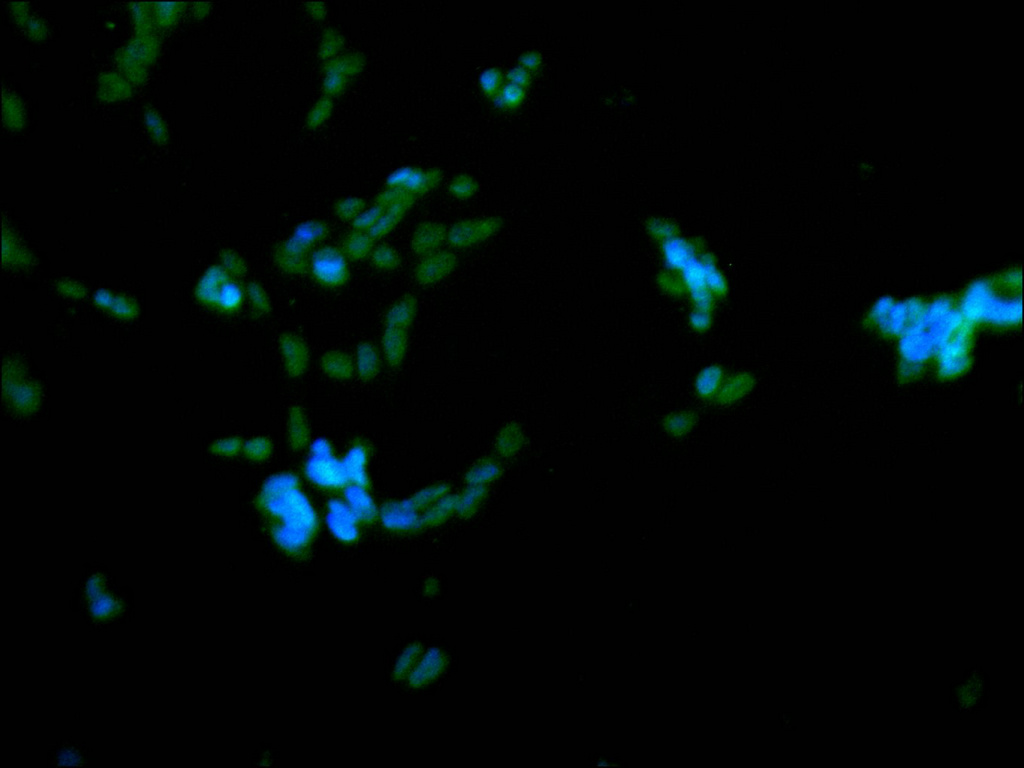
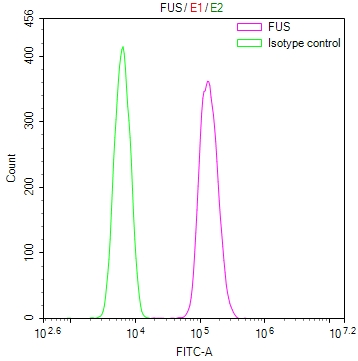
The antibody has been validated across a versatile range of applications, providing flexibility for diverse experimental approaches. Western blot analysis in Jurkat whole cell lysate detects a band at approximately 70 kDa, which is larger than the predicted 53 kDa molecular weight. This size difference is commonly attributed to post-translational modifications, including glycosylation and phosphorylation, which are well-documented for FUS. Immunohistochemistry validation demonstrates clear staining in human glioma and liver tissue sections, supporting its utility in pathological studies. Immunofluorescence analysis in SH-SY5Y neuroblastoma cells reveals the expected nuclear localization pattern, while flow cytometry data confirms robust detection in the same cell line.
This antibody serves as a reliable tool for researchers investigating FUS biology in cancer, neurodegeneration, and RNA metabolism studies.
There are currently no reviews for this product.





