HDAC10 Recombinant Monoclonal Antibody

Code CSB-RA596488A0HU
Size US$210
Order now
Image
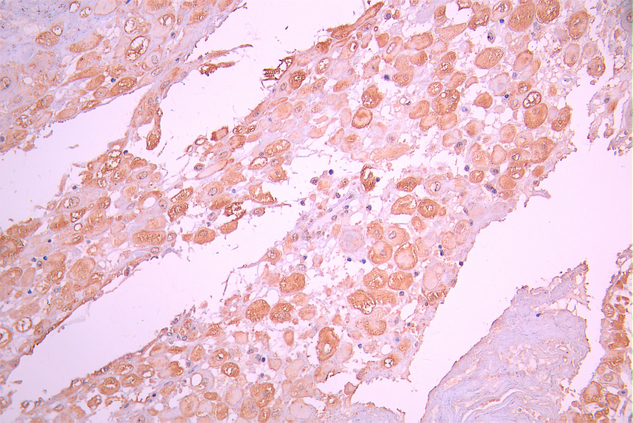
  • IHC image of CSB-RA596488A0HU diluted at 1:100 and staining in paraffin-embedded human placenta tissue performed on a Leica BondTM system. After dewaxing and hydration, antigen retrieval was mediated by high pressure in a citrate buffer (pH 6.0). Section was blocked with 10% normal goat serum 30min at RT. Then primary antibody (1% BSA) was incubated at 4°C overnight. The primary is detected by a Goat anti-rabbit polymer IgG labeled by HRP and visualized using 0.05% DAB.
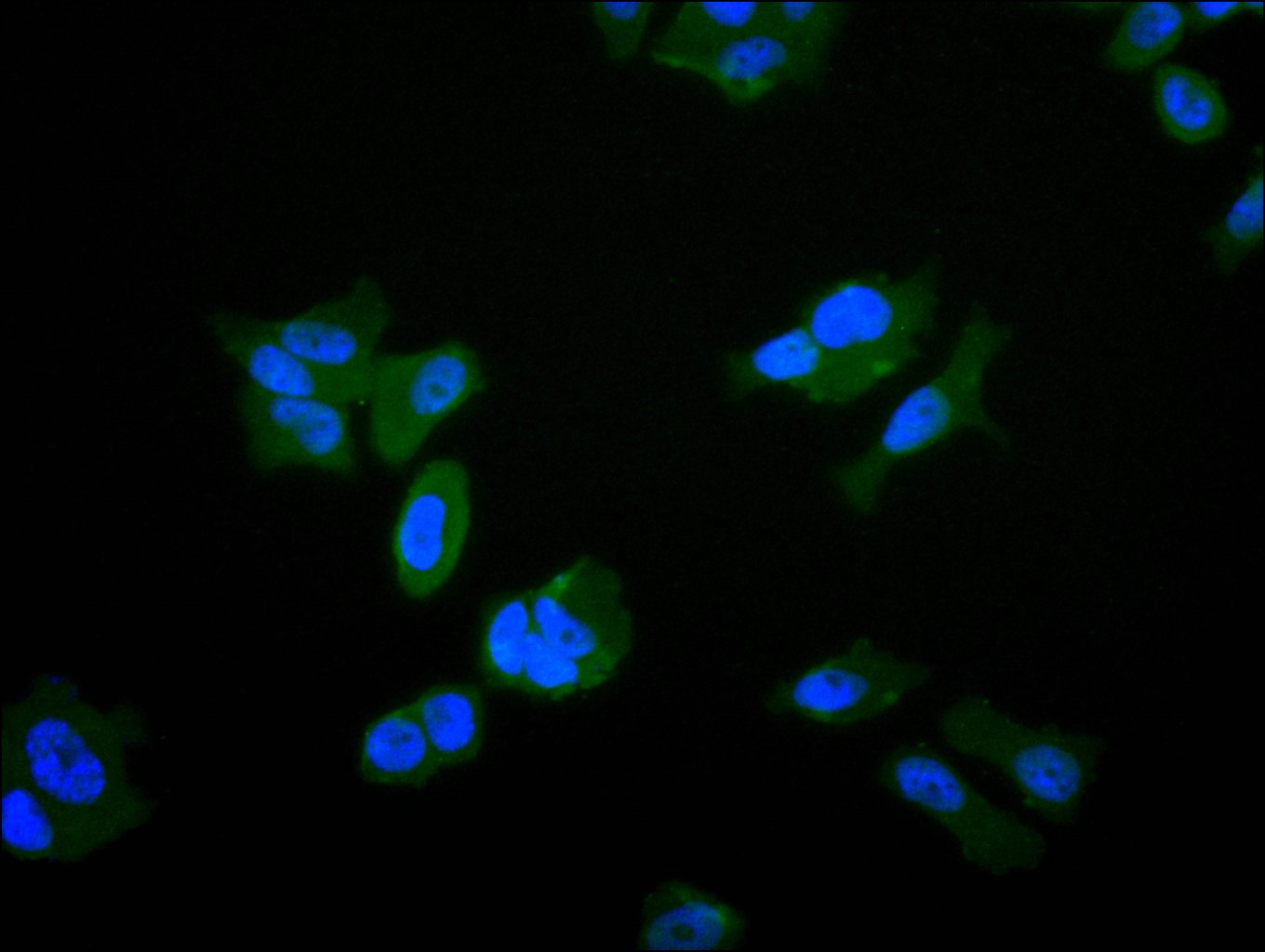
  • Immunofluorescence staining of MCF-7 cell with CSB-RA596488A0HU at 1:50 ,counter-stained with DAPI. The cells were fixed in 4% formaldehyde, permeabilized using 0.2% Triton X-100 and blocked in 10% normal Goat Serum. The cells were then incubated with the antibody overnight at 4°C. The secondary antibody was Alexa Fluor 488-congugated AffiniPure Goat Anti-Rabbit IgG(H+L).
  • Overlay Peak curve showing HL-60 cells stained with CSB-RA596488A0HU (red line) at 1:100. The cells were fixed in 4% formaldehyde and permeated by 0.2% TritonX-100 for 10min. Then 10% normal goat serum to block non-specific protein-protein interactions followed by the antibody (1ug/1*106cells) for 45min at 4℃. The secondary antibody used was FITC-conjugated goat anti-rabbit IgG (H+L) at 1/200 dilution for 35min at 4℃.Control antibody (green line) was Rabbit IgG (1ug/1*106cells) used under the same conditions. Acquisition of >10,000 events was performed.
Have Questions? Leave a Message or Start an on-line Chat

Product Details

Uniprot No.
Target Names
Alternative Names
Histone deacetylase 10 (HD10) (EC 3.5.1.98), HDAC10
Species Reactivity
Human
Immunogen
A synthesized peptide derived from Human HDAC10 protein
Immunogen Species
Homo sapiens (Human)
Conjugate
Non-conjugated
Clonality
Monoclonal
Isotype
Rabbit IgG
Clone No.
15D4
Purification Method
Affinity-chromatography
Concentration
It differs from different batches. Please contact us to confirm it.
Buffer
Rabbit IgG in 10mM phosphate buffered saline , pH 7.4, 150mM sodium chloride, 0.05% BSA, 0.02% sodium azide and 50% glycerol.
Form
Liquid
Tested Applications
ELISA, IHC, IF, FC
Recommended Dilution
Application Recommended Dilution
IHC 1:50-1:200
IF 1:20-1:200
FC 1:20-1:200
Troubleshooting and FAQs
Storage
Upon receipt, store at -20°C or -80°C. Avoid repeated freeze.
Lead Time
Basically, we can dispatch the products out in 1-3 working days after receiving your orders. Delivery time maybe differs from different purchasing way or location, please kindly consult your local distributors for specific delivery time.
Usage
For Research Use Only. Not for use in diagnostic or therapeutic procedures.

Customer Reviews and Q&A

 Customer Reviews

There are currently no reviews for this product.

Submit a Review here

Target Background

Function
Polyamine deacetylase (PDAC), which acts preferentially on N(8)-acetylspermidine, and also on acetylcadaverine and acetylputrescine. Exhibits attenuated catalytic activity toward N(1),N(8)-diacetylspermidine and very low activity, if any, toward N(1)-acetylspermidine. Histone deacetylase activity has been observed in vitro. Has also been shown to be involved in MSH2 deacetylation. The physiological relevance of protein/histone deacetylase activity is unclear and could be very weak. May play a role in the promotion of late stages of autophagy, possibly autophagosome-lysosome fusion and/or lysosomal exocytosis in neuroblastoma cells. May play a role in homologous recombination. May promote DNA mismatch repair.
Gene References into Functions
  1. HDAC10 structure and molecular function as a polyamine deacetylase has been reported. PMID: 28516954
  2. this study demonstrated that HDAC10 localizes and functions in the cytoplasm of lung cancer cells, thereby underscoring its potential role in the diagnosis and treatment of lung cancer PMID: 27449083
  3. HDAC10 regulates cyclin A2 expression by deacetylating histones near the let-7 promoter. PMID: 26240284
  4. study identifies an HDAC10-mediated regulatory mechanism controlling the DNA mismatch repair function of MSH2. PMID: 26221039
  5. Suggest HDAC10 expression as a prognostic marker for gastric cancer. PMID: 25337229
  6. this study is describing HDAC10 as a promoter of autophagy-mediated survival in neuroblastoma cells and identifying this HDAC isozyme as a druggable regulator of advanced-stage tumor cell survival. PMID: 24145760
  7. HDAC10 suppresses expression of matrix metalloproteinase (MMP) 2 and 9 genes, which are known to be critical for cancer cell invasion and metastasis PMID: 23897811
  8. results demonstrate that HDAC10 protects cancer cells from cytotoxic agents by mediating autophagy and identify this HDAC isozyme as a druggable regulator of advanced-stage tumor cell survival PMID: 23801752
  9. Histone deacetylases 9 and 10 are required for homologous recombination. PMID: 21247901
  10. HDAC10 is involved in transcriptional downregulation of TXNIP, leading to altered reactive oxygen species signaling in human gastric cancer cells. PMID: 20680488
  11. Results not only show that HDAC10 regulates melanogenesis but also demonstrate that the transcriptional activities of Pax3 and KAP1 are intimately linked to their acetylation status. PMID: 20032463
  12. another histone deacetylase PMID: 11739383
  13. molecular cloning and characterization of a novel class II histone deacetylase PMID: 11861901
  14. Reduced expression of histone deacetylase 10 is associated lung cancer PMID: 15305372
  15. Results suggest that the "T" allele of HDAC10-589C>T affect on the increased transcription activity, and might accelerate HCC development through increased expression of HDAC10. PMID: 17892858

Show More

Hide All

Subcellular Location
Cytoplasm. Nucleus.
Protein Families
Histone deacetylase family, HD type 2 subfamily
Tissue Specificity
Widely expressed with high levels in liver and kidney.
Database Links

HGNC: 18128

OMIM: 608544

KEGG: hsa:83933

STRING: 9606.ENSP00000216271

UniGene: Hs.26593

icon of phone
Call us
301-363-4651 (Available 9 a.m. to 5 p.m. CST from Monday to Friday)
icon of address
Address
7505 Fannin St., Ste 610, Room 7 (CUBIO Innovation Center), Houston, TX 77054, USA
icon of social media
Join us with

Subscribe newsletter

Leave a message

* To protect against spam, please pass the CAPTCHA test below.
CAPTCHA verification
© 2007-2026 CUSABIO TECHNOLOGY LLC All rights reserved. 鄂ICP备15011166号-1
Place an order now

I. Product details

*
*
*
*

II. Contact details

*
*

III. Ship To

*
*
*
*
*
*
*

IV. Bill To

*
*
*
*
*
*
*
*