
Call us
301-363-4651 (Available 9 a.m. to 5 p.m. CST from Monday to Friday)

| Code | CSB-RA244542A0HU |
| Size | US$210 |
| Order now | |
| Image |
|
| Have Questions? | Leave a Message or Start an on-line Chat |
| Application | Recommended Dilution |
|---|---|
| WB | 1:500-1:2000 |
| FC | 1:50-1:200 |
KHDRBS1, commonly known as Sam68 (Src-associated in mitosis 68 kDa protein), is an RNA-binding protein that plays a central role in signal transduction and post-transcriptional gene regulation. As a substrate of Src kinases during mitosis, KHDRBS1 participates in cell cycle progression, alternative splicing regulation, and cellular responses to growth factor signaling. Its involvement in diverse processes including neuronal development, adipogenesis, and cancer progression makes it a compelling target for researchers investigating signal transduction pathways and RNA metabolism.
This recombinant monoclonal antibody, generated from clone 3B5, offers the reproducibility and consistency that demanding experimental workflows require. Because recombinant antibodies are produced from defined sequences rather than traditional hybridoma methods, you can expect reliable performance across experiments and between lots, eliminating a common source of variability in long-term studies.
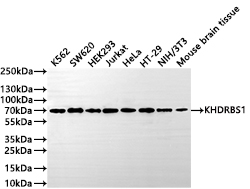
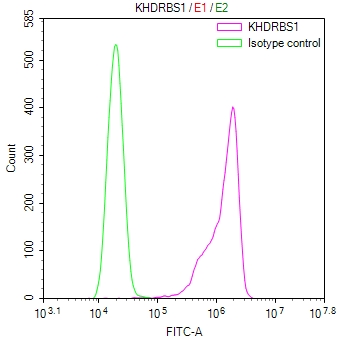
Validation by western blot demonstrates robust detection across a broad panel of human cell lines including K562, SW620, HEK293, Jurkat, HeLa, and HT-29, as well as mouse NIH/3T3 cells and mouse brain tissue, confirming cross-species reactivity for both human and mouse samples. The observed band at 68 kDa, rather than the predicted 48 kDa molecular weight, reflects the well-documented post-translational modifications of Sam68, including phosphorylation and potential glycosylation events that contribute to its regulatory functions. Flow cytometry validation in A549 cells further demonstrates utility for single-cell analysis applications.
This antibody supports researchers studying RNA-binding protein biology, Src kinase signaling networks, and the molecular mechanisms underlying cell proliferation, making it a versatile tool for both basic research and translational studies in oncology and developmental biology.
There are currently no reviews for this product.





