
Call us
301-363-4651 (Available 9 a.m. to 5 p.m. CST from Monday to Friday)

| Code | CSB-RA189175A0HU |
| Size | US$210 |
| Order now | |
| Image |
|
| Have Questions? | Leave a Message or Start an on-line Chat |
| Application | Recommended Dilution |
|---|---|
| WB | 1:500-1:2000 |
| IHC | 1:50-1:200 |
| FC | 1:50-1:200 |
Kinesin light chain 1 (KLC1) serves as an essential regulatory subunit of the kinesin-1 motor complex, playing a critical role in microtubule-based intracellular transport. This protein facilitates the movement of organelles, vesicles, and protein complexes along axons and throughout the cytoplasm, making it a key focus in neuroscience research, particularly in studies of axonal transport dysfunction associated with neurodegenerative conditions.
This recombinant monoclonal antibody, generated from clone 1B1 in rabbit host, offers the consistency and reproducibility that demanding research applications require. Because the antibody sequence is defined and production occurs in controlled recombinant systems, researchers benefit from lot-to-lot uniformity that supports reliable longitudinal studies and reproducible experimental outcomes.
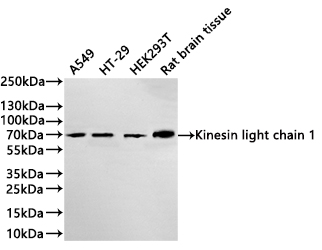
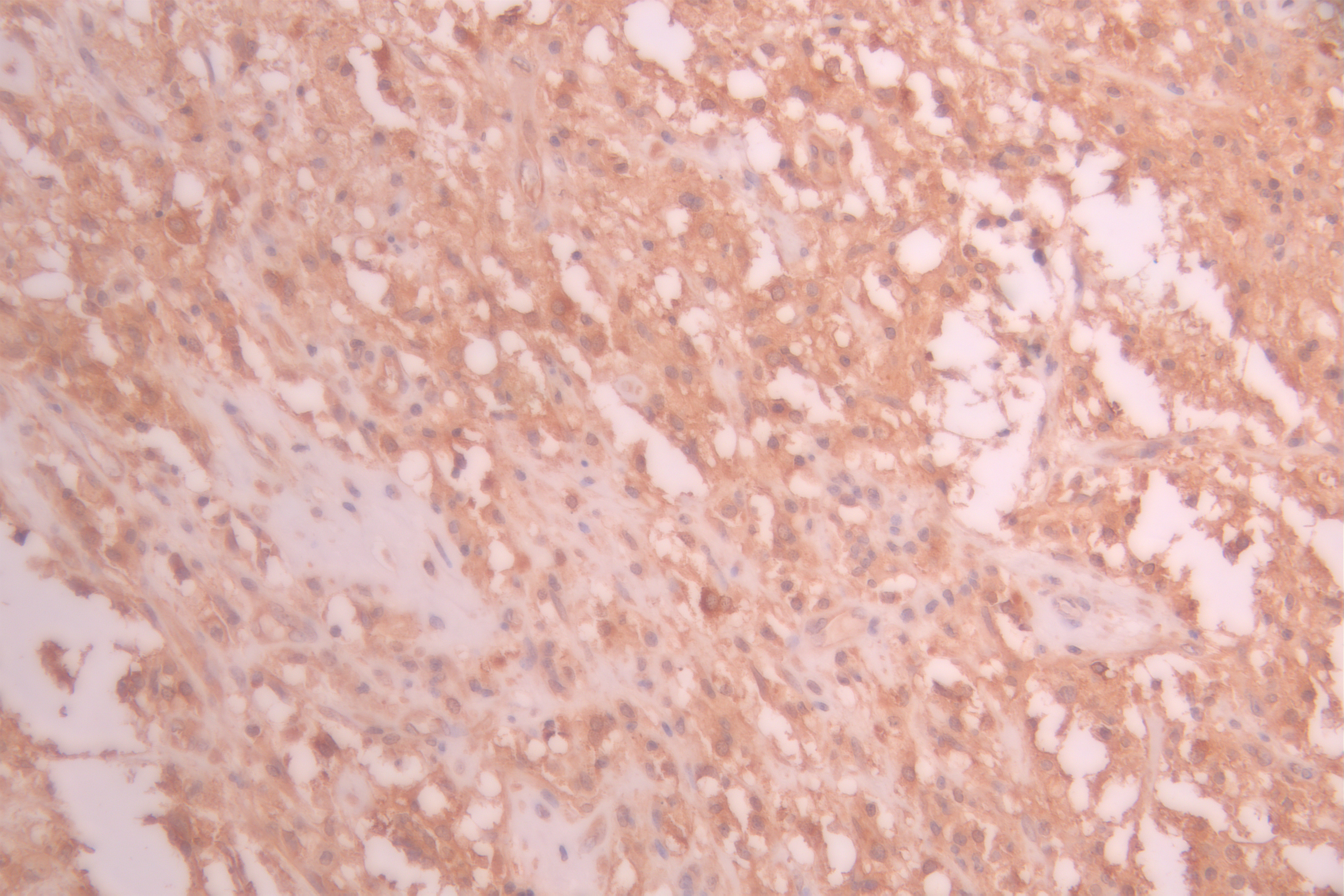
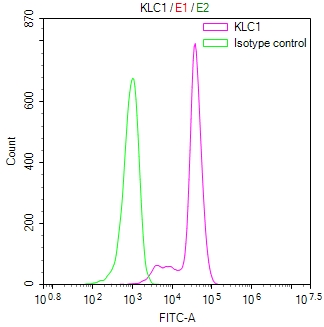
Validation across multiple platforms demonstrates the versatility of this antibody in diverse experimental workflows. Western blot analysis confirms specific detection in human cell lines including A549, HT-29, and HEK293T, as well as rat brain tissue, providing cross-species reactivity valuable for translational research. The observed band at approximately 69 kDa, slightly higher than the predicted 65 kDa molecular weight, likely reflects post-translational modifications such as glycosylation that are characteristic of the native protein. Immunohistochemical staining has been validated in paraffin-embedded human glioma tissue, while flow cytometry analysis in SH-SY5Y neuroblastoma cells demonstrates utility for single-cell studies.
With applications spanning protein expression analysis, tissue localization, and cell population studies, this antibody supports investigations into motor protein biology, intracellular trafficking mechanisms, and neurological disease pathways where kinesin dysfunction has been implicated.
There are currently no reviews for this product.





