
Call us
301-363-4651 (Available 9 a.m. to 5 p.m. CST from Monday to Friday)

| Code | CSB-RA448521A0HU |
| Size | US$210 |
| Order now | |
| Image |
|
| Have Questions? | Leave a Message or Start an on-line Chat |
| Application | Recommended Dilution |
|---|---|
| FC | 1:50-1:200 |
Keratin 4 is a type II intermediate filament protein that plays a fundamental role in maintaining the structural integrity of stratified squamous epithelia, particularly in the oral mucosa, esophagus, and other mucosal surfaces. As a key component of the cytoskeletal network, KRT4 forms heterodimers with its type I partner keratin 13, creating filaments essential for cellular resilience against mechanical stress. Mutations in KRT4 are associated with white sponge nevus, making this protein a significant target for researchers investigating epithelial biology, mucosal disorders, and keratin-related pathologies.
This recombinant monoclonal antibody, clone 17B11, offers the reproducibility and consistency that demanding research applications require. Developed using recombinant technology with a sequence-defined approach, this antibody eliminates the lot-to-lot variability that can compromise longitudinal studies and multi-site collaborations. The rabbit host and monoclonal nature ensure high specificity against the human KRT4 epitope, derived from a synthesized peptide immunogen.
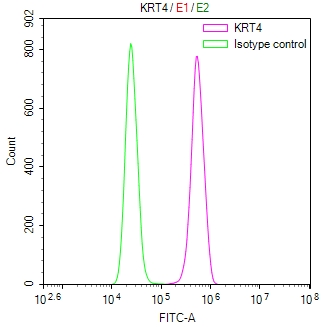
Validation through flow cytometry demonstrates reliable intracellular detection, with testing in HeLa cells showing clear positive signal separation from isotype control when used at 1:100 dilution. The protocol employed fixation with formaldehyde followed by Triton X-100 permeabilization, providing researchers with a validated workflow for intracellular keratin detection. The antibody is also suitable for ELISA applications, with recommended dilutions of 1:50 to 1:200 for flow cytometry experiments.
Supplied in a stabilized liquid format with glycerol for convenient long-term storage at -20°C or -80°C, this affinity-purified antibody serves researchers investigating epithelial differentiation, mucosal tissue biology, and keratin-associated disease mechanisms.
There are currently no reviews for this product.





