
Call us
301-363-4651 (Available 9 a.m. to 5 p.m. CST from Monday to Friday)

| Code | CSB-RA916460A0HU |
| Size | US$210 |
| Order now | |
| Image |
|
| Have Questions? | Leave a Message or Start an on-line Chat |
| Application | Recommended Dilution |
|---|---|
| WB | 1:500-1:5000 |
| IHC | 1:50-1:200 |
| FC | 1:50-1:200 |
Lamin B receptor (LBR) serves as a critical inner nuclear membrane protein that anchors the nuclear lamina to the membrane while also functioning as a sterol reductase in cholesterol biosynthesis. This dual role makes LBR an important target for researchers investigating nuclear envelope organization, chromatin architecture, and disorders linked to lamin-associated proteins, including Pelger-Huët anomaly and Greenberg skeletal dysplasia.
This recombinant monoclonal antibody, clone 18D8, offers the reproducibility and consistency that demanding experiments require. Because it is generated from a defined sequence rather than traditional hybridoma methods, researchers can expect reliable performance across experiments and between lots, eliminating a common source of variability in long-term studies.
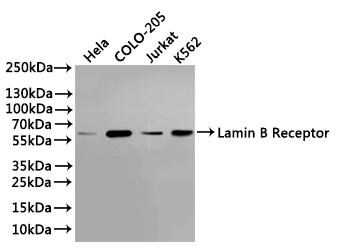
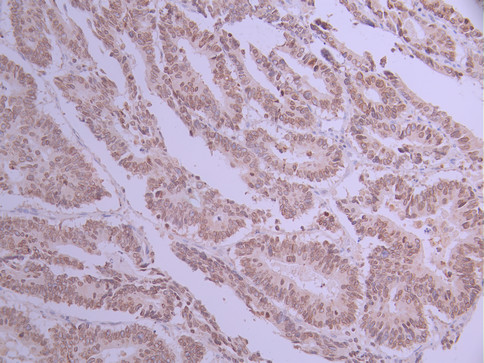
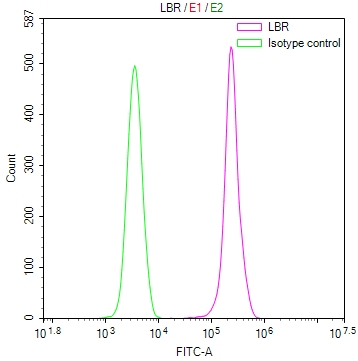
Validation testing demonstrates robust detection across multiple human cell lines in western blot applications, including HeLa, COLO-205, Jurkat, and K562 lysates. The observed band at 58 kDa differs from the predicted 71 kDa molecular weight, which likely reflects post-translational processing or proteolytic cleavage events that are commonly observed with integral membrane proteins during sample preparation. Immunohistochemistry validation in human colorectal cancer tissue sections shows clear nuclear envelope staining patterns at 1:100 dilution, while flow cytometry analysis of Jurkat cells confirms utility for single-cell analysis of intracellular LBR expression.
The antibody's compatibility with immunohistochemistry, flow cytometry, and ELISA provides workflow flexibility for researchers examining LBR expression across different experimental contexts. This reagent is particularly well-suited for studies exploring nuclear lamina biology, chromatin organization during cell division, and the pathophysiology of laminopathies and related nuclear envelope disorders.
There are currently no reviews for this product.





