
Call us
301-363-4651 (Available 9 a.m. to 5 p.m. CST from Monday to Friday)

| Code | CSB-RA559330A0HU |
| Size | US$210 |
| Order now | |
| Image |
|
| Have Questions? | Leave a Message or Start an on-line Chat |
| Application | Recommended Dilution |
|---|---|
| WB | 1:500-1:2000 |
| IHC | 1:50-1:200 |
METTL3 serves as the catalytic core of the N6-methyladenosine (m6A) writer complex, the most abundant internal modification found in eukaryotic messenger RNA. This methyltransferase plays a fundamental role in post-transcriptional gene regulation, influencing mRNA stability, splicing, nuclear export, and translation efficiency. Given its emerging connections to stem cell differentiation, circadian rhythm regulation, and oncogenic pathways, METTL3 has become a compelling target for researchers investigating epitranscriptomic mechanisms in both normal physiology and disease states.
This recombinant monoclonal antibody, generated from clone 6D10 in rabbit host, offers the reproducibility essential for longitudinal studies of m6A biology. Because the antibody sequence is defined and production occurs through recombinant expression rather than hybridoma culture, researchers benefit from consistent performance across experiments and minimal lot-to-lot variation, a critical consideration when comparing results over time or across collaborating laboratories.
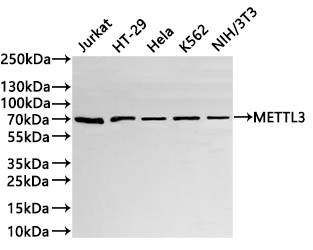
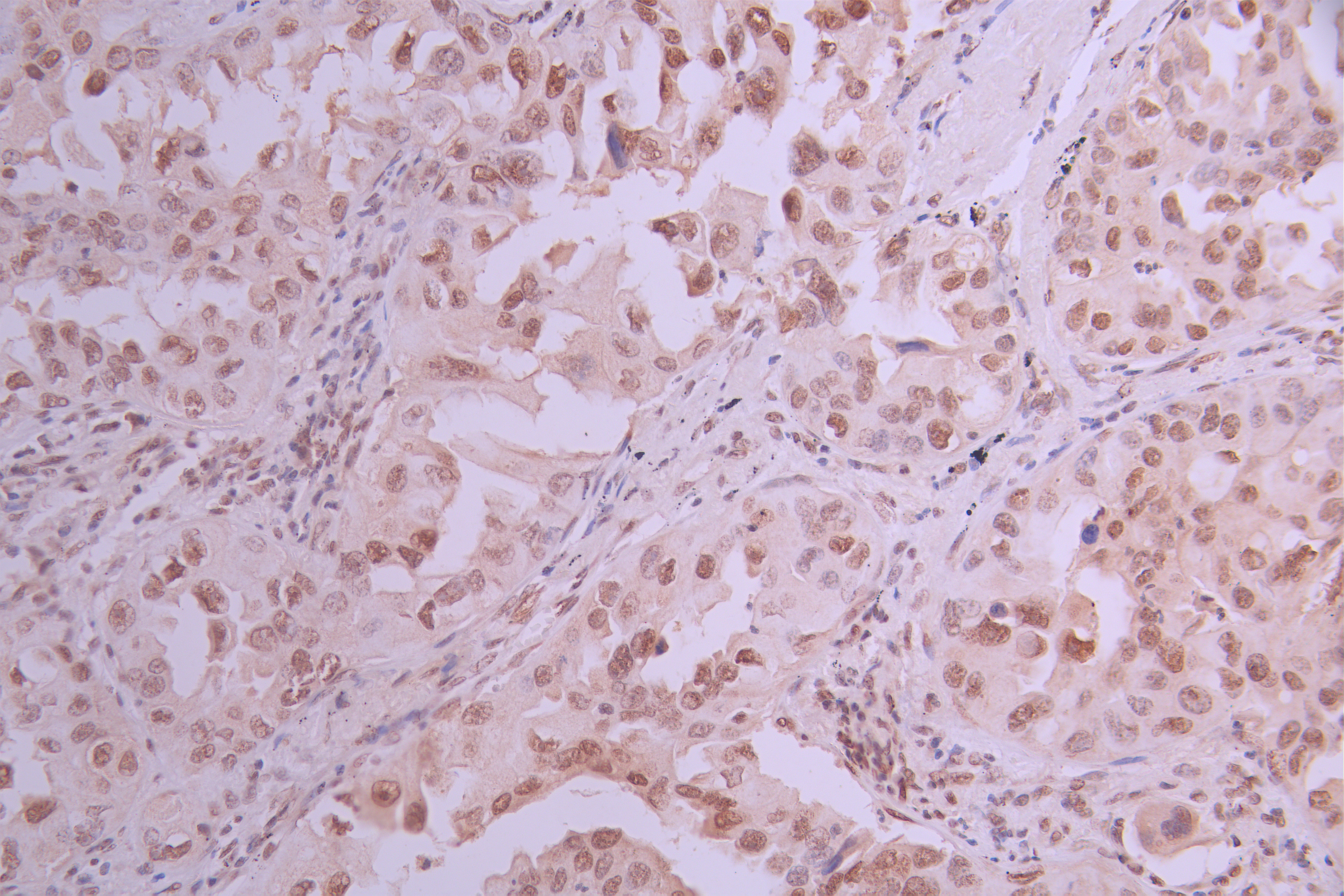
Validation by western blot demonstrates reliable detection across multiple human cell lines including Jurkat, HT-29, HeLa, and K562, as well as mouse NIH/3T3 cells, confirming cross-species reactivity between human and mouse samples. The observed band at approximately 70 kDa runs slightly higher than the predicted 64 kDa molecular weight, consistent with post-translational modifications commonly observed for this protein. Immunohistochemical staining has been validated in paraffin-embedded human lung cancer tissue using citrate buffer antigen retrieval, with clear signal achieved at 1:100 dilution.
This antibody supports researchers exploring m6A-mediated gene regulation in cancer biology, developmental processes, and metabolic disease, providing a dependable tool for interrogating METTL3 expression and localization across diverse experimental systems.
There are currently no reviews for this product.





