
Call us
301-363-4651 (Available 9 a.m. to 5 p.m. CST from Monday to Friday)

| Code | CSB-RA799368A0HU |
| Size | US$210 |
| Order now | |
| Image |
|
| Have Questions? | Leave a Message or Start an on-line Chat |
| Application | Recommended Dilution |
|---|---|
| IHC | 1:50-1:200 |
Mitofusin-2 is a mitochondrial outer membrane GTPase that plays a central role in mitochondrial fusion dynamics, a process essential for maintaining cellular energy homeostasis and mitochondrial network integrity. Beyond its fusion activity, MFN2 participates in mitochondria-endoplasmic reticulum tethering, influencing calcium signaling and lipid transfer between organelles. Dysregulation of MFN2 has been implicated in neurodegenerative conditions, metabolic disorders, and cancer progression, making it a compelling target for researchers investigating mitochondrial biology and its intersection with disease pathophysiology.
This recombinant monoclonal antibody, generated against a synthetic peptide derived from human Mitofusin-2, offers the reproducibility and consistency that demanding experimental workflows require. As a sequence-defined recombinant clone, it eliminates the lot-to-lot variability inherent in traditional hybridoma-derived antibodies, ensuring that your results remain comparable across extended studies and collaborative projects. The rabbit IgG format provides excellent signal amplification potential while maintaining specificity for your target.
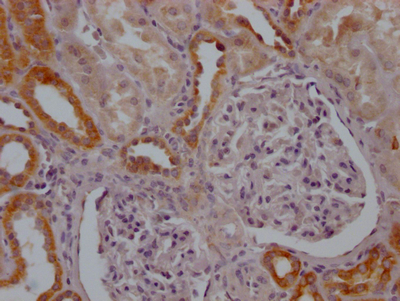
Validation in immunohistochemistry demonstrates reliable performance in paraffin-embedded human kidney tissue, where the antibody was applied at 1:100 dilution following citrate buffer antigen retrieval. The protocol employed standard detection with a goat anti-rabbit HRP polymer system and DAB visualization, confirming compatibility with widely used automated staining platforms including the Leica Bond system. Recommended working dilutions range from 1:50 to 1:200 for immunohistochemistry applications, with additional utility confirmed for ELISA-based detection methods.
This antibody serves researchers exploring mitochondrial dynamics in neuroscience, cancer biology, metabolic regulation, and signal transduction pathways, providing a dependable tool for characterizing MFN2 expression patterns in human tissue specimens.
There are currently no reviews for this product.





