
Call us
301-363-4651 (Available 9 a.m. to 5 p.m. CST from Monday to Friday)

| Code | CSB-RA965164A0HU |
| Size | US$210 |
| Order now | |
| Image |
|
| Have Questions? | Leave a Message or Start an on-line Chat |
| Application | Recommended Dilution |
|---|---|
| WB | 1:500-1:5000 |
| IHC | 1:50-1:200 |
| FC | 1:50-1:200 |
PDLIM1, also known as CLP-36 or Elfin, is a PDZ and LIM domain-containing protein that plays a critical role in cytoskeletal organization and cell signaling. This adapter protein localizes to actin stress fibers and focal adhesions, where it mediates protein-protein interactions essential for cellular architecture and mechanotransduction. PDLIM1 has garnered significant research interest for its involvement in epigenetics and nuclear signaling pathways, making it a valuable target for investigators studying cellular dynamics and signal transduction mechanisms.
This recombinant rabbit monoclonal antibody, clone 19E12, offers the consistency and reproducibility that demanding experimental workflows require. Generated against a synthetic peptide derived from human PDLIM1, the recombinant production method ensures sequence-defined specificity and eliminates the lot-to-lot variability often encountered with traditional hybridoma-derived antibodies. Affinity chromatography purification further enhances performance by removing non-specific immunoglobulins.
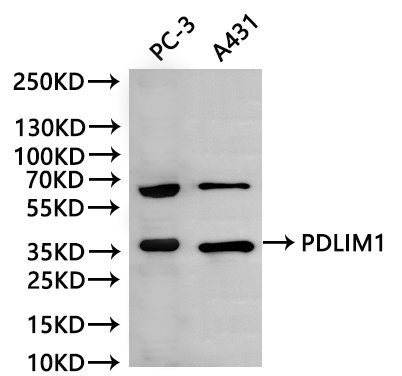
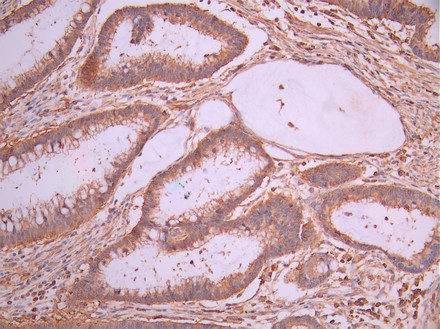
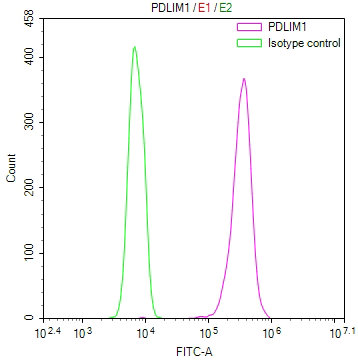
Validation studies demonstrate reliable detection across multiple experimental platforms. Western blot analysis confirms specific recognition of PDLIM1 at the expected 36 kDa molecular weight in both PC-3 prostate cancer and A431 epidermoid carcinoma cell lysates, with effective detection at 1:1000 dilution. Immunohistochemistry validation in paraffin-embedded human gastric cancer tissue shows clear staining at 1:100 dilution using standard citrate buffer antigen retrieval. Flow cytometry analysis in HeLa cells demonstrates distinct positive signal separation from isotype control, confirming utility for intracellular protein detection in fixed and permeabilized samples.
This versatile antibody supports researchers investigating cytoskeletal biology, focal adhesion dynamics, and nuclear signaling pathways, providing a dependable tool for characterizing PDLIM1 expression and localization across diverse experimental contexts.
There are currently no reviews for this product.





