
Call us
301-363-4651 (Available 9 a.m. to 5 p.m. CST from Monday to Friday)

| Code | CSB-RA999292A0HU |
| Size | US$210 |
| Order now | |
| Image |
|
| Have Questions? | Leave a Message or Start an on-line Chat |
| Application | Recommended Dilution |
|---|---|
| WB | 1:500-1:5000 |
| IHC | 1:50-1:200 |
PELP1 (Proline-, glutamic acid- and leucine-rich protein 1) serves as a critical scaffold protein that modulates estrogen receptor signaling through both genomic and non-genomic pathways. As a coregulator that bridges nuclear receptors with various signaling cascades, PELP1 has emerged as a significant focus in cancer biology research, particularly in hormone-responsive malignancies where its dysregulation contributes to tumor progression and therapeutic resistance.
This recombinant monoclonal antibody, generated from clone 6H4, offers the reproducibility and sequence-defined consistency that demanding experimental workflows require. Because recombinant production eliminates the batch variability inherent in traditional hybridoma methods, researchers can confidently compare results across extended studies without concerns about antibody drift affecting their data.
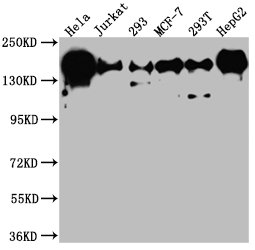
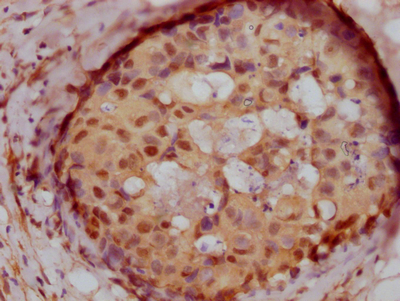
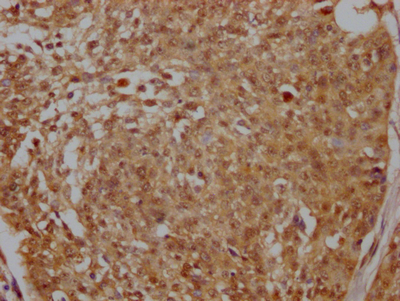
Validation testing demonstrates robust performance across multiple platforms. In western blot applications, this antibody reliably detects PELP1 in a diverse panel of human cell lines including HeLa, Jurkat, 293, MCF-7, 293T, and HepG2 lysates at dilutions ranging from 1:500 to 1:5000. The observed band at approximately 160 kDa runs higher than the predicted 120 kDa molecular weight, a shift commonly attributed to post-translational modifications such as glycosylation or the protein's proline-rich composition affecting gel migration. For immunohistochemistry applications, the antibody has been validated in paraffin-embedded human breast cancer and cervical cancer tissues at 1:50 to 1:200 dilutions using citrate buffer antigen retrieval, producing clear nuclear staining patterns consistent with PELP1's known localization.
This antibody supports investigations into epigenetics, nuclear signaling, and signal transduction pathways, making it particularly valuable for researchers exploring estrogen receptor biology, transcriptional regulation, and hormone-dependent cancer mechanisms.
There are currently no reviews for this product.





