
Call us
301-363-4651 (Available 9 a.m. to 5 p.m. CST from Monday to Friday)

| Code | CSB-RA069971A0HU |
| Size | US$210 |
| Order now | |
| Image |
|
| Have Questions? | Leave a Message or Start an on-line Chat |
| Application | Recommended Dilution |
|---|---|
| IF | 1:50-1:200 |
| FC | 1:50-1:200 |
PITX3 is a paired-like homeodomain transcription factor that plays an essential role in the development and survival of midbrain dopaminergic neurons. This transcription factor has garnered significant attention in neuroscience research due to its involvement in dopaminergic neuron differentiation and its potential implications for understanding neurodegenerative conditions affecting these neuronal populations. Beyond its neurological significance, PITX3 also participates in lens development and broader developmental processes, making it a valuable target for researchers investigating transcriptional regulation in multiple biological contexts.
This recombinant monoclonal antibody, clone 28A9, offers the consistency and reliability that demanding experimental workflows require. Because it is produced from a defined sequence rather than traditional hybridoma methods, researchers can expect exceptional lot-to-lot reproducibility, ensuring that optimization efforts translate reliably across experiments and over time. The rabbit IgG format provides strong signal characteristics while maintaining specificity against the human PITX3 target.
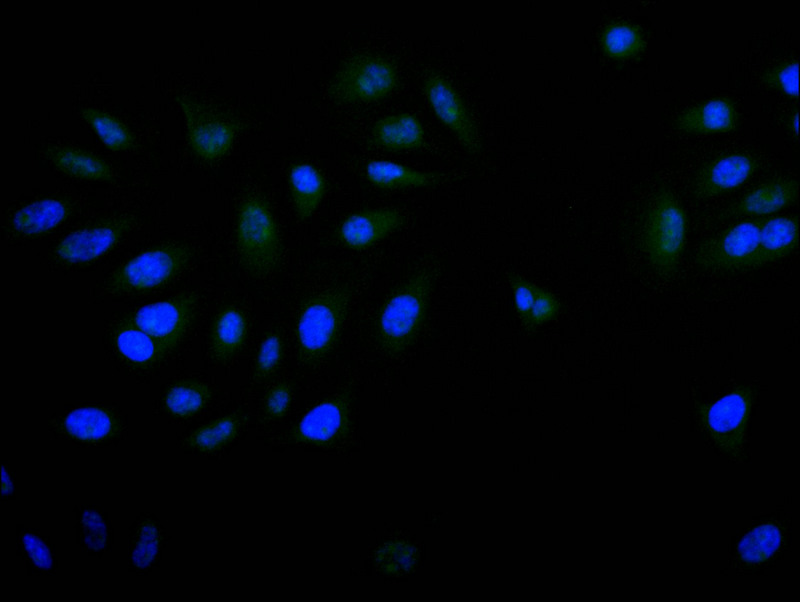
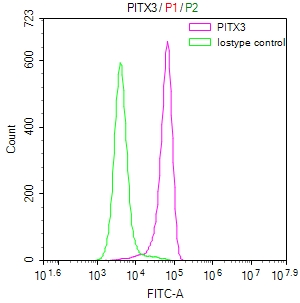
Validation studies demonstrate this antibody's utility across multiple detection platforms. Immunofluorescence staining of A549 cells reveals clear nuclear localization patterns consistent with PITX3's function as a transcription factor, with effective detection at dilutions ranging from 1:50 to 1:200. Flow cytometry analysis using SH-SY5Y cells, a neuroblastoma line frequently employed in neuroscience research, shows distinct positive population shifts compared to isotype controls, confirming specific detection in a physiologically relevant cell model.
For researchers investigating epigenetic regulation, nuclear signaling pathways, or dopaminergic neuron biology, this antibody provides a dependable tool for immunofluorescence and flow cytometry applications. The validated performance in both adherent epithelial and neuronal cell lines offers flexibility for diverse experimental designs in developmental and neuroscience research programs.
There are currently no reviews for this product.





