
Call us
301-363-4651 (Available 9 a.m. to 5 p.m. CST from Monday to Friday)

| Code | CSB-RA207245A0HU |
| Size | US$210 |
| Order now | |
| Image |
|
| Have Questions? | Leave a Message or Start an on-line Chat |
| Application | Recommended Dilution |
|---|---|
| WB | 1:500-1:2000 |
| IHC | 1:50-1:200 |
| FC | 1:50-1:200 |
POLD1 encodes the catalytic subunit of DNA polymerase delta, a critical enzyme complex responsible for lagging strand synthesis during DNA replication and essential repair pathways including nucleotide excision repair and mismatch repair. Mutations in POLD1 have been linked to hereditary cancer syndromes and genomic instability, making this target particularly relevant for researchers investigating DNA replication fidelity, cancer predisposition, and cellular responses to replicative stress.
This recombinant monoclonal antibody, generated from clone 24B10, offers the reproducibility and consistency that demanding experimental workflows require. Because recombinant antibodies are produced from defined sequences rather than traditional hybridoma methods, researchers benefit from lot-to-lot uniformity that supports longitudinal studies and ensures comparable results across experiments.
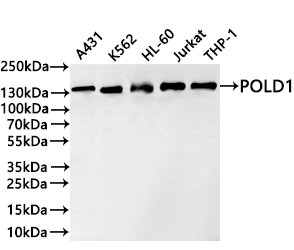
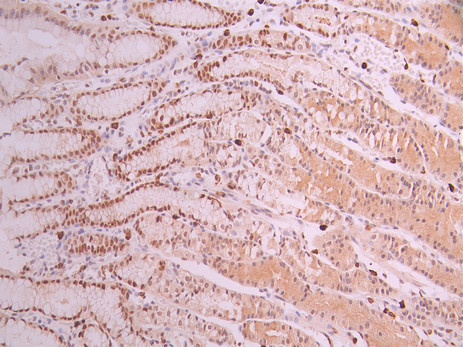
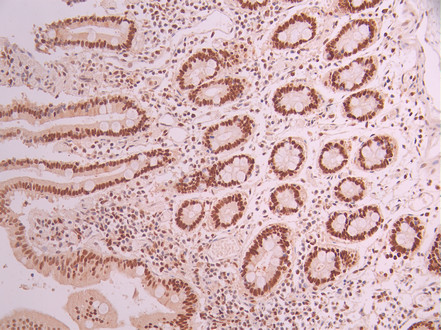
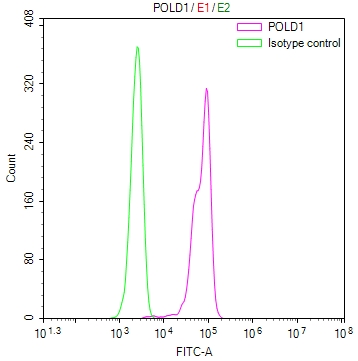
Validation data demonstrates robust performance across multiple applications in human samples. Western blot analysis detects POLD1 across diverse cell lines including A431, K562, HL-60, Jurkat, and THP-1 lysates, with an observed band at approximately 132 kDa. This slight shift from the predicted 124 kDa molecular weight likely reflects post-translational modifications such as phosphorylation, which is known to regulate POLD1 activity during cell cycle progression. Immunohistochemistry staining has been validated in paraffin-embedded human gastric cancer and small intestine tissues using citrate buffer antigen retrieval, while flow cytometry analysis confirms intracellular detection in Jurkat cells following fixation and permeabilization.
The antibody's compatibility with ELISA, western blotting, immunohistochemistry, and flow cytometry provides flexibility for researchers studying POLD1 expression, localization, and regulation across different experimental contexts. This versatility makes it well-suited for investigations into DNA replication mechanisms, cancer biology, and the molecular basis of genomic maintenance disorders.
There are currently no reviews for this product.





