
Call us
301-363-4651 (Available 9 a.m. to 5 p.m. CST from Monday to Friday)

| Code | CSB-RA119753A0HU |
| Size | US$210 |
| Order now | |
| Image |
|
| Have Questions? | Leave a Message or Start an on-line Chat |
| Application | Recommended Dilution |
|---|---|
| WB | 1:500-1:2000 |
| FC | 1:50-1:200 |
Periostin, encoded by the POSTN gene, is a matricellular protein that plays critical roles in tissue remodeling, wound healing, and cellular adhesion. Originally identified as osteoblast-specific factor 2, periostin has emerged as a significant molecule in cancer research, where it contributes to tumor progression and metastasis, as well as in cardiovascular studies examining fibrosis and cardiac repair mechanisms. Its involvement in epithelial-mesenchymal transition and extracellular matrix organization makes it a valuable target for researchers investigating signal transduction pathways and disease biomarkers.
This recombinant monoclonal antibody, clone 14F2, offers the consistency and reliability that demanding experimental workflows require. Developed using recombinant technology with a sequence-defined approach, it eliminates the lot-to-lot variability that can compromise longitudinal studies and reproducibility. The rabbit host-derived IgG format, combined with affinity chromatography purification, ensures high specificity for human POSTN detection.
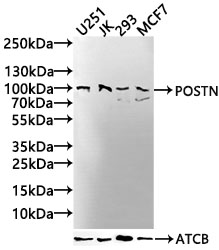
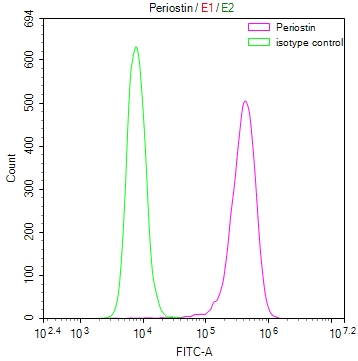
Validation studies demonstrate robust performance across multiple platforms. Western blot analysis successfully detected POSTN in diverse human cell lines including U251 glioblastoma, JK, HEK293, and MCF7 breast cancer cells, with observed bands at approximately 100 kDa. The slight difference from predicted molecular weights of 81-94 kDa likely reflects post-translational modifications, particularly glycosylation, which is characteristic of this secreted matricellular protein. Flow cytometry validation using HEK293T cells confirms utility for cell surface detection applications, while immunohistochemistry compatibility at dilutions of 1:50-1:200 enables tissue-based investigations.
Whether exploring periostin's role in tumor microenvironment remodeling, cardiac fibrosis, or stem cell niche regulation, this antibody provides researchers with a dependable tool for advancing their understanding of this multifunctional protein.
There are currently no reviews for this product.





