
Call us
301-363-4651 (Available 9 a.m. to 5 p.m. CST from Monday to Friday)

| Code | CSB-RA162205A0HU |
| Size | US$210 |
| Order now | |
| Image |
|
| Have Questions? | Leave a Message or Start an on-line Chat |
| Application | Recommended Dilution |
|---|---|
| WB | 1:500-1:5000 |
| FC | 1:50-1:200 |
PPID, also known as Cyclophilin-40, is a peptidyl-prolyl cis-trans isomerase that plays essential roles in protein folding and cellular signaling pathways. As a member of the cyclophilin family, PPID functions as a co-chaperone in steroid receptor complexes and has been implicated in various cellular processes including heat shock response and hormone signaling regulation. Its involvement in protein homeostasis makes it a compelling target for researchers investigating chaperone biology, stress responses, and related disease mechanisms.
This recombinant monoclonal antibody, clone 4F2, offers the consistency and reproducibility that demanding experimental workflows require. Generated against a synthetic peptide derived from human PPID, the recombinant format ensures sequence-defined specificity and eliminates the lot-to-lot variability that can compromise longitudinal studies. Affinity-chromatography purification delivers a reagent ready for sensitive detection applications.
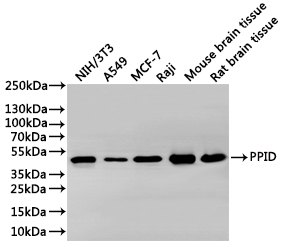
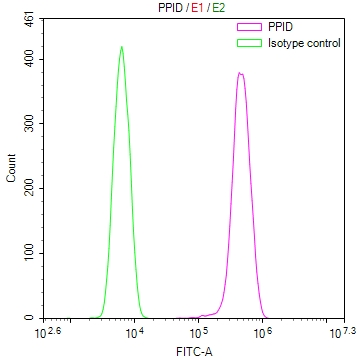
Validation studies demonstrate robust performance across multiple experimental platforms. Western blot analysis confirms detection of the expected 41 kDa band in human cell lines including A549 and MCF-7, as well as NIH/3T3 cells and both mouse and rat brain tissue lysates, indicating useful cross-species reactivity for comparative studies. Flow cytometry validation using SH-SY5Y neuroblastoma cells shows clear separation from isotype control, with recommended dilutions ranging from 1:50 to 1:200 providing flexibility for optimization in your specific experimental system.
Whether you are exploring cyclophilin biology in cancer cell models, investigating chaperone networks in neuronal tissue, or characterizing PPID expression across mammalian species, this antibody provides a reliable tool for advancing your research into protein folding machinery and cellular stress responses.
There are currently no reviews for this product.





