
Call us
301-363-4651 (Available 9 a.m. to 5 p.m. CST from Monday to Friday)

| Code | CSB-RA439849A0HU |
| Size | US$210 |
| Order now | |
| Image |
|
| Have Questions? | Leave a Message or Start an on-line Chat |
| Application | Recommended Dilution |
|---|---|
| WB | 1:500-1:2000 |
| FC | 1:50-1:200 |
PSMB8, also known as LMP7 or proteasome subunit beta type-8, is a catalytic component of the immunoproteasome that plays a central role in antigen processing and MHC class I-mediated immune responses. This inducible proteasome subunit replaces its constitutive counterpart following interferon-gamma stimulation, generating peptides optimized for presentation to cytotoxic T cells. PSMB8 has emerged as a significant target in immunology research, with implications spanning autoimmune disorders, inflammatory conditions, and cancer immunotherapy studies.
This recombinant monoclonal antibody, clone 13D2, offers researchers the reproducibility and consistency that only sequence-defined antibodies can provide. Developed in rabbit and raised against a synthetic peptide derived from human PSMB8, this antibody delivers reliable performance across experiments and eliminates the lot-to-lot variability that can compromise longitudinal studies or multi-site collaborations.
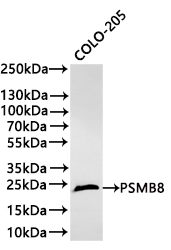
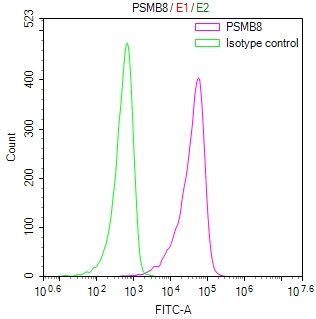
Validation studies confirm robust performance across multiple applications. Western blot analysis of COLO-205 colorectal adenocarcinoma whole cell lysate demonstrates specific detection at an observed molecular weight of approximately 23 kDa. The difference from the predicted 30 kDa size likely reflects post-translational processing, as PSMB8 undergoes proteolytic maturation during immunoproteasome assembly. Flow cytometry validation using Jurkat T cells shows clear positive signal separation from isotype controls, confirming utility for intracellular protein detection in suspension cell populations.
With validated performance in ELISA, Western blot, and flow cytometry applications, this antibody provides workflow flexibility for researchers investigating proteasome biology, immune regulation, or inflammatory signaling pathways. The unconjugated format allows pairing with detection systems of choice, supporting integration into established laboratory protocols.
There are currently no reviews for this product.





