
Call us
301-363-4651 (Available 9 a.m. to 5 p.m. CST from Monday to Friday)

| Code | CSB-RA010833A82phHU |
| Size | US$210 |
| Order now | |
| Image |
|
| Have Questions? | Leave a Message or Start an on-line Chat |
| Application | Recommended Dilution |
|---|---|
| WB | 1:500-1:5000 |
| IHC | 1:50-1:200 |
HSPB1, commonly known as HSP27, is a small heat shock protein that plays a central role in cellular stress responses, cytoskeletal organization, and apoptosis regulation. Phosphorylation at serine 82 represents a critical post-translational modification that modulates HSPB1's chaperone activity and its ability to protect cells from stress-induced damage. This phosphorylation event, triggered by the p38 MAPK pathway, makes phospho-S82 detection essential for researchers investigating stress signaling, cancer biology, and therapeutic resistance mechanisms.
This recombinant monoclonal antibody, generated from clone 2E8 in rabbit, offers the reproducibility and sequence-defined consistency that phospho-specific detection demands. Because phosphorylation studies often require precise quantitative comparisons across experiments, the lot-to-lot uniformity inherent to recombinant production ensures your results remain comparable over time and across research teams.
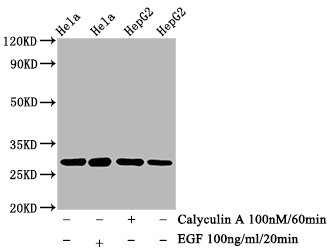
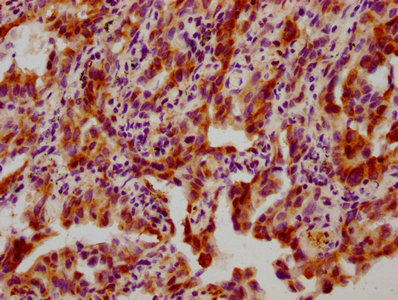
Validation studies confirm reliable performance in Western blot applications, where the antibody detects phospho-HSPB1 at the expected 27 kDa molecular weight. Testing in HeLa and HepG2 whole cell lysates, including HepG2 cells treated with Calyculin A or EGF to enhance phosphorylation signals, demonstrates the antibody's ability to detect both basal and induced phosphorylation states. For immunohistochemistry, validation in paraffin-embedded human lung cancer tissue shows clear staining at 1:100 dilution following citrate buffer antigen retrieval, supporting applications in clinical and translational research contexts.
With demonstrated utility across Western blot, immunohistochemistry, and ELISA platforms, this antibody provides flexibility for researchers studying signal transduction pathways, stress responses, and phosphorylation-dependent regulation of HSPB1 in human samples.
There are currently no reviews for this product.





