
Call us
301-363-4651 (Available 9 a.m. to 5 p.m. CST from Monday to Friday)

| Code | CSB-RA871518A0HU |
| Size | US$210 |
| Order now | |
| Image |
|
| Have Questions? | Leave a Message or Start an on-line Chat |
| Application | Recommended Dilution |
|---|---|
| FC | 1:50-1:200 |
6-pyruvoyl tetrahydrobiopterin synthase, commonly known as PTS or PTPS, catalyzes the second step in the biosynthesis of tetrahydrobiopterin (BH4), an essential cofactor for aromatic amino acid hydroxylases and nitric oxide synthases. Phosphorylation at serine 19 represents a key regulatory modification that modulates enzyme activity and cellular BH4 levels, making this site particularly relevant for researchers investigating neurotransmitter biosynthesis, nitric oxide signaling, and metabolic disorders associated with BH4 deficiency.
This recombinant monoclonal antibody, clone 18G10, specifically recognizes the phosphorylated serine 19 residue of human PTS. Developed using recombinant technology and raised in rabbit, this antibody offers the consistency and reproducibility that phospho-specific detection demands. Each lot is derived from a defined sequence, eliminating the variability inherent in traditional hybridoma-based production and ensuring reliable performance across longitudinal studies where detecting subtle changes in phosphorylation status is critical.
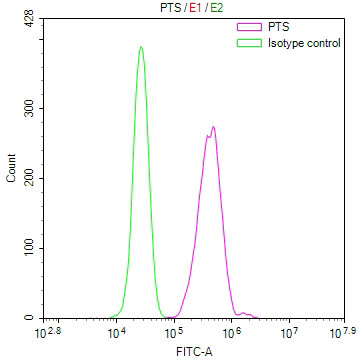
Validation through flow cytometry demonstrates clear detection of phospho-PTS in HepG2 cells, with the overlay histogram showing distinct separation between the specific antibody signal and isotype control when used at 1:100 dilution. The protocol employed formaldehyde fixation with Triton X-100 permeabilization, providing researchers with an established workflow for intracellular phospho-protein detection in hepatocyte models.
For investigators exploring BH4-dependent pathways in neuroscience contexts, including studies of dopamine and serotonin synthesis regulation, this antibody provides a focused tool for monitoring PTS phosphorylation dynamics. The validated flow cytometry application enables quantitative, single-cell analysis of this post-translational modification in human cell populations.
There are currently no reviews for this product.





