
Call us
301-363-4651 (Available 9 a.m. to 5 p.m. CST from Monday to Friday)

| Code | CSB-RA123000A0HU |
| Size | US$210 |
| Order now | |
| Image |
|
| Have Questions? | Leave a Message or Start an on-line Chat |
| Application | Recommended Dilution |
|---|---|
| FC | 1:50-1:200 |
Serum amyloid A-1 (SAA1) serves as a major acute-phase reactant that plays a central role in inflammatory responses and lipid metabolism. Produced primarily by hepatocytes in response to inflammatory cytokines, SAA1 levels can increase dramatically during infection, tissue injury, and chronic inflammatory conditions. This protein is also the precursor to amyloid A, the fibrillar component deposited in secondary amyloidosis, making it a significant target for cardiovascular and inflammatory disease research.
This recombinant monoclonal antibody against human SAA1 offers the reproducibility and consistency that demanding experimental workflows require. Generated through recombinant technology using clone 20G5, this antibody provides sequence-defined specificity that eliminates the lot-to-lot variability often encountered with traditional hybridoma-derived reagents. The rabbit IgG format, combined with affinity chromatography purification, ensures high purity suitable for sensitive detection methods.
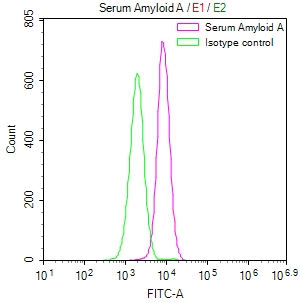
Validation studies using flow cytometry demonstrate effective intracellular detection of SAA1 in HepG2 cells, a human hepatocellular carcinoma line that naturally expresses this acute-phase protein. The clear separation between specific staining and isotype control signals confirms reliable target recognition under standard fixation and permeabilization conditions. For flow cytometry applications, dilutions between 1:50 and 1:200 provide optimal results, with the antibody also validated for ELISA-based detection.
Researchers investigating acute-phase responses, systemic inflammation, amyloidosis pathogenesis, or cardiovascular disease biomarkers will find this antibody well-suited for quantitative and qualitative SAA1 detection. The unconjugated format allows flexibility in secondary antibody selection, accommodating various experimental designs and multiplexing strategies within your research program.
There are currently no reviews for this product.





