
Call us
301-363-4651 (Available 9 a.m. to 5 p.m. CST from Monday to Friday)

| Code | CSB-RA181279A0HU |
| Size | US$210 |
| Order now | |
| Image |
|
| Have Questions? | Leave a Message or Start an on-line Chat |
| Application | Recommended Dilution |
|---|---|
| IHC | 1:50-1:200 |
| FC | 1:50-1:200 |
SERPINB3, also known as squamous cell carcinoma antigen 1 (SCCA-1), belongs to the serine protease inhibitor family and plays a significant role in protecting cells from apoptosis induced by certain proteases. This protein has garnered considerable research interest due to its elevated expression in squamous cell carcinomas of various origins, including cervical, lung, and head and neck cancers, making it a valuable marker for studying tumor biology and disease progression.
This recombinant monoclonal antibody, clone 5A1, offers researchers the reliability that comes with sequence-defined production. Unlike traditional hybridoma-derived antibodies, recombinant technology ensures consistent performance across lots, allowing you to confidently compare results from experiments conducted months or even years apart. The rabbit host and monoclonal nature provide high specificity for human SERPINB3, generated against a synthesized peptide from the human protein sequence.
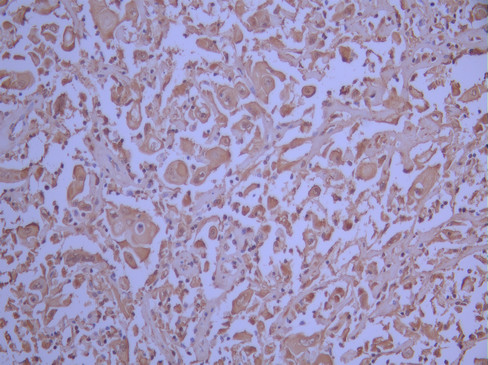
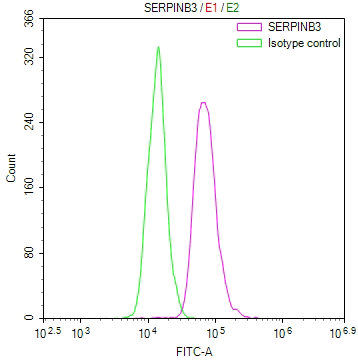
Validation studies demonstrate robust performance across multiple detection platforms. Immunohistochemistry testing on paraffin-embedded human cervical cancer tissue reveals clear staining patterns when used at dilutions between 1:50 and 1:200, with optimal results observed at 1:100 using citrate buffer antigen retrieval. Flow cytometry analysis using BxPC-3 cells, a human pancreatic cancer cell line, shows distinct positive signal separation from isotype control, confirming the antibody's utility for intracellular detection of SERPINB3 in fixed and permeabilized cells.
The unconjugated format provides flexibility for pairing with your preferred secondary detection systems, while affinity chromatography purification ensures minimal background interference. For researchers investigating protease regulation in cancer biology, epithelial differentiation, or tumor marker expression, this antibody delivers the specificity and reproducibility needed for meaningful experimental outcomes.
There are currently no reviews for this product.





