SLC22A3 Recombinant Monoclonal Antibody

Code CSB-RA237159A0HU
Size US$210
Order now
Image
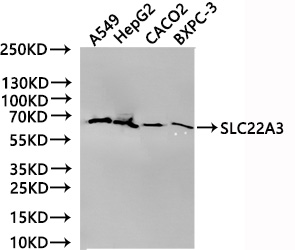
  • Western Blot
    Positive WB detected in: A549 whole cell lysate(30µg), HepG2 whole cell lysate(30µg), CACO-2 whole cell lysate(30µg), BXPC-3 whole cell lysate(30µg)
    All lanes: SLC22A3 antibody at 1:1000
    Secondary
    Goat polyclonal to rabbit IgG at 1/40000 dilution
    Predicted band size: 61 kDa
    Observed band size: 61 kDa
    Exposure time:2min
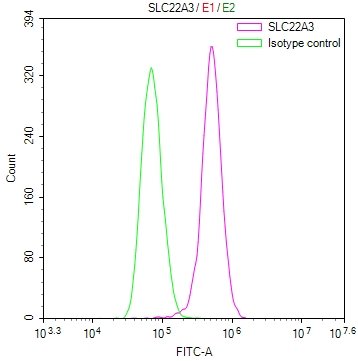
  • Overlay Peak curve showing PC-3 cells stained with CSB-RA237159A0HU (red line) at 1:100. The cells were fixed in 4% formaldehyde and permeated by 0.2% TritonX-100 for 10min. Then 10% normal goat serum to block non-specific protein-protein interactions followed by the antibody (1ug/1*106cells) for 45min at 4℃. The secondary antibody used was FITC-conjugated goat anti-rabbit IgG (H+L) at 1/200 dilution for 35min at 4℃.Control antibody (green line) was Rabbit IgG (1ug/1*106cells) used under the same conditions. Acquisition of >10,000 events was performed.
Have Questions? Leave a Message or Start an on-line Chat

Product Details

Uniprot No.
Target Names
SLC22A3
Alternative Names
Solute carrier family 22 member 3 (Extraneuronal monoamine transporter) (EMT) (Organic cation transporter 3), SLC22A3, EMTH OCT3
Species Reactivity
Human
Immunogen
A synthesized peptide derived from Human SLC22A3 protein
Immunogen Species
Homo sapiens (Human)
Conjugate
Non-conjugated
Clonality
Monoclonal
Isotype
Rabbit IgG
Clone No.
14C3
Purification Method
Affinity-chromatography
Concentration
It differs from different batches. Please contact us to confirm it.
Buffer
Rabbit IgG in 10mM phosphate buffered saline , pH 7.4, 150mM sodium chloride, 0.05% BSA, 0.02% sodium azide and 50% glycerol.
Form
Liquid
Tested Applications
ELISA, WB, FC
Recommended Dilution
Application Recommended Dilution
WB 1:500-1:5000
FC 1:20-1:200
Troubleshooting and FAQs
Storage
Upon receipt, store at -20°C or -80°C. Avoid repeated freeze.
Lead Time
Basically, we can dispatch the products out in 1-3 working days after receiving your orders. Delivery time maybe differs from different purchasing way or location, please kindly consult your local distributors for specific delivery time.
Usage
For Research Use Only. Not for use in diagnostic or therapeutic procedures.

Customer Reviews and Q&A

 Customer Reviews

There are currently no reviews for this product.

Submit a Review here

Target Background

Function
Mediates potential-dependent transport of a variety of organic cations. May play a significant role in the disposition of cationic neurotoxins and neurotransmitters in the brain.
Gene References into Functions
  1. Data show that the common variation in the solute carrier family 22 member 3 (SLC22A3) gene is unlikely to significantly contribute to pancreatic cancer risk, and the rs2504938 single nucleotide polymorphism (SNP) in SLC22A3 significantly associates with an unfavorable prognosis of pancreatic cancer patients. PMID: 28272475
  2. SNPs in SLC22A3 and H3F3B may influence lipid levels through altering the expression of local genes. PMID: 29894858
  3. A-to-I RNA editing of SLC22A3 contributes to the early development and progression of familial esophageal squamous cell carcinoma in high-risk individuals. PMID: 28533408
  4. our study suggests that several PHACTR1 and SLC22A3 gene polymorphisms may exert a protective effect against the CAD in the Chinese Han male population. PMID: 27893421
  5. SLC22A3 deletion is associated with motor speech disorders, and language delays. PMID: 28767196
  6. may be a regulator of the concentration of norepinephrine in adipose tissue. PMID: 28034777
  7. the rs3088442G>A variant as a genetic marker may potentially assist in the identification of individuals at an increased risk of T2D. PMID: 28625319
  8. The genotype of rs3088442 within the SLC22A3-LPAL2-LPA gene cluster may contribute to regulation of plasma Lp(a) levels and possibly to the severity of coronary artery disease in a Chinese Han population. PMID: 27417586
  9. Findings suggest that OCT3 plays an important role in the absorption and elimination of metformin and that the transporter is a critical determinant of metformin bioavailability, clearance, and pharmacologic action. PMID: 25920679
  10. The markers of EMT were detected by using Western blot. PMID: 25322669
  11. Findings suggest a negative feedback mechanism against inflammatory response by which solute carrier family 22 member 3 (SLC22A3) variant rs3088442 G-->A decreased the risk of coronary heart disease (CHD). PMID: 25561729
  12. Cultured astroctye line 1321N1 and primary human astrocytes transport monoamines partly through OCT3. PMID: 24471494
  13. There was no association between rs7758229 in 6q26-q27/SLC22A3 and the risk of colorectal cancer in a Chinese population. PMID: 23555006
  14. Decreasing expression of OCT3 and MATE1 in human placenta indicates these transporters may play a role in fetal protection preferentially at earlier stages of gestation. PMID: 23303678
  15. Our studies demonstrate that genetic polymorphisms in the proximal promoter region of OCT3 alter the transcription rate of the gene and may be associated with altered expression levels of OCT3 in human liver. PMID: 22231567
  16. The increased Wnt3 in the trastuzumab-resistant cells also promoted a partial EMT-like transition. PMID: 23071104
  17. PDLIM5 (rs17021918,T), SLC22A3 (rs9364554,C) and NKX3-1 (rs1512268,A) SNPs might not be associated with prostate cancer in Chinese men. PMID: 22741436
  18. The risk for coronary artery disease in a Chinese Han population is not associated with single nucleotide polymorphisms in the SLC22A3-LPAL2-LPA gene cluster. PMID: 23036009
  19. NUDT11, HNF1B, and SLC22A3 genes have roles in prostate cancer pathogenesis PMID: 22730461
  20. SLC22A3 was expressed high in the human heart with strongest OCT3 immunoreactivity in vascular endothelial cells. SLC22A3/OCT3 expression was not changed in failing human left ventricular myocardium PMID: 21697722
  21. OCT3 overexpression significantly increased cisplatin cellular accumulation and cytotoxicity in KB-3-1 cells. PMID: 21905038
  22. evidence for a new means of downregulating IL-4 production by basophils, both in vitro and in vivo, through OCT3 targeted by 5-HT and pharmacologic ligands. PMID: 21636115
  23. Genetic association studies indicate 5 SNPs are associated with reduced transport activity of OCT3 (using 5-HT & MPP). PMID: 20562519
  24. The regulation of EMT-mediated transport by second-messenger phosphorylation/dephosphorylation mechanisms has been characterized in stably transfected HEK293 cells with tritiated 1-methyl-4-phenylpyridinium as substrate. PMID: 11770002
  25. EMT efficiently translocates agmatine and must be considered for the control of agmatine levels. PMID: 12538837
  26. Genetic variation of EMT was studied in Caucasians. PMID: 12768439
  27. EMT is expressed in the area postrema of rat brain and may play a role in physiological functions of this circumventricular organ such as emesis, food intake and the regulation of cardiovascular functions. PMID: 14690517
  28. organic cation transporter EMT mRNA was mainly detected in the intra lobular septa and also expressed in scattered cells of placental vessel adventitias with lower expression of EMT mRNAs in pre-eclamptic placentae PMID: 15135235
  29. Ranitidine and famotidine elicited differential inhibitory activities on SLC22A3. PMID: 16141367
  30. These results suggest that polymorphisms of SLC22A3 are related to the development of polysubstance use in Japanese patients with methamphetamine (MAP) dependence. PMID: 17010131
  31. PMAT, EMT, and OCT2 transporters are expressed in the endometrial stroma and can potentially regulate reuptake of monoamines in general and histamine in particular. PMID: 17393420
  32. rare mutations in the EMT gene suggest a causative or modulating role in genetic subtypes of obsessive-compulsive disorder PMID: 17477885
  33. Confirm the usefulness of Caki-1 cells as a proximal tubule model system for investigations of OCT3. PMID: 18253050
  34. We conclude that the proliferation of immature germ cells in GB may be due to an interaction between OCT3/4 and accumulated beta-catenin in the nuclei of the immature germ cells. PMID: 18295396
  35. Identification of the SLC22A3-LPAL2-LPA gene cluster as a strong susceptibility locus for coronary artery disease. PMID: 19198611

Show More

Hide All

Subcellular Location
Membrane; Multi-pass membrane protein.
Protein Families
Major facilitator (TC 2.A.1) superfamily, Organic cation transporter (TC 2.A.1.19) family
Tissue Specificity
Expressed in placenta, skeletal muscle, prostate, aorta, liver, fetal lung, salivary gland, adrenal gland, kidney and brain cortex. No expression detected in spleen.
Database Links

HGNC: 10967

OMIM: 604842

KEGG: hsa:6581

STRING: 9606.ENSP00000275300

UniGene: Hs.567337

icon of phone
Call us
301-363-4651 (Available 9 a.m. to 5 p.m. CST from Monday to Friday)

icon of address
Address
7505 Fannin St., Ste 610, Room 7 (CUBIO Innovation Center), Houston, TX 77054, USA
icon of social media
Join us with

Subscribe newsletter

Leave a message

* To protect against spam, please pass the CAPTCHA test below.
CAPTCHA verification
© 2007-2026 CUSABIO TECHNOLOGY LLC All rights reserved. 鄂ICP备15011166号-1
Place an order now

I. Product details

*
*
*
*

II. Contact details

*
*

III. Ship To

*
*
*
*
*
*
*

IV. Bill To

*
*
*
*
*
*
*
*


