STX16 Recombinant Monoclonal Antibody

Code CSB-RA027547A0HU
Size US$210
Order now
Image
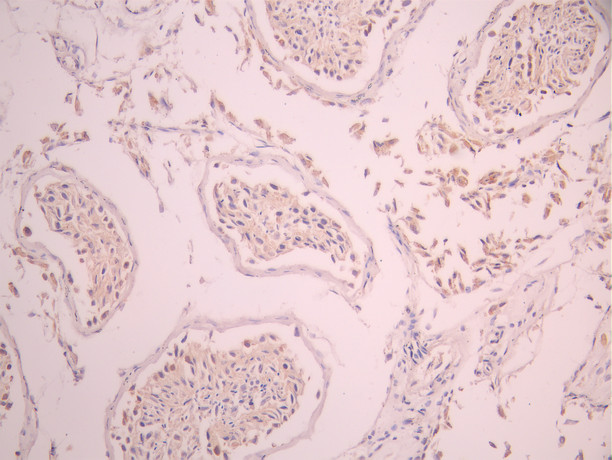
  • IHC image of CSB-RA027547A0HU diluted at 1:100 and staining in paraffin-embedded human testis tissue performed on a Leica BondTM system. After dewaxing and hydration, antigen retrieval was mediated by high pressure in a citrate buffer (pH 6.0). Section was blocked with 10% normal goat serum 30min at RT. Then primary antibody (1% BSA) was incubated at 4°C overnight. The primary is detected by a Goat anti-rabbit polymer IgG labeled by HRP and visualized using 0.05% DAB.
Have Questions? Leave a Message or Start an on-line Chat

Product Details

Uniprot No.
Target Names
STX16
Alternative Names
hsyn16 antibody; MGC90328 antibody; Stx16 antibody; STX16_HUMAN antibody; Syn16 antibody; Syntaxin-16 antibody
Species Reactivity
Human
Immunogen
A synthesized peptide from human STX16 protein
Immunogen Species
Homo sapiens (Human)
Conjugate
Non-conjugated
Clonality
Monoclonal
Isotype
Rabbit IgG
Clone No.
17B11
Purification Method
Affinity-chromatography
Concentration
It differs from different batches. Please contact us to confirm it.
Buffer
Rabbit IgG in 10mM phosphate buffered saline , pH 7.4, 150mM sodium chloride, 0.05% BSA, 0.02% sodium azide and 50% glycerol.
Form
Liquid
Tested Applications
ELISA, IHC
Recommended Dilution
Application Recommended Dilution
IHC 1:50-1:200
Troubleshooting and FAQs
Storage
Upon receipt, store at -20°C or -80°C. Avoid repeated freeze.
Lead Time
Basically, we can dispatch the products out in 1-3 working days after receiving your orders. Delivery time maybe differs from different purchasing way or location, please kindly consult your local distributors for specific delivery time.
Description

Syntaxin-16 plays a central role in intracellular membrane trafficking, functioning as a SNARE protein that mediates vesicle fusion events within the Golgi apparatus and endosomal compartments. This trafficking machinery is essential for maintaining cellular homeostasis, protein sorting, and secretory pathway function, making STX16 a valuable marker for researchers investigating membrane dynamics, organelle identity, and vesicular transport mechanisms.

This recombinant monoclonal antibody, clone 17B11, offers the reproducibility and consistency that demanding research protocols require. Generated against a synthetic peptide derived from human STX16 protein, the antibody is produced using recombinant technology, ensuring sequence-defined specificity and eliminating the lot-to-lot variability that can compromise longitudinal studies or multi-site collaborations. The rabbit IgG format provides robust signal amplification compatible with standard secondary detection systems.

Validation in immunohistochemistry demonstrates reliable performance in paraffin-embedded human tissues. Testing in human testis sections using a Leica Bond automated staining platform with citrate buffer antigen retrieval and HRP-polymer detection confirms the antibody's suitability for formalin-fixed samples at dilutions ranging from 1:50 to 1:200. This flexibility allows researchers to optimize signal intensity based on their specific tissue types and detection systems. The antibody is additionally validated for ELISA applications, providing options for both quantitative and spatial analysis of STX16 expression.

Supplied in a glycerol-containing buffer optimized for long-term storage stability, this affinity-purified antibody serves researchers exploring Golgi organization, membrane trafficking pathways, and cellular compartmentalization. Its defined specificity for human STX16 makes it particularly suited for studies examining vesicular transport in normal physiology and disease contexts.

Usage
For Research Use Only. Not for use in diagnostic or therapeutic procedures.

Customer Reviews and Q&A

 Customer Reviews

There are currently no reviews for this product.

Submit a Review here

Target Background

Function
SNARE involved in vesicular transport from the late endosomes to the trans-Golgi network.
Gene References into Functions
  1. we here present a patient with PHP1b caused by a recurrent STX16 deletion, presenting with macrosomia, early onset obesity, and macrocephaly without other AHO symptoms. we reemphasize STX16 deletions and PHP1b as a rare cause for early onset obesity and macrosomia. PMID: 27338644
  2. STX16 microdeletion was identified in male monozygotic twins (with pseudohypoparathyroidism type 1B leading to growth hormone deficiency) and mother/grandmother (not father/grandfather or sister [their triplet with separate placenta]). [CASE STUDY] PMID: 25843330
  3. syntaxin 16 is a key regulator of cytokinesis. PMID: 24109596
  4. A patient with familial pseudohypoparathyroidism type Ib and his asymptomatic brother were found to have methylation defect at GNAS (guanine nucleotide-binding protein G) and microdeletion involving exons 4-6 of neighboring gene STX16. [CASE REPORT] PMID: 23095209
  5. De novo 3-kb STX16 deletions, reported only once previously, are infrequent but should be excluded in all cases of Pseudohypoparathyroidism-Ib, even when the family history is negative for an inherited form of this disorder. PMID: 23087324
  6. Results suggest that STX16 mediates recycling of CFTR and constitutes an important component of CFTR trafficking machinery in intestinal epithelial cells. PMID: 20826815
  7. the region of overlap between the two microdeletions likely harbors a cis-acting imprinting control element that is necessary for establishing and methylation at GNAS exon A/B, thus allowing normal G alpha(s) expression in the proximal renal tubules. I PMID: 15800843
  8. function of syntaxin 16 was specifically required for, and restricted to, the retrograde pathway PMID: 17389686
  9. Syntaxin 16 may thus play a role in neurite outgrowth and perhaps other specific dendritic anterograde/retrograde traffic. PMID: 17852734
  10. phosphorylation of RASSF1A by Aurora B is required for the recruitment of Syntaxin16 PMID: 19887622

Show More

Hide All

Involvement in disease
Pseudohypoparathyroidism 1B (PHP1B)
Subcellular Location
Golgi apparatus membrane; Single-pass type IV membrane protein.; [Isoform C]: Cytoplasm.
Protein Families
Syntaxin family
Tissue Specificity
Ubiquitous.
Database Links

HGNC: 11431

OMIM: 603233

KEGG: hsa:8675

STRING: 9606.ENSP00000360183

UniGene: Hs.307913

icon of phone
Call us
301-363-4651 (Available 9 a.m. to 5 p.m. CST from Monday to Friday)

icon of address
Address
No. 269, Shendun 5th Road, Donghu Hi-Tech Development Area, Hubei Province, 430206, P.R.China
icon of social media
Join us with

Subscribe newsletter

Leave a message

* To protect against spam, please pass the CAPTCHA test below.
CAPTCHA verification
© 2007-2026 CUSABIO TECHNOLOGY LLC All rights reserved. 鄂ICP备15011166号-1
Place an order now

I. Product details

*
*
*
*

II. Contact details

*
*

III. Ship To

*
*
*
*
*
*
*

IV. Bill To

*
*
*
*
*
*
*
*


