
Call us
301-363-4651 (Available 9 a.m. to 5 p.m. CST from Monday to Friday)

| Code | CSB-RA102182A0HU |
| Size | US$210 |
| Order now | |
| Image |
|
| Have Questions? | Leave a Message or Start an on-line Chat |
| Application | Recommended Dilution |
|---|---|
| WB | 1:500-1:5000 |
| FC | 1:50-1:200 |
TERF2 (Telomeric repeat-binding factor 2) plays an essential role in maintaining chromosome stability by protecting telomere ends from being recognized as DNA damage sites. As a core component of the shelterin complex, TERF2 prevents inappropriate DNA repair responses at chromosome termini and regulates telomerase access to telomeric DNA. This makes TERF2 a critical target for researchers investigating telomere biology, cellular senescence, genomic instability, and cancer progression.
This recombinant monoclonal antibody (clone 4H10) offers significant advantages for telomere research. Produced using recombinant technology with a sequence-defined rabbit IgG backbone, it delivers the lot-to-lot consistency essential for longitudinal studies and reproducible quantification of TERF2 expression. The affinity-chromatography purification ensures high specificity, while the monoclonal nature guarantees recognition of a single epitope on the human TERF2 protein.
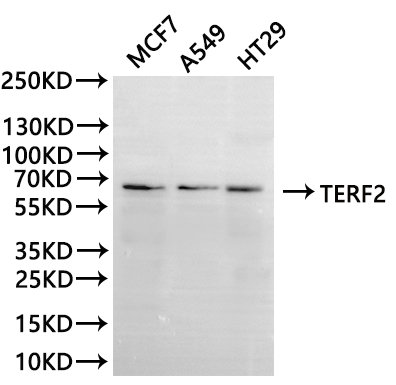
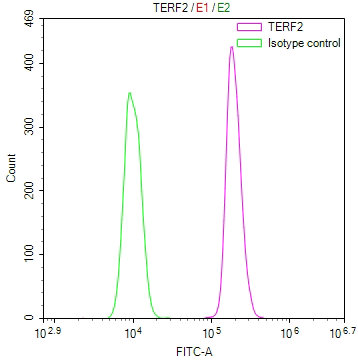
Validation studies demonstrate reliable performance across multiple experimental platforms. In western blot applications, the antibody detects TERF2 in human cell lysates including MCF7 breast cancer cells, A549 lung adenocarcinoma cells, and HT-29 colorectal adenocarcinoma cells at dilutions ranging from 1:500 to 1:5000. The observed band size of 66 kDa runs slightly higher than the predicted 60 kDa molecular weight, which is consistent with post-translational modifications (e.g., glycosylation) commonly observed for this protein. Flow cytometry validation in HeLa cells confirms utility for single-cell analysis of TERF2 expression, with recommended dilutions of 1:50 to 1:200.
This antibody serves researchers exploring epigenetics and nuclear signaling pathways, particularly those examining telomere maintenance mechanisms, DNA damage responses, and the molecular basis of cellular aging and malignant transformation.
There are currently no reviews for this product.





