UFD1 Recombinant Monoclonal Antibody

Code CSB-RA075327A0HU
Size US$210
Order now
Image
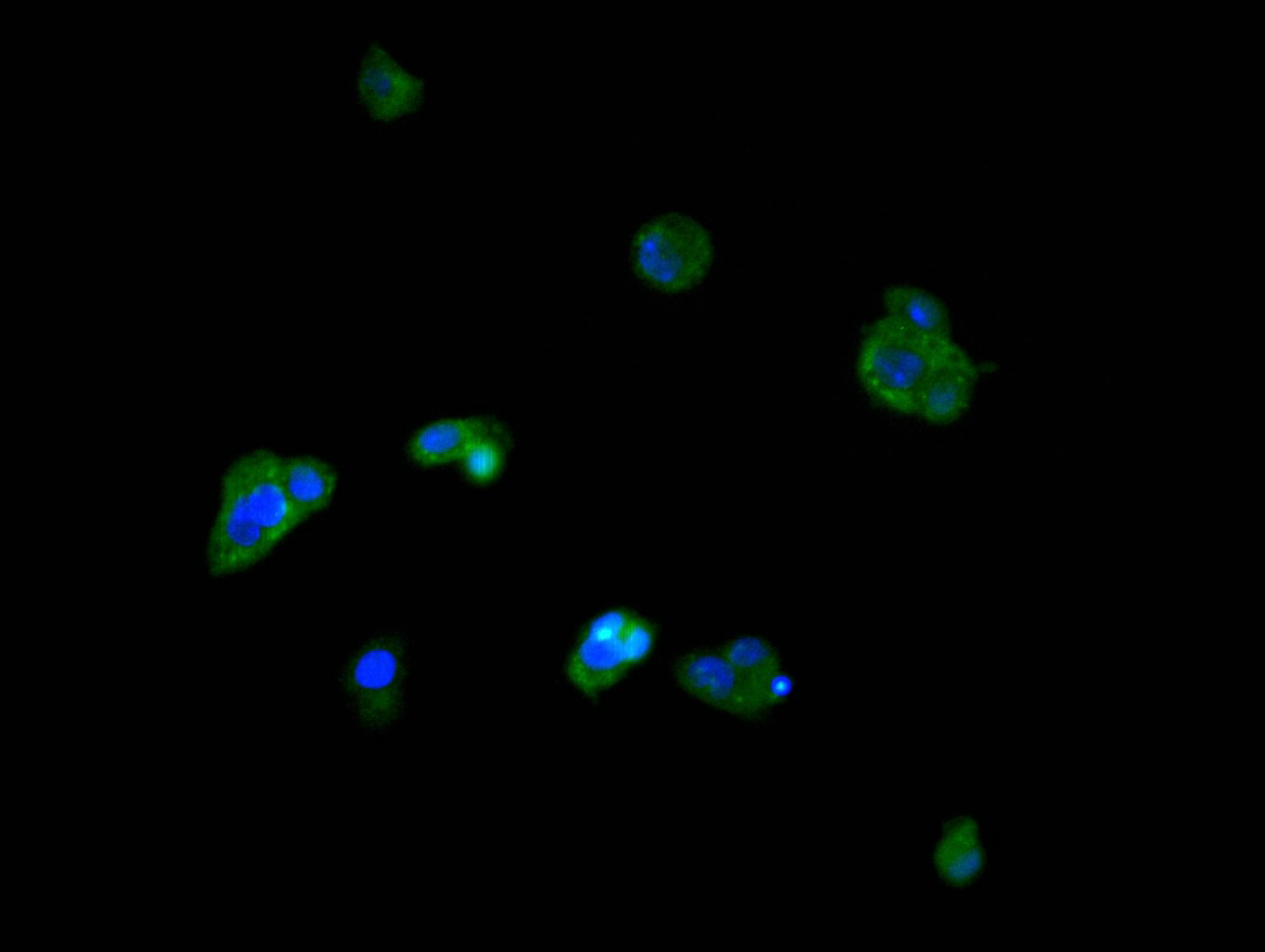
  • Immunofluorescence staining of hela cell with CSB-RA075327A0HU at 1:50 ,counter-stained with DAPI. The cells were fixed in 4% formaldehyde, permeabilized using 0.2% Triton X-100 and blocked in 10% normal Goat Serum. The cells were then incubated with the antibody overnight at 4°C. The secondary antibody was Alexa Fluor 488-congugated AffiniPure Goat Anti-Rabbit IgG(H+L).
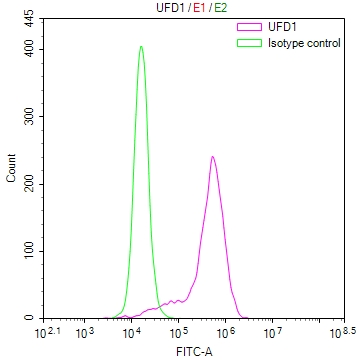
  • Overlay Peak curve showing HEK-293 cells stained with CSB-RA075327A0HU (red line) at 1:100. The cells were fixed in 4% formaldehyde and permeated by 0.2% TritonX-100 for 10min. Then 10% normal goat serum to block non-specific protein-protein interactions followed by the antibody (1ug/1*106cells) for 45min at 4℃. The secondary antibody used was FITC-conjugated goat anti-rabbit IgG (H+L) at 1/200 dilution for 35min at 4℃.Control antibody (green line) was Rabbit IgG (1ug/1*106cells) used under the same conditions. Acquisition of >10,000 events was performed.
Have Questions? Leave a Message or Start an on-line Chat

Product Details

Uniprot No.
Target Names
Alternative Names
Ubiquitin recognition factor in ER-associated degradation protein 1 (Ubiquitin fusion degradation protein 1) (UB fusion protein 1), UFD1, UFD1L
Species Reactivity
Human
Immunogen
A synthesized peptide derived from Human UFD1 protein
Immunogen Species
Homo sapiens (Human)
Conjugate
Non-conjugated
Clonality
Monoclonal
Isotype
Rabbit IgG
Clone No.
17A3
Purification Method
Affinity-chromatography
Concentration
It differs from different batches. Please contact us to confirm it.
Buffer
Rabbit IgG in 10mM phosphate buffered saline , pH 7.4, 150mM sodium chloride, 0.05% BSA, 0.02% sodium azide and 50% glycerol.
Form
Liquid
Tested Applications
ELISA, IF, FC
Recommended Dilution
Application Recommended Dilution
IF 1:20-1:200
FC 1:20-1:200
Troubleshooting and FAQs
Storage
Upon receipt, store at -20°C or -80°C. Avoid repeated freeze.
Lead Time
Basically, we can dispatch the products out in 1-3 working days after receiving your orders. Delivery time maybe differs from different purchasing way or location, please kindly consult your local distributors for specific delivery time.
Usage
For Research Use Only. Not for use in diagnostic or therapeutic procedures.
Customer Reviews and Q&A

 Customer Reviews

There are currently no reviews for this product.

Submit a Review here

Target Background

Function
Essential component of the ubiquitin-dependent proteolytic pathway which degrades ubiquitin fusion proteins. The ternary complex containing UFD1, VCP and NPLOC4 binds ubiquitinated proteins and is necessary for the export of misfolded proteins from the ER to the cytoplasm, where they are degraded by the proteasome. The NPLOC4-UFD1-VCP complex regulates spindle disassembly at the end of mitosis and is necessary for the formation of a closed nuclear envelope. It may be involved in the development of some ectoderm-derived structures. Acts as a negative regulator of type I interferon production via the complex formed with VCP and NPLOC4, which binds to DDX58/RIG-I and recruits RNF125 to promote ubiquitination and degradation of DDX58/RIG-I.
Gene References into Functions
  1. We demonstrate that WT p97 can unfold proteins and that this activity is dependent on the p97 adaptor NPLOC4-UFD1L, ATP hydrolysis, and substrate ubiquitination, with branched chains providing maximal stimulation. PMID: 28512218
  2. The study revealed a regulatory role of the p97-Npl4-Ufd1 complex in regulating a partial degradation of the NF-kappaB subunit p100. PMID: 26112410
  3. p97-Ufd1-Npl4 is an integral part of G2/M checkpoint signaling and thereby suppresses chromosome instability. PMID: 24429874
  4. Data indicate that the p97-UFD1L-NPL4 protein complex specifically associates with ubiquitinated IkappaBalpha via the interactions between p97 and the SCF(beta-TRCP) ubiquitin ligase. PMID: 24248593
  5. This study demonistrated that UFD1L may participate in the core cognitive deficits observed in schizophrenia. PMID: 23623450
  6. In coordination with the P97-UFD1-NPL4 complex (P97(UFD1/NPL4)), NUB1L promotes transfer of NEDD8 to proteasome for degradation. PMID: 24019527
  7. increased corpus callosum volume in children with 22q11DS is associated with UFD1L polymorphism. PMID: 22763378
  8. Data indicate that Npl4-Ufd1 heterodimer is required for VCP-FAF1 interaction. PMID: 23293021
  9. Data establish Cdc48/p97-Ufd1-Npl4 as a crucial negative regulator of Aurora B early in mitosis of human somatic cells and suggest that the activity of Aurora B on chromosomes needs to be restrained to ensure faithful chromosome segregation. PMID: 21486945
  10. Ubiquitin-recognition protein Ufd1 couples the endoplasmic reticulum (ER) stress response to cell cycle control PMID: 21571647
  11. This study suggested that AA genotype of UFD1L gene, which is involved in neurodevelopmental processes, may contribute to early-onset schizophrenia. Therefore, rs5992403 polymorphism may not be a risk factor for schizophrenia. PMID: 20471029
  12. Data suggest that the human cytomegalovirus dislocation reaction in US2 cells is independent of the p97 cofactor Ufd1-Npl4, and different retrotranslocation mechanisms can employ distinct p97 ATPase complexes to dislocate substrates. PMID: 20702414
  13. a functional analysis of its 5' regulatory region PMID: 11979512
  14. Ufd1l is localized around the nucleus and it does not interfere with Fas-and ceramide-mediated apoptosis. PMID: 12910480
  15. Ufd1-nuclear protein localization 4 is a negative regulator of retrotranslocation, delaying the retrotranslocation of endoplasmic reticulum-associated degradation substrates independently of its association with VCP PMID: 17331469
  16. This study identifies Ufd1 as a cofactor of gp78, reveals an unappreciated function of Ufd1 in the ubiquitination reaction during endoplasmic reticulum -associated degradation, and illustrates that Ufd1 plays a critical role in cholesterol metabolism. PMID: 17681147
  17. allelic associations of the UFD1L locus identified; 4-SNP haplotype analysis showed strong association with schizophrenia; possibility that a disease-resistant variant may be carried by two or more haplotypes due to frequent recombination during meiosis. PMID: 18270977
  18. This favors the model where the Ufd1-Npl4 dimer forms a regulatory gate at the exit from the retrotranslocone, rather than actively promoting retrotranslocation like the p97VCP ATPase. PMID: 18586029

Show More

Hide All

Subcellular Location
Nucleus. Cytoplasm, cytosol.
Protein Families
UFD1 family
Tissue Specificity
Found in adult heart, skeletal muscle and pancreas, and in fetal liver and kidney.
Database Links

HGNC: 12520

OMIM: 601754

KEGG: hsa:7353

STRING: 9606.ENSP00000263202

UniGene: Hs.474213

icon of phone
Call us
301-363-4651 (Available 9 a.m. to 5 p.m. CST from Monday to Friday)
icon of address
Address
7505 Fannin St., Ste 610, Room 7 (CUBIO Innovation Center), Houston, TX 77054, USA
icon of social media
Join us with

Subscribe newsletter

Leave a message

* To protect against spam, please pass the CAPTCHA test below.
CAPTCHA verification
© 2007-2026 CUSABIO TECHNOLOGY LLC All rights reserved. 鄂ICP备15011166号-1
Place an order now

I. Product details

*
*
*
*

II. Contact details

*
*

III. Ship To

*
*
*
*
*
*
*

IV. Bill To

*
*
*
*
*
*
*
*



