
Call us
301-363-4651 (Available 9 a.m. to 5 p.m. CST from Monday to Friday)

| Code | CSB-RA934095A0HU |
| Size | US$210 |
| Order now | |
| Image |
|
| Have Questions? | Leave a Message or Start an on-line Chat |
| Application | Recommended Dilution |
|---|---|
| WB | 1:500-1:5000 |
| FC | 1:50-1:200 |
USP11 is a deubiquitinating enzyme that plays critical roles in DNA damage repair, cell cycle regulation, and chromatin remodeling. By removing ubiquitin modifications from substrate proteins, USP11 influences the stability and function of key signaling molecules involved in genomic integrity and transcriptional control. This makes USP11 an important target for researchers investigating epigenetic mechanisms, nuclear signaling pathways, and the cellular response to genotoxic stress.
This recombinant monoclonal antibody, generated from clone 4C5, offers the reproducibility and consistency that demanding experimental workflows require. Because the antibody sequence is defined and production occurs in a controlled recombinant system, researchers can expect reliable performance across experiments and between lots, eliminating the variability often encountered with traditional hybridoma-derived antibodies. The rabbit IgG format provides excellent sensitivity while the affinity-chromatography purification ensures high specificity for your target.
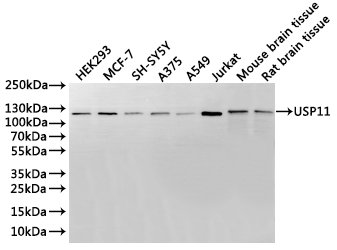
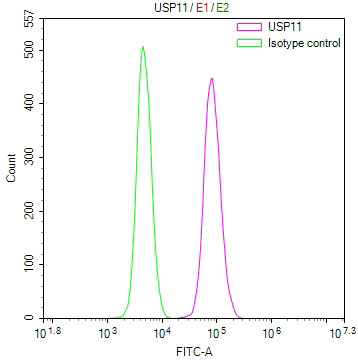
Validation studies demonstrate robust performance across multiple applications. In western blot experiments, this antibody detects a clear band at the predicted molecular weight of 110 kDa across a diverse panel of human cell lines including HEK293, MCF-7, SH-SY5Y, A375, A549, and Jurkat cells at dilutions ranging from 1:500 to 1:5000. Cross-species reactivity has been confirmed through successful detection in mouse and rat brain tissue lysates, expanding the utility of this reagent for comparative studies and animal model research. Flow cytometry validation in SH-SY5Y cells demonstrates clear positive staining with appropriate signal separation from isotype controls, supporting intracellular detection applications.
Whether you are exploring USP11's role in DNA repair pathways, investigating its contributions to epigenetic regulation, or characterizing its expression across different experimental models, this antibody provides a dependable tool for your research.
There are currently no reviews for this product.





