
Call us
301-363-4651 (Available 9 a.m. to 5 p.m. CST from Monday to Friday)

| Code | CSB-RA286515A0HU |
| Size | US$210 |
| Order now | |
| Image |
|
| Have Questions? | Leave a Message or Start an on-line Chat |
| Application | Recommended Dilution |
|---|---|
| FC | 1:50-1:200 |
YES1 is a non-receptor tyrosine kinase belonging to the Src family, playing essential roles in signal transduction pathways that regulate cell proliferation, differentiation, and survival. As a proto-oncogene, YES1 has garnered significant research attention for its involvement in various malignancies, where its aberrant activation contributes to tumor progression and metastasis. Understanding YES1 signaling dynamics is crucial for researchers investigating cancer biology, cellular adhesion mechanisms, and therapeutic targeting strategies.
This recombinant monoclonal antibody, clone 2G10, offers the reproducibility and consistency that demanding experimental workflows require. Developed using recombinant technology with a sequence-defined approach, this antibody eliminates the lot-to-lot variability that can compromise longitudinal studies and multi-site collaborations. The rabbit host origin provides excellent affinity characteristics, while the monoclonal nature ensures recognition of a single epitope on the YES1 protein, generated against a synthesized peptide from the human sequence.
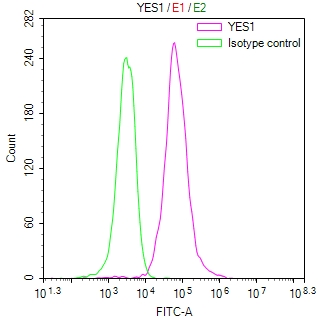
Validation studies demonstrate reliable performance in flow cytometry applications, with successful detection of YES1 in MCF-7 human breast cancer cells. Using intracellular staining protocols with formaldehyde fixation and Triton X-100 permeabilization, the antibody produced clear positive signal separation from isotype control at a 1:100 dilution, confirming specificity for endogenous YES1 expression. The antibody is also validated for ELISA applications, offering flexibility across different experimental platforms.
Supplied in a stabilized liquid format with glycerol for convenient storage at -20°C or -80°C, this antibody is well-suited for researchers investigating Src family kinase signaling, oncogenic transformation mechanisms, or screening potential therapeutic interventions targeting YES1-dependent pathways in human cancer models.
There are currently no reviews for this product.





