


Call us
301-363-4651 (Available 9 a.m. to 5 p.m. CST from Monday to Friday)

| Code | CSB-RA063930A0HU |
| Size | US$210 |
| Order now | |
| Image |
|
| Have Questions? | Leave a Message or Start an on-line Chat |
| Application | Recommended Dilution |
|---|---|
| WB | 1:500-1:2000 |
| IHC | 1:50-1:200 |
| IF | 1:50-1:200 |
| FC | 1:50-1:200 |
ZBTB7A, also known as LRF (leukemia/lymphoma-related factor) or Pokemon, is a transcriptional repressor belonging to the POK family of zinc finger proteins. This protein plays critical roles in cellular differentiation, lineage commitment, and oncogenesis, functioning as a master regulator in hematopoietic development and serving as a proto-oncogene in various malignancies. Its involvement in repressing tumor suppressor genes and regulating metabolic pathways makes ZBTB7A a significant target for cancer biology and developmental research.
This recombinant monoclonal antibody, generated in rabbit against a synthetic peptide derived from human ZBTB7A, offers the consistency and reproducibility that demanding experimental workflows require. As a sequence-defined reagent produced through recombinant technology, it eliminates the lot-to-lot variability often encountered with traditional hybridoma-derived antibodies, ensuring your results remain comparable across extended studies.
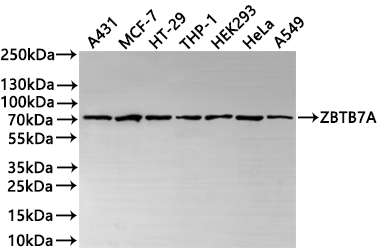
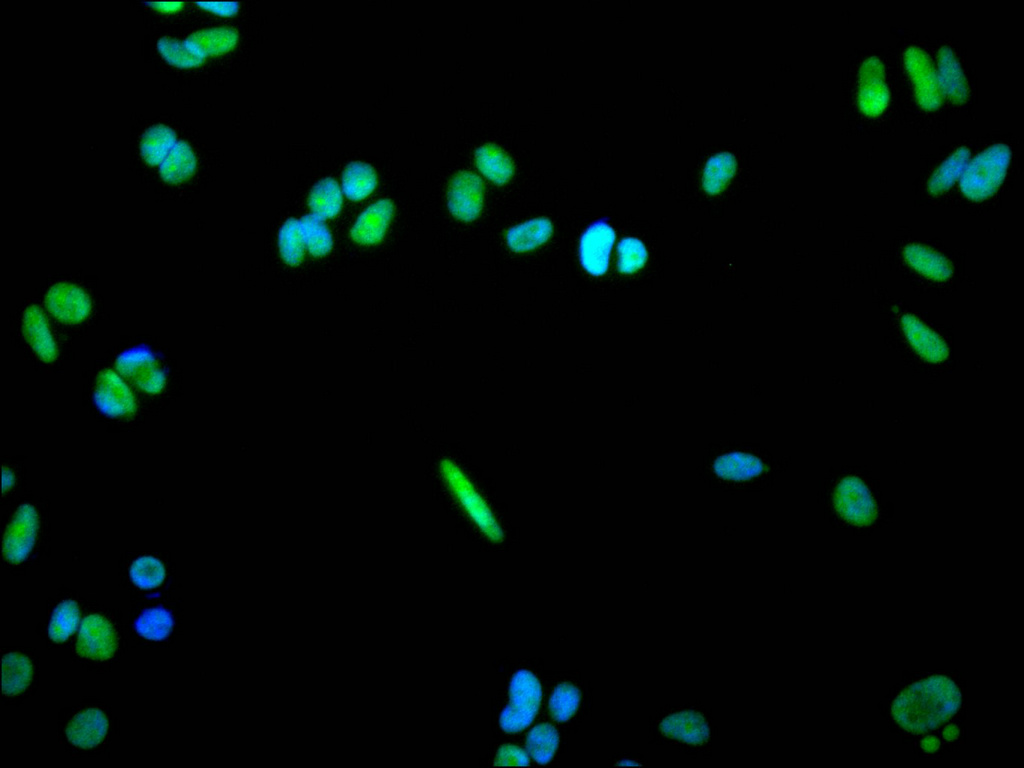
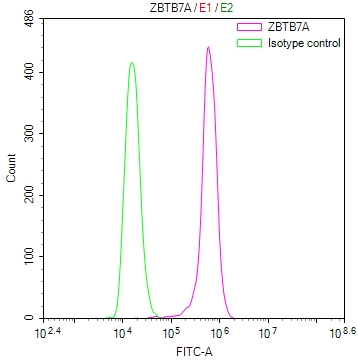
Validation across multiple platforms demonstrates this antibody's versatility for diverse experimental approaches. Western blot analysis confirms specific detection in numerous human cell lines including A431, MCF-7, HT-29, THP-1, HEK293, HeLa, and A549, with an observed band at approximately 70 kDa. This migration slightly above the predicted 61 kDa molecular weight likely reflects post-translational modifications such as phosphorylation or glycosylation common to transcription factors. Immunohistochemistry validation in human colorectal cancer and small intestine tissues demonstrates clear nuclear staining patterns consistent with ZBTB7A's function as a transcription factor. Additional validation includes immunofluorescence microscopy in MCF-7 cells and flow cytometry analysis in BxPC-3 cells, providing flexibility for both imaging and quantitative applications.
This antibody serves researchers investigating transcriptional regulation, hematopoiesis, metabolic reprogramming, and cancer biology where ZBTB7A function is implicated.
There are currently no reviews for this product.





