crr Antibody

Rare Species
Code CSB-PA302513XA01ENV
Size US$299
Image
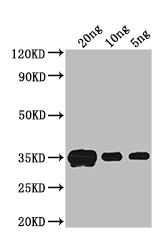
  • Western Blot
    Positive WB detected in: recombinant protein
    All lanes: crr Antibody at 1:1000
    Secondary
    Goat polyclonal to rabbit IgG at 1/50000 dilution
    Predicted band size: 33 kDa
    Observed band size: 33 kDa
Promotion Free Antibody trial simple
Have Questions? Leave a Message or Start an on-line Chat

Product Details

Uniprot No.
Target Names
crr
Alternative Names
PTS system glucose-specific EIIA component (EIIA-Glc) (EIII-Glc) (Glucose-specific phosphotransferase enzyme IIA component) (EC 2.7.1.199) crr gsr iex tgs treD b2417 JW2410
Species Reactivity
Escherichia coli (strain K12)
Immunogen
Recombinant Escherichia coli (strain K12) crr protein (12-67aa)
Immunogen Species
Escherichia coli (strain K12)
Conjugate
Non-conjugated
Clonality
Polyclonal
Isotype
IgG
Purification Method
Affinity-chromatography
Concentration
It differs from different batches. Please contact us to confirm it.
Buffer
Preservative: 0.03% Proclin 300
Constituents: 50% Glycerol, 0.01M PBS, pH 7.4
Form
Liquid
Tested Applications
ELISA, WB
Troubleshooting and FAQs
Storage
Upon receipt, store at -20°C or -80°C. Avoid repeated freeze.
Lead Time
Basically, we can dispatch the products out in 1-3 working days after receiving your orders. Delivery time maybe differs from different purchasing way or location, please kindly consult your local distributors for specific delivery time.
Description

The generation of polyclonal antibodies against crr entails repeated immunizations of a rabbit with recombinant Escherichia coli (strain K12) crr protein (12-67aa). After achieving a sufficient antibody titer, the rabbit is bled, and antibodies are purified from the serum through affinity chromatography. The resulting crr antibody is then tested for functionality in ELISA and WB applications, showing reactivity with Escherichia coli (strain K12) crr protein.

The Escherichia coli (strain K12) crr protein is a crucial component of the phosphoenolpyruvate (PEP): carbohydrate phosphotransferase system (PTS), a major regulatory mechanism governing carbohydrate transport and utilization. Crr functions as a phospho-carrier protein, facilitating the transfer of phosphoryl groups from PEP to incoming sugar substrates, a pivotal step in sugar uptake by the bacterial cell. Beyond its role in sugar phosphotransferase activity, crr is instrumental in the regulation of carbohydrate uptake, responding dynamically to changes in the availability of sugars in the environment.

Usage
For Research Use Only. Not for use in diagnostic or therapeutic procedures.

Customer Reviews and Q&A

 Customer Reviews

There are currently no reviews for this product.

Submit a Review here

Target Background

Function
The phosphoenolpyruvate-dependent sugar phosphotransferase system (sugar PTS), a major carbohydrate active transport system, catalyzes the phosphorylation of incoming sugar substrates concomitantly with their translocation across the cell membrane. The enzyme II complex composed of PtsG and Crr is involved in glucose transport. The non-phosphorylated EIII-Glc is an inhibitor for uptake of certain sugars such as maltose, melibiose, lactose, and glycerol. Phosphorylated EIII-Glc, however, may be an activator for adenylate cyclase. It is an important regulatory protein for cell metabolism.
Gene References into Functions
  1. Results suggest that the phosphoenolpyruvate hexose phosphotransferases PTS network serves as a global sensor of the sugar influx and also monitors the levels of several non-PTS compounds. PMID: 27557415
  2. results of a detailed investigation of the role of EIIAGlc in CsrB/C decay; unphosphorylated EIIAGlc binds specifically to the EAL domain of CsrD and stimulates CsrB/C turnover PMID: 26507976
  3. The data suggest a model of how the central regulatory protein EIIA(Glc) allosterically inhibits maltose uptake in E. coli. PMID: 23770568
Subcellular Location
Cytoplasm.
Database Links
icon of phone
Call us
301-363-4651 (Available 9 a.m. to 5 p.m. CST from Monday to Friday)

icon of address
Address
7505 Fannin St., Ste 610, Room 7 (CUBIO Innovation Center), Houston, TX 77054, USA
icon of social media
Join us with

Subscribe newsletter

Leave a message

* To protect against spam, please pass the CAPTCHA test below.
CAPTCHA verification
© 2007-2026 CUSABIO TECHNOLOGY LLC All rights reserved. 鄂ICP备15011166号-1



