
Call us
301-363-4651 (Available 9 a.m. to 5 p.m. CST from Monday to Friday)

| Code | CSB-E14285h-IS |
| Size | 96T,5×96T,10×96T |
| Price | Request a Quote |
| Trial Size |
24T ELISA Kit Trial Size (Only USD$150/ kit) * Sample kit cost can be deducted as a $30 credit for each 96-assay kit of the same analyte and brand you subsequently purchase within six months until depleted. More details >> Interested in a trial size? Please leave a message below.
|
| Have Questions? | Leave a Message or Start an on-line Chat |
Intra-assay Precision (Precision within an assay): CV%<8% | ||||||
Three samples of known concentration were tested twenty times on one plate to assess. | ||||||
Inter-assay Precision (Precision between assays): CV%<10% | ||||||
Three samples of known concentration were tested in twenty assays to assess. | ||||||
To assess the linearity of the assay, samples were spiked with high concentrations of human sCD276/sB7-H3 in various matrices and diluted with the Sample Diluent to produce samples with values within the dynamic range of the assay. | ||||||
| Sample | Serum(n=4) | ||||
1:20 | Average % | 104 | ||||
Range % | 98-110 | |||||
1:40 | Average % | 90 | ||||
Range % | 84-95 | |||||
1:80 | Average % | 96 | ||||
Range % | 90-103 | |||||
1:160 | Average % | 110 | ||||
Range % | 105-117 | |||||
The recovery of human sCD276/sB7-H3 spiked to levels throughout the range of the assay in various matrices was evaluated. Samples were diluted prior to assay as directed in the Sample Preparation section. | ||||||
Sample Type | Average % Recovery | Range | ||||
Serum (n=5) | 105 | 97-111 | ||||
EDTA plasma (n=4) | 94 | 88-101 | ||||
These standard curves are provided for demonstration only. A standard curve should be generated for each set of samples assayed. | ||||||
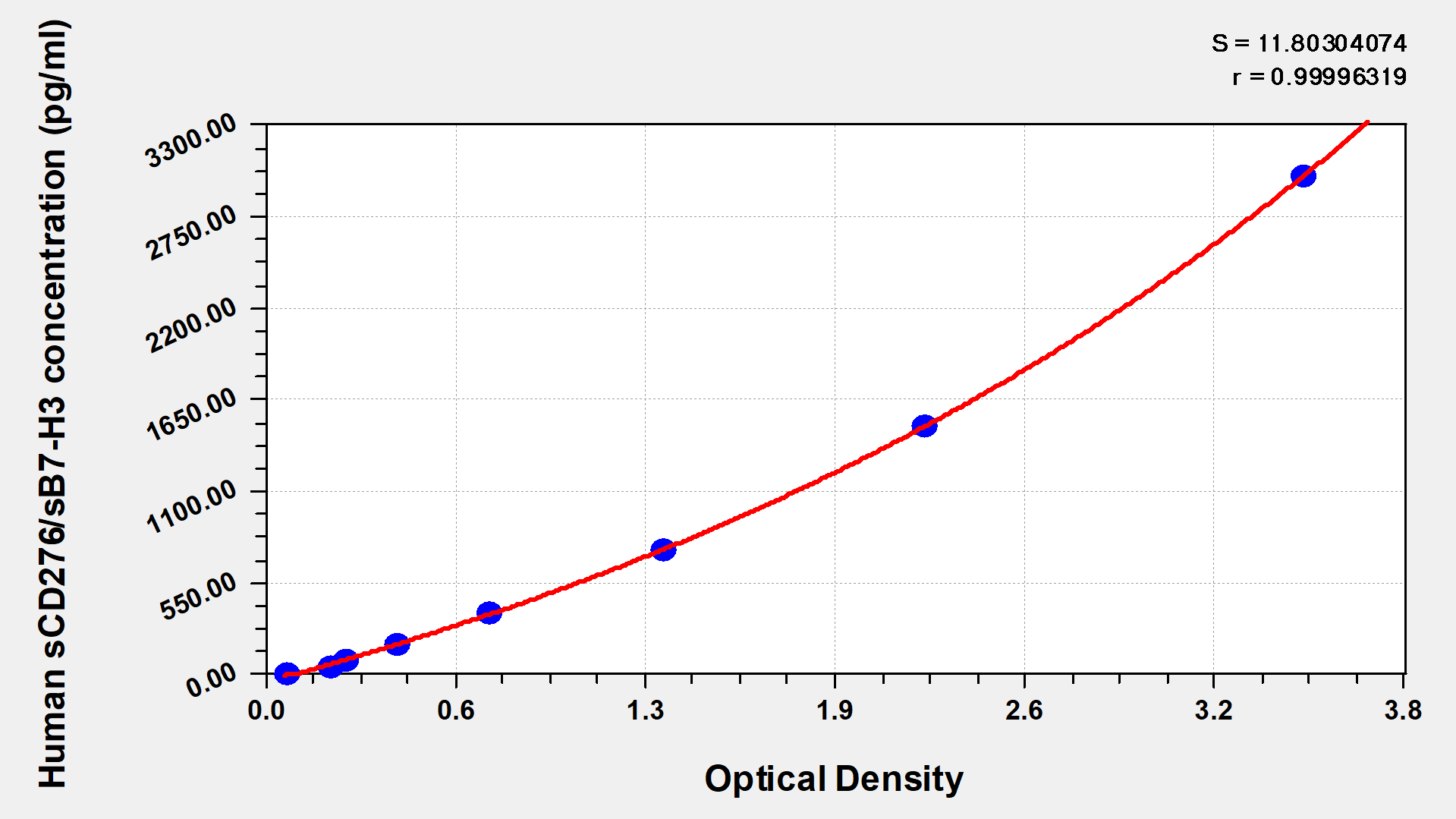 |
pg/ml | OD1 | OD2 | Average | Corrected | ||
3000 | 3.512 | 3.498 | 3.505 | 3.422 | ||
1500 | 2.286 | 2.180 | 2.233 | 2.149 | ||
750 | 1.336 | 1.366 | 1.351 | 1.268 | ||
375 | 0.771 | 0.753 | 0.762 | 0.678 | ||
187.5 | 0.456 | 0.448 | 0.452 | 0.368 | ||
94 | 0.273 | 0.280 | 0.276 | 0.193 | ||
47 | 0.224 | 0.230 | 0.227 | 0.143 | ||
0 | 0.083 | 0.084 | 0.084 |
| ||
There are currently no reviews for this product.
Earlier studies found that B7H3 (also known as B7H3) promotes the activation of T cells. Chapoval et al. confirmed that in the presence of anti-CD3 antibodies, B7H3 can promote the proliferation of CD4 and CD8+ T cells and selectively promote the secretion of IFN-γ. And B7H3 transfection into tumor cells can enhance the killing ability of CTL. Further research found that only TLT-2 transgenic cells could bind to mouse B7H3 with high affinity, and TLT-2 was determined to be the receptor molecule of B7H3. Moreover, Hashiguchi et al. confirmed that the B7H3-TLT-2 pathway enhanced T cell activation. However, Leitner et al. did not find the specific binding of B7H3 to TLT-2 by flow cytometry, therefore, the exact receptor molecule of B7H3 is still unclear.
On the other hand, studies have found that B7H3 can also suppress T-cell immune responses. Some studies have shown that B7H3 can inhibit human and mouse T cells by activating or inhibiting NFTA (nuclear factor for activated T cells), NF-KB (nuclear factor kB) and AP-1 (activator protein-1) pathways. activation. In addition, results have demonstrated that B7H3 may inhibit T cell immune responses by inhibiting the activity of Thl. The study of Leiner et al. also found that B7H3 can down-regulate the secretion of IL-2 in T cells to inhibit the activity of T cells.





