
Call us
301-363-4651 (Available 9 a.m. to 5 p.m. CST from Monday to Friday)

| Code | CSB-RA733578MA1HU |
| Size | $49.9 |
| Order now | |
| Promotion |

|
| Image |
|
| Have Questions? | Leave a Message or Start an on-line Chat |
| Application | Recommended Dilution |
|---|---|
| FC | 1:50-1:200 |
CD276, also known as B7-H3, is an immune checkpoint molecule that has emerged as a compelling target in cancer immunology and immunotherapy research. As a member of the B7 family of co-stimulatory proteins, CD276 plays complex roles in modulating T cell responses and is frequently overexpressed across multiple tumor types while showing limited expression in normal tissues. This expression pattern makes it an attractive candidate for both diagnostic studies and therapeutic targeting strategies.
This recombinant monoclonal antibody, clone 5F9, offers researchers the consistency and reliability that comes with sequence-defined production. Unlike traditional hybridoma-derived antibodies, recombinant technology ensures lot-to-lot reproducibility, allowing you to maintain experimental continuity across long-term studies without concerns about antibody drift or batch variation.
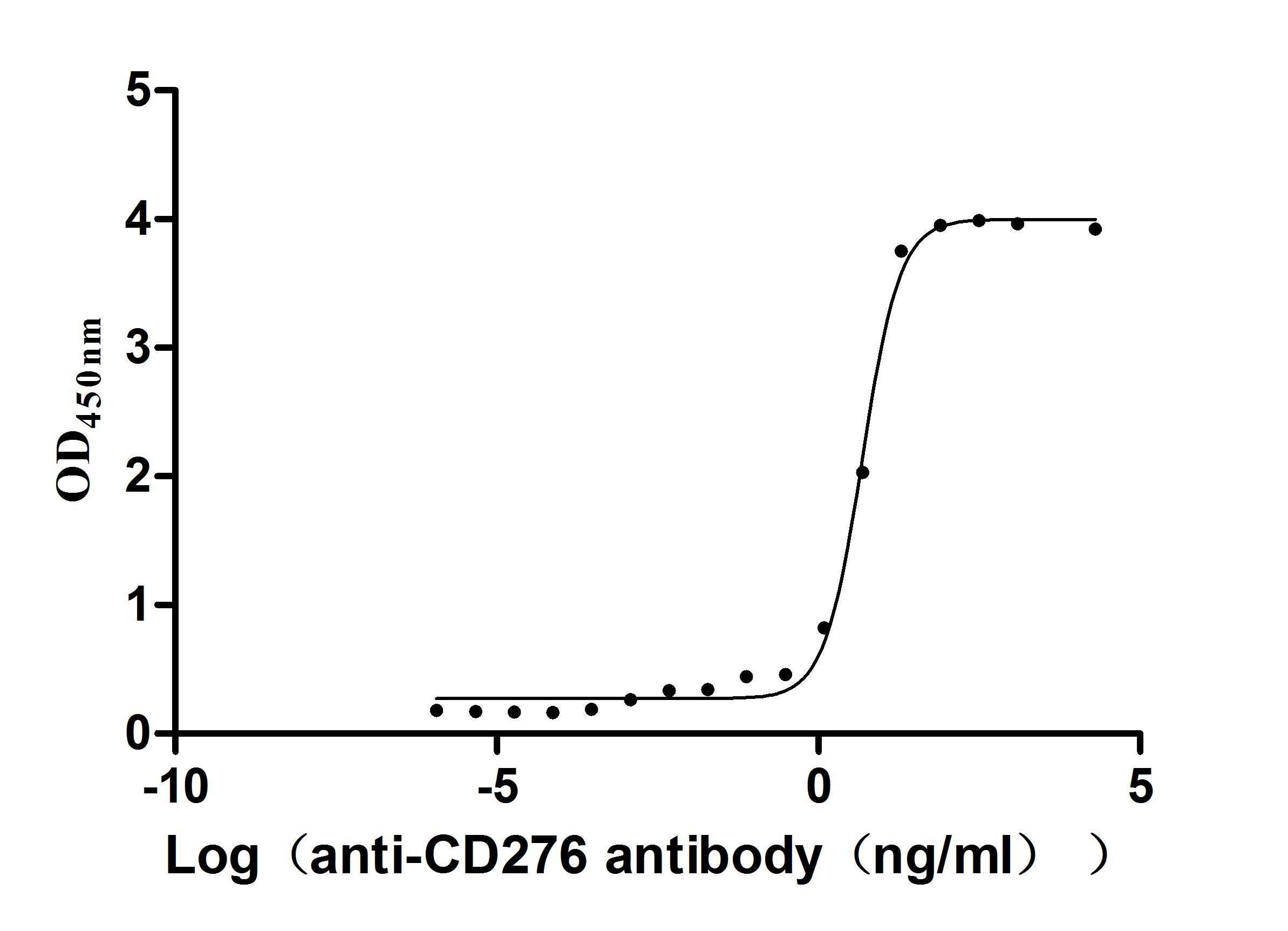
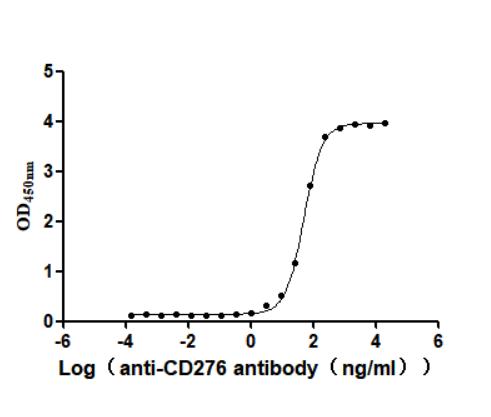
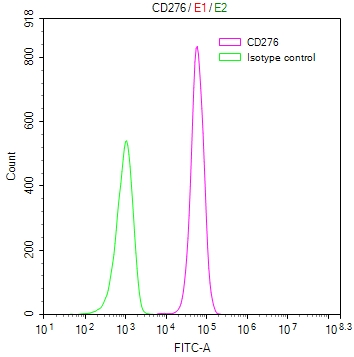
Validation data demonstrates robust binding activity in functional ELISA assays, with EC50 values in the low nanogram per milliliter range when tested against immobilized human CD276 protein. Flow cytometry analysis using MCF7 cells confirms the antibody's ability to detect endogenous CD276 expression on human breast cancer cells, showing clear positive signal separation from isotype control. The antibody exhibits cross-species reactivity with both human and cynomolgus samples, supporting translational research workflows that bridge preclinical primate studies with human applications.
Supplied as a purified human IgG1 format in a glycerol-based buffer system, this antibody is well-suited for researchers investigating immune checkpoint biology, tumor microenvironment characterization, and cancer immunotherapy mechanisms. Its validated performance in ELISA applications at dilutions ranging from 1:5000 to 1:50000 provides flexibility for assay optimization across diverse experimental conditions.
There are currently no reviews for this product.
Earlier studies found that B7H3 (also known as B7H3) promotes the activation of T cells. Chapoval et al. confirmed that in the presence of anti-CD3 antibodies, B7H3 can promote the proliferation of CD4 and CD8+ T cells and selectively promote the secretion of IFN-γ. And B7H3 transfection into tumor cells can enhance the killing ability of CTL. Further research found that only TLT-2 transgenic cells could bind to mouse B7H3 with high affinity, and TLT-2 was determined to be the receptor molecule of B7H3. Moreover, Hashiguchi et al. confirmed that the B7H3-TLT-2 pathway enhanced T cell activation. However, Leitner et al. did not find the specific binding of B7H3 to TLT-2 by flow cytometry, therefore, the exact receptor molecule of B7H3 is still unclear.
On the other hand, studies have found that B7H3 can also suppress T-cell immune responses. Some studies have shown that B7H3 can inhibit human and mouse T cells by activating or inhibiting NFTA (nuclear factor for activated T cells), NF-KB (nuclear factor kB) and AP-1 (activator protein-1) pathways. activation. In addition, results have demonstrated that B7H3 may inhibit T cell immune responses by inhibiting the activity of Thl. The study of Leiner et al. also found that B7H3 can down-regulate the secretion of IL-2 in T cells to inhibit the activity of T cells.





