Recombinant Human T cell receptor beta constant 1 (TRBC1), partial (Active)

In Stock
Code CSB-YP024291HU2
Abbreviation Recombinant Human TRBC1 protein, partial (Active)
MSDS
Size $250
Order now
Image
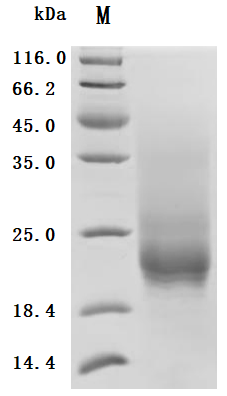
  • (Tris-Glycine gel) Discontinuous SDS-PAGE (reduced) with 5% enrichment gel and 15% separation gel.
  • Activity
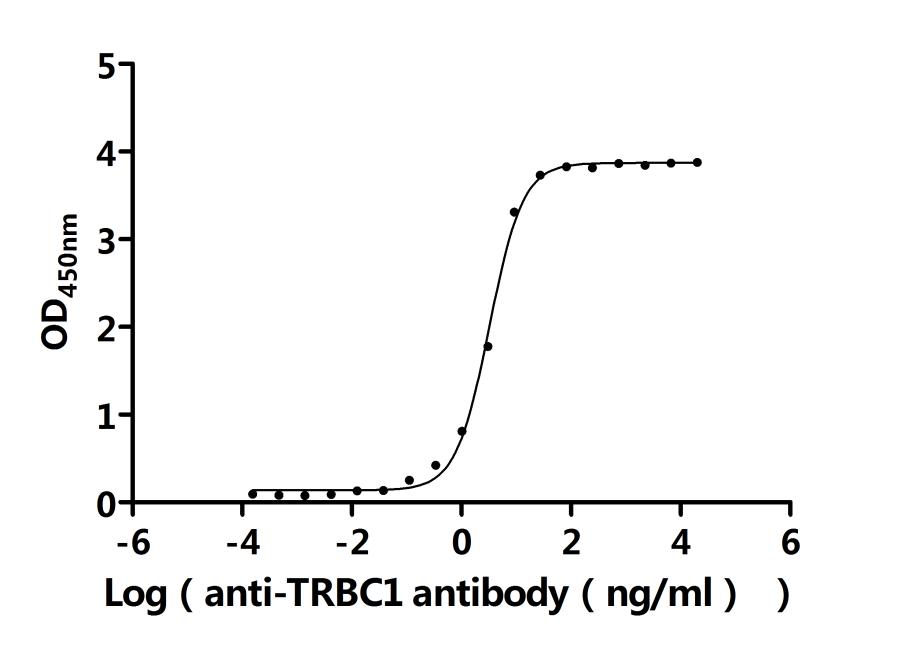
    Measured by its binding ability in a functional ELISA. Immobilized Human TRBC1 at 2 μg/ml can bind Anti-TRBC1 recombinant antibody (CSB-RA024291MA1HU). The EC50 is 2.977-3.524 ng/mL. Biological Activity Assay
  • Activity
    TRBC1 Recombinant Monoclonal Antibody (CSB-RA024291MA1HU) captured on Protein A Chip can bind Recombinant Human TRBC1 with an affinity constant of 3.48 nM as detected by MetaSPR Assay (WeSPRTM 200). Biological Activity Assay
Have Questions? Leave a Message or Start an on-line Chat

Product Details

Purity
Greater than 95% as determined by SDS-PAGE.
Endotoxin
Less than 1.0 EU/ug as determined by LAL method.
Activity
①Measured by its binding ability in a functional ELISA. Immobilized Human TRBC1 at 2 μg/mL can bind Anti-TRBC1 recombinant antibody (CSB-RA024291MA1HU). The EC50 is 2.977-3.524 ng/mL.
②TRBC1 Recombinant Monoclonal Antibody (CSB-RA024291MA1HU) captured on Protein A Chip can bind Recombinant Human TRBC1 with an affinity constant of 3.48 nM as detected by MetaSPR Assay (WeSPRTM 200).
Target Names
Uniprot No.
Alternative Names
T cell receptor beta constant 1
Species
Homo sapiens (Human)
Source
Yeast
Expression Region
1-144aa
Target Protein Sequence
DLNKVFPPEVAVFEPSEAEISHTQKATLVCLATGFFPDHVELSWWVNGKEVHSGVSTDPQPLKEQPALNDSRYCLSSRLRVSATFWQNPRNHFRCQVQFYGLSENDEWTQDRAKPVTQIVSAEAWGRADCGFTSVSYQQGVLSA
Mol. Weight
18.3 kDa
Protein Length
Partial
Tag Info
C-terminal 10xHis-tagged
Form
Lyophilized powder
Note: We will preferentially ship the format that we have in stock, however, if you have any special requirement for the format, please remark your requirement when placing the order, we will prepare according to your demand.
Buffer
Lyophilized from a 0.2 μm sterile filtered PBS, 6% Trehalose, pH 7.4
Reconstitution
We recommend that this vial be briefly centrifuged prior to opening to bring the contents to the bottom. Please reconstitute protein in deionized sterile water to a concentration of 0.1-1.0 mg/mL.We recommend to add 5-50% of glycerol (final concentration) and aliquot for long-term storage at -20°C/-80°C. Our default final concentration of glycerol is 50%. Customers could use it as reference.
Troubleshooting and FAQs
Storage Condition
Store at -20°C/-80°C upon receipt, aliquoting is necessary for mutiple use. Avoid repeated freeze-thaw cycles.
Shelf Life
The shelf life is related to many factors, storage state, buffer ingredients, storage temperature and the stability of the protein itself.
Generally, the shelf life of liquid form is 6 months at -20°C/-80°C. The shelf life of lyophilized form is 12 months at -20°C/-80°C.
Lead Time
Basically, we can dispatch the products out in 3-7 working days after receiving your orders. Delivery time may differ from different purchasing way or location, please kindly consult your local distributors for specific delivery time.
Notes
Repeated freezing and thawing is not recommended. Store working aliquots at 4℃ for up to one week.
Datasheet & COA
Please contact us to get it.
Customer Reviews and Q&A

 Customer Reviews

There are currently no reviews for this product.

Submit a Review here

Target Background

Function
Constant region of T cell receptor (TR) beta chain. Alpha-beta T cell receptors are antigen specific receptors which are essential to the immune response and are present on the cell surface of T lymphocytes. Recognize peptide-major histocompatibility (MH) (pMH) complexes that are displayed by antigen presenting cells (APC), a prerequisite for efficient T cell adaptive immunity against pathogens. Binding of alpha-beta TR to pMH complex initiates TR-CD3 clustering on the cell surface and intracellular activation of LCK that phosphorylates the ITAM motifs of CD3G, CD3D, CD3E and CD247 enabling the recruitment of ZAP70. In turn, ZAP70 phosphorylates LAT, which recruits numerous signaling molecules to form the LAT signalosome. The LAT signalosome propagates signal branching to three major signaling pathways, the calcium, the mitogen-activated protein kinase (MAPK) kinase and the nuclear factor NF-kappa-B (NF-kB) pathways, leading to the mobilization of transcription factors that are critical for gene expression and essential for T cell growth and differentiation. The T cell repertoire is generated in the thymus, by V-(D)-J rearrangement. This repertoire is then shaped by intrathymic selection events to generate a peripheral T cell pool of self-MH restricted, non-autoaggressive T cells. Post-thymic interaction of alpha-beta TR with the pMH complexes shapes TR structural and functional avidity.
Subcellular Location
Cell membrane.
Database Links

HGNC: 12156

OMIM: 186930

UniGene: Hs.382212

icon of phone
Call us
301-363-4651 (Available 9 a.m. to 5 p.m. CST from Monday to Friday)
icon of address
Address
7505 Fannin St., Ste 610, Room 7 (CUBIO Innovation Center), Houston, TX 77054, USA
icon of social media
Join us with

Subscribe newsletter

Leave a message

* To protect against spam, please pass the CAPTCHA test below.
CAPTCHA verification
© 2007-2026 CUSABIO TECHNOLOGY LLC All rights reserved. 鄂ICP备15011166号-1
Place an order now

I. Product details

*
*
*
*

II. Contact details

*
*

III. Ship To

*
*
*
*
*
*
*

IV. Bill To

*
*
*
*
*
*
*
*