Recombinant Mouse Serotransferrin (Tf) (Active)

In Stock
Code CSB-MP856363MO
Abbreviation Recombinant Mouse Tf protein (Active)
MSDS
Size $102
Order now
Image
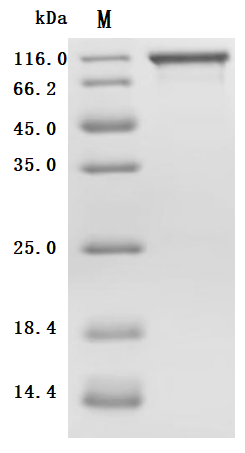
  • (Tris-Glycine gel) Discontinuous SDS-PAGE (reduced) with 5% enrichment gel and 15% separation gel.
  • Activity
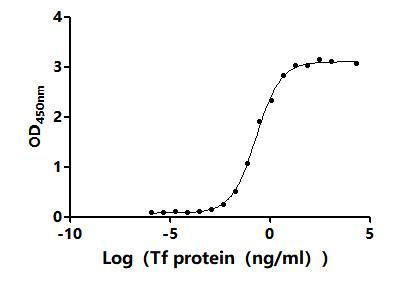
    Measured by its binding ability in a functional ELISA. Immobilized Rat Tfrc at 2 μg/ml can bind Mouse Tf (CSB-MP856363MO). The EC50 is 0.1424-0.3233 ng/mL. Biological Activity Assay
  • Activity
    Mouse Tf (CSB-MP856363MO) captured on Protein A Chip can bind Recombinant Rat Tfrc with an affinity constant of 0.362 nM as detected by MetaSPR Assay (WeSPRTM 200). Biological Activity Assay
Have Questions? Leave a Message or Start an on-line Chat

Product Details

Purity
Greater than 95% as determined by SDS-PAGE.
Endotoxin
Less than 1.0 EU/ug as determined by LAL method.
Activity
①Measured by its binding ability in a functional ELISA. Immobilized Rat Tfrc at 2 μg/mL can bind Mouse Tf (CSB-MP856363MO). The EC50 is 0.1424-0.3233 ng/mL.
②Mouse Tf (CSB-MP856363MO) captured on Protein A Chip can bind Recombinant Rat Tfrc with an affinity constant of 0.362 nM as detected by MetaSPR Assay (WeSPRTM 200).
Target Names
Uniprot No.
Alternative Names
Serotransferrin; Transferrin; Beta-1 metal-binding globulin; Siderophilin
Species
Mus musculus (Mouse)
Source
Mammalian cell
Expression Region
20-697aa
Target Protein Sequence
VPDKTVKWCAVSEHENTKCISFRDHMKTVLPPDGPRLACVKKTSYPDCIKAISASEADAMTLDGGWVYDAGLTPNNLKPVAAEFYGSVEHPQTYYYAVAVVKKGTDFQLNQLEGKKSCHTGLGRSAGWVIPIGLLFCKLSEPRSPLEKAVSSFFSGSCVPCADPVAFPKLCQLCPGCGCSSTQPFFGYVGAFKCLKDGGGDVAFVKHTTIFEVLPEKADRDQYELLCLDNTRKPVDQYEDCYLARIPSHAVVARKNNGKEDLIWEILKVAQEHFGKGKSKDFQLFSSPLGKDLLFKDSAFGLLRVPPRMDYRLYLGHNYVTAIRNQQEGVCPEGSIDNSPVKWCALSHLERTKCDEWSIISEGKIECESAETTEDCIEKIVNGEADAMTLDGGHAYIAGQCGLVPVMAEYYESSNCAIPSQQGIFPKGYYAVAVVKASDTSITWNNLKGKKSCHTGVDRTAGWNIPMGMLYNRINHCKFDEFFSQGCAPGYEKNSTLCDLCIGPLKCAPNNKEEYNGYTGAFRCLVEKGDVAFVKHQTVLDNTEGKNPAEWAKNLKQEDFELLCPDGTRKPVKDFASCHLAQAPNHVVVSRKEKAARVKAVLTSQETLFGGSDCTGNFCLFKSTTKDLLFRDDTKCFVKLPEGTTPEKYLGAEYMQSVGNMRKCSTSRLLEACTFHKH
Mol. Weight
104.2 kDa
Protein Length
Full Length of Mature Protein
Tag Info
C-terminal mFc-tagged
Form
Lyophilized powder
Note: We will preferentially ship the format that we have in stock, however, if you have any special requirement for the format, please remark your requirement when placing the order, we will prepare according to your demand.
Buffer
Lyophilized from a 0.2 μm sterile filtered PBS, 6% Trehalose, pH 7.4
Reconstitution
We recommend that this vial be briefly centrifuged prior to opening to bring the contents to the bottom. Please reconstitute protein in deionized sterile water to a concentration of 0.1-1.0 mg/mL.We recommend to add 5-50% of glycerol (final concentration) and aliquot for long-term storage at -20°C/-80°C. Our default final concentration of glycerol is 50%. Customers could use it as reference.
Troubleshooting and FAQs
Storage Condition
Store at -20°C/-80°C upon receipt, aliquoting is necessary for mutiple use. Avoid repeated freeze-thaw cycles.
Shelf Life
The shelf life is related to many factors, storage state, buffer ingredients, storage temperature and the stability of the protein itself.
Generally, the shelf life of liquid form is 6 months at -20°C/-80°C. The shelf life of lyophilized form is 12 months at -20°C/-80°C.
Lead Time
Basically, we can dispatch the products out in 3-7 working days after receiving your orders. Delivery time may differ from different purchasing way or location, please kindly consult your local distributors for specific delivery time.
Notes
Repeated freezing and thawing is not recommended. Store working aliquots at 4℃ for up to one week.
Datasheet & COA
Please contact us to get it.
Customer Reviews and Q&A

 Customer Reviews

There are currently no reviews for this product.

Submit a Review here

Target Background

Function
Transferrins are iron binding transport proteins which can bind two Fe(3+) ions in association with the binding of an anion, usually bicarbonate. It is responsible for the transport of iron from sites of absorption and heme degradation to those of storage and utilization. Serum transferrin may also have a further role in stimulating cell proliferation.
Gene References into Functions
  1. the value of transferrin receptors (TfRs)/cell reveals a 100-fold increase in the number of TfRs per bEnd3 cells compared to human umbilical vein cells. PMID: 27100851
  2. Identification of multiple transferrin species in the spleen and serum from mice with collagen-induced arthritis which may reflect changes in transferrin glycosylation associated with disease activity: The role of CD38. PMID: 26639305
  3. Transcytosis and brain uptake of transferrin-containing nanoparticles by tuning avidity to transferrin receptor. PMID: 23650374
  4. Together, these data indicate that Lcn2, in combination with transferrin, confines Klebsiella pneumoniae to the airways and prevents invasion into tissue containing the pulmonary vasculature. PMID: 23169997
  5. Transferrin(hpx/hpx) Hemojuvelin(+/+) and Transferrin(hpx/hpx) Hemojuvelin(-/-) phenotypes did not differ markedly, but RBC transfusions increased hepcidin levels in Transferrin(hpx/hpx) Hemojuvelin(+/+) but not Transferrin(hpx/hpx) Hemojuvelin(-/-)mice. PMID: 21993681
  6. These results indicate that CALM is required for erythroid maturation and transferrin internalization in mice. PMID: 22363754
  7. Neurodegenerative conditions involving iron-mediated toxicity may be due to a failure of iron transport or storage mechanisms, rather than to the presence of high levels of non-transferrin-bound iron. PMID: 20431983
  8. Apotransferrin mitigates the neurotoxicity of hemoglobin in a cell culture model of intracerebral hemorrhage. PMID: 21034753
  9. Descibed is the 2.4 A structure of inhibitor of carbonic anhydrase from a pseudomerohedral twinned crystal: a member of the transferrin superfamily. PMID: 20572014
  10. transferrin receptor 2 and HFE are involved in holotransferrin-dependent signaling for the regulation of furin which involved Erk phosphorylation. Furin in turn may control hepcidin expression. PMID: 20634490
  11. hepcidin expression in hypotransferrinemic mice is regulated both by transferrin-restricted erythropoiesis and by transferrin through a mechanism independent of its role in erythropoiesis PMID: 20956801
  12. These data show that mycobacteria reside in the Rab11(+) endocytic recycling pathway, thereby retaining access to metabolizing transferrin and avoiding endocytosed immunoproteins like Lcn2. PMID: 20121435
  13. during later times postinfection (1.5 to 3 h), the virus meets up with transferrin in the Rab11-positive recycling endosome PMID: 16611921
  14. Transsferrin overexpression has negative effects on testicular function and that transfserrin levels require strict regulation in the testis. PMID: 16998850
  15. developing erythroid cells, which are taking up vast amounts of Fe, deliver the metal directly from transferrin-containing endosomes to mitochondria PMID: 17376890
  16. The role of transferrin in glial protection was investigated. PMID: 18509548
  17. Data show that the transferrin receptor TfR1 provided transferrin to the ureteric bud, but not to the capsule or the stroma, and that Scara5 bound serum ferritin and then stimulated its endocytosis from the cell surface with consequent iron delivery. PMID: 19154717

Show More

Hide All

Subcellular Location
Secreted.
Protein Families
Transferrin family
Tissue Specificity
Expressed by the liver and secreted in plasma.
Database Links
icon of phone
Call us
301-363-4651 (Available 9 a.m. to 5 p.m. CST from Monday to Friday)
icon of address
Address
No. 269, Shendun 5th Road, Donghu Hi-Tech Development Area, Hubei Province, 430206, P.R.China
icon of social media
Join us with

Subscribe newsletter

Leave a message

* To protect against spam, please pass the CAPTCHA test below.
CAPTCHA verification
© 2007-2026 CUSABIO TECHNOLOGY LLC All rights reserved. 鄂ICP备15011166号-1
Place an order now

I. Product details

*
*
*
*

II. Contact details

*
*

III. Ship To

*
*
*
*
*
*
*

IV. Bill To

*
*
*
*
*
*
*
*



