• Call: 301-363-4651
  • Email: [email protected]
Cusabio Life Science – Your Biology Science Partner
All
  • All
  • ELISA Kit
  • Protein
  • Antibody
  • Molecular Biology Product
  • Small Molecule
  • Peptide
  • Home
  • Products
    Kits
    • ELISA Kits
    • Exosome Isolation Kits
    • ELISA Kits For Food Safety & Drug Residues
    • Plasmid DNA Purification Maxiprep Kit
    • HCP Detection ELISA Kit
    Proteins
    • Active Proteins*
    • Native Proteins
    • Recombinant Proteins
    • Transmembrane Proteins
    Antibodies
    • Recombinant Antibodies
    • Monoclonal Antibodies
    • Polyclonal Antibodies
    • Secondary Antibodies
    • Tag/Control Antibodies
    • Small Molecular Antibodies
    • ChIP Antibodies
    • Antibody Pairs
    • Custom Antibodies
    • Modified Histone Antibodies
    • Biosimilar Antibodies
    Biochemical Reagents
    • Cell Electrofusion Buffer
    Stable Cell Line Clone Peptide
    • Cosmetic Peptide
    • Amino Acids and Derivatives
    Small Molecule
    • Food Safety Small Molecular Antigens
    • Other Small Molecular Antigens

    Solutions
    • mRNA Vaccine Research Solutions
    • ADC Development Solutions
    • CAR-T Therapy Development Solutions
    Hot Categories
    • IS Series Cytokine Detection ELISA Kit*
    • Mini Sample ELISA kit*
    • Notch Receptors and Ligands
    • Claudin (CLDN) Family Proteins
    • Rare Species Antibodies
    • Anti-CAR Linker Antibody
    • Anti-payload Antibodies
    • Immunohistochemistry (IHC) Antibodies
    • Flow Cytometry Antibodies
    • Recombinant DT3C protein
    • Chemokine Receptors
    • G protein-Coupled Receptor
    • Recombinant Antibodies for Drug Discovery
    • Recombinant Proteins for ADCs
    • New Products Launch
  • CRO Service
    Quote for CRO Service Specialized CRO Services
    • Stable Cell Line Developmentm Service
    • Custom Peptide Synthesis
    • SPR Detection Service
    Protein Expression Services
    • Transmembrane Protein Expression Service*
    • E.coli Expression System
    • Yeast Expression System
    • In vitro E.coli Expression System
    • Insect Baculovirus Expression System
    • Mammalian Cell Expression System
    Oligo Synthesis Service Gene Synthesis Service
    Therapeutic Antibody Discovery Service*
    • Mouse hybridoma screening & sequencing
    • Single B Cell Antibody Discovery*
    • VHH library screening
    Custom Antibody Services
    • HTP Recombinant Antibody Production
    • Recombinant Ab Production
    • Monoclonal Ab Production
    • Polyclonal Ab Production
    • Modified Ab Production
    • Anti-idiotype Antibody Production*
      • Home
      • Antibody
      • Polyclonal Antibodies
      • MLH3 Antibody

      MLH3 Antibody

      Datasheet
      Code CSB-PA262280
      Size US$297
      Order now
      Image
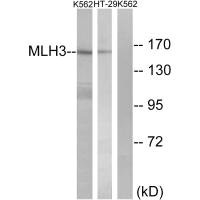
      • Western blot analysis of extracts from K562 cells and HT-29 cells, using MLH3 antibody.
      Have Questions? Leave a Message or Start an on-line Chat
      • Product Details
      • Related Products
      • Customer Reviews and Q&A
      • Target Background

      Product Details

      Full Product Name
      Rabbit anti-Homo sapiens (Human) MLH3 Polyclonal antibody
      Uniprot No.
      Q9UHC1
      Target Names
      MLH3
      Alternative Names
      DNA mismatch repair protein Mlh3 antibody; HNPCC 7 antibody; HNPCC antibody; HNPCC7 antibody; MGC138372 antibody; Mismatch repair gene MLH 3 antibody; Mismatch repair gene MLH3 antibody; MLH 3 antibody; MLH3 antibody; MLH3_HUMAN antibody; MutL homolog 3 (E. coli) antibody; MutL homolog 3 antibody; MutL protein homolog 3 antibody; S240II117 antibody
      Raised in
      Rabbit
      Species Reactivity
      Human
      Immunogen
      Synthesized peptide derived from internal of Human MLH3.
      Immunogen Species
      Homo sapiens (Human)
      Clonality
      Polyclonal
      Purification Method
      The antibody was affinity-purified from rabbit antiserum by affinity-chromatography using epitope-specific immunogen.
      Concentration
      It differs from different batches. Please contact us to confirm it.
      Form
      Rabbit IgG in phosphate buffered saline (without Mg2+ and Ca2+), pH 7.4, 150mM NaCl, 0.02% sodium azide and 50% glycerol.
      Tested Applications
      ELISA,WB
      Recommended Dilution
      Application Recommended Dilution
      WB 1:500-1:3000
      Protocols
      ELISA Protocol
      Western Blotting(WB) Protocol
      Troubleshooting and FAQs
      Antibody FAQs
      Storage
      Upon receipt, store at -20°C or -80°C. Avoid repeated freeze.
      Lead Time
      Basically, we can dispatch the products out in 1-3 working days after receiving your orders. Delivery time maybe differs from different purchasing way or location, please kindly consult your local distributors for specific delivery time.
      Usage
      For Research Use Only. Not for use in diagnostic or therapeutic procedures.
      Related Products

      MLH3 Antibodies

      • MLH3 Antibody ( WB, IHC, ELISA ) ( CSB-PA008838 )

      MLH3 Proteins

      • Recombinant Human DNA mismatch repair protein Mlh3 (MLH3), partial ( Yeast-CSB-YP883389HU E.coli-CSB-EP883389HU Baculovirus-CSB-BP883389HU Mammalian cell-CSB-MP883389HU In Vivo Biotinylation in E.coli-CSB-EP883389HU-B )

      Customer Reviews and Q&A

      ■ Customer Reviews

      There are currently no reviews for this product.

      Submit a Review here

      Target Background

      Function
      Probably involved in the repair of mismatches in DNA.
      Gene References into Functions
      1. The effects of chronic smoking on oral mucosa led to the methylation of genes MRE11A PMS2, XRCC1 and MLH3, but resulted in a reduction of gene expression of MRE11A and PMS2, which showed >/=50% methylation. These results provide evidence that smoking cause methylation and reduced expression of repair genes. PMID: 29775861
      2. MLH3 germline variants are associated with colon cancer patients belonging to families with Lynch syndrome-associated brain tumors. PMID: 27401157
      3. A polymorphism within the MLH3 gene is associated with oligozoospermia in Caucasian men of a certain area. PMID: 26520453
      4. MutL homolog 3 (MLH3) promoter methylation was observed in 61% of oligoastrocytoma and 27% of astrocytoma. PMID: 26303387
      5. Results indicate that CT(844)-CC(942) was associated with a high risk of cervical carcinoma and cervical intraepithelial neoplasia, and the CC(844)-CT(942) decreased the risk. PMID: 24759751
      6. The experiments show recruitment and persistence of MutLgamma-heterodimers at UVA-induced DNA lesions. PMID: 23696135
      7. the MutSbeta-MutLalpha interaction is mediated in part by residues ((L/I)SRFF) embedded within the MSH3 PCNA-binding motif PMID: 20154325
      8. hMLH3 mRNA is present at low levels in numerous tissues but high levels in testis. hMLH3 functions in meiosis as well as hMSH2-hMSH3 repair processes & has little if any role in Hereditary Non-Polyposis Colorectal Cancer (HNPCC). PMID: 19483466
      9. There is an association of polymorphism C85T in MSH5 or C2531T in MLH3 with male infertility, specifically azoospermia or severe oligozoospermia, and interaction between these MSH5 and MLH3 polymorphisms increased the risk of developing male infertility PMID: 19808033
      10. Little evidence for involvement of MLH3 in colorectal cancer predisposition. PMID: 12800209
      11. at pachynema, when chromosomes are fully paired, we find significant heterogeneity in the localization of the MutL homologs, MLH1 and MLH3, among human oocyte populations PMID: 15558497
      12. The identification of inherited missense variants, somatic missense mutations (present in 3 of 57 tumors), and LOH in the tumor from a patient with a germ line missense change suggest a role for MLH3 in endometrial tumorigenesis. PMID: 16885347
      13. Mutations of Mlh3 may work together with other genes in an accumulated manner and result in an increased risk of esophageal tumor PMID: 16981255
      14. in absence of hPMS2, hMLH3 (hMutLgamma) is located in the nucleus, suggesting a conditional activity in MMR and supporting its role as a low-risk gene in hereditary non-polyposis colorectal cancer PMID: 17203173
      15. Two simultaneous hMLH3 variants might predispose to spermatogenic arrest. PMID: 17482610
      16. results suggest that the endonuclease activity of MutLalpha is important not only in MMR-dependent mutation avoidance but also for recombination and damage response functions PMID: 17567544
      17. MLH3 and EXO1 alterations in familial colorectal cancer patients not fulfilling Amsterdam criteria. PMID: 17656264
      18. To assess the significance of the inherited sequence variations in MLH3, we functionally characterized seven missense mutations PMID: 18521850
      19. Mlh3 nullizygosity significantly increased Apc frameshift mutations and tumor multiplicity. PMID: 18551179
      20. the different biochemical assays yielded no evidence that the eight MLH3 unclassified variants (missense mutations) tested are the cause of hereditary colorectal cancer, including Lynch syndrome PMID: 19156873

      Show More

      Hide All

      Involvement in disease
      Hereditary non-polyposis colorectal cancer 7 (HNPCC7); Colorectal cancer (CRC)
      Subcellular Location
      Nucleus.
      Protein Families
      DNA mismatch repair MutL/HexB family
      Tissue Specificity
      Ubiquitous.
      Database Links

      HGNC: 7128

      OMIM: 114500

      KEGG: hsa:27030

      STRING: 9606.ENSP00000348020

      UniGene: Hs.436650

      Promotions
      Reward For Reviews
      Free antibody trial
      Contact Us

        Email: [email protected]
        Distributors Worldwide

      Service

      Phage Display Service

      Antibody Service

      • −  Polyclonal Antibody Production
      • −  Monoclonal Antibody Production
      • −  Custom Recombinant Antibody Production
      • −  Modification-specific Antibody Production

      Protein Service

      • −  E.coli Expression Service
      • −  Yeast Expression Service
      • −  In vitro E.coli Expression System
      • −  Insect baculovirus expression system
      • −  Mammalian Cell Expression System

      Gene Synthesis Service

      Oligo Synthesis Service

      Related Articles
      Antibody FAQs What Is an Antibody? How to Choose an Antibody for Scientific Research? The difference between primary antibody and secondary antibod The Meaning of Irregular Antibody Screening Tag Antibodies, Your Good Partner in Protein Research How to Choose the Loading Control Antibodies?
      Related pathways
      DNA repair pathway
      CUSABIO guaranteed quality
    icon of phone
    Call us
    301-363-4651 (Available 9 a.m. to 5 p.m. CST from Monday to Friday)
    icon of email
    Email
    [email protected]
    icon of address
    Address
    7505 Fannin St., Ste 610, Room 7 (CUBIO Innovation Center), Houston, TX 77054, USA
    icon of social media
    Join us with

    Subscribe newsletter

    Leave a message

    * To protect against spam, please pass the CAPTCHA test below.
    CAPTCHA verification
    © 2007-2026 CUSABIO TECHNOLOGY LLC All rights reserved. 鄂ICP备15011166号-1
    Privacy Policy
    Message
    • *
    • *
    • Since emails may get flagged by spam filters occasionally, we recommend leaving your phone number as a precaution. Your information is safe with us.

    • *
    • *
    • CAPTCHA verification

      Please enter the characters shown. Click the image to refresh if unclear.

    •  
    Place an order now

    I. Product details

    *
    *
    *
    *

    II. Contact details

    *
    *

    III. Ship To

    *
    *
    *
    *
    *
    *
    *

    IV. Bill To

    *
    *
    *
    *
    *
    *
    *
    *



