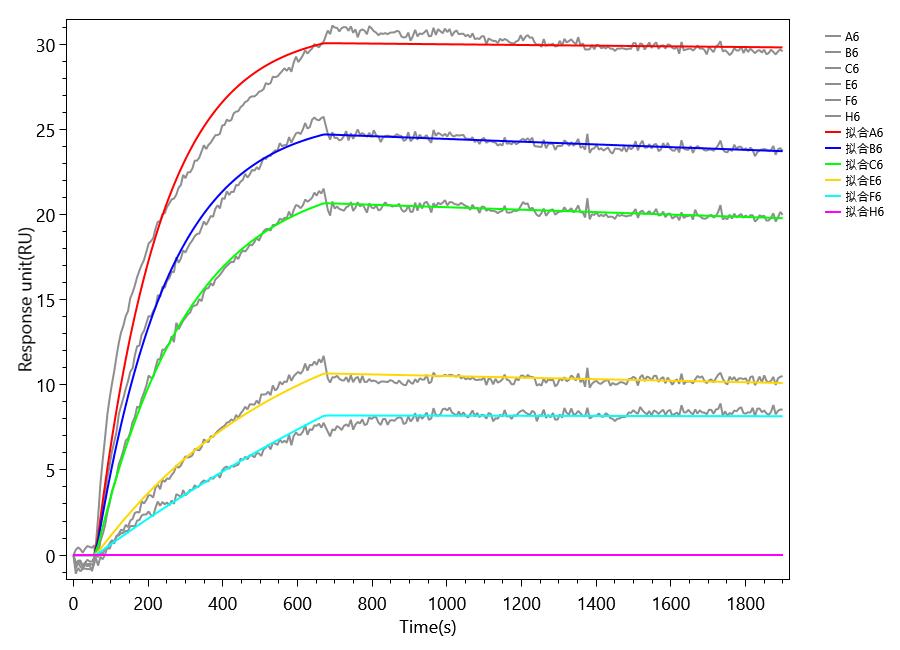
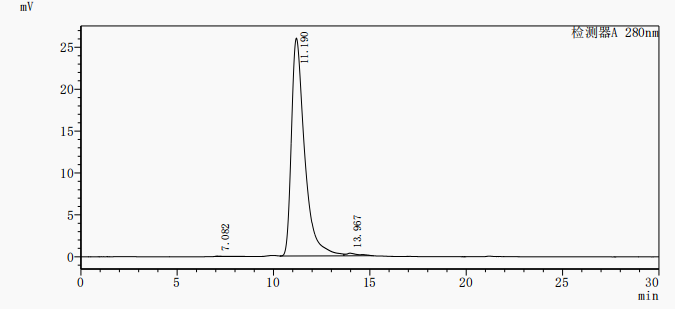
Recombinant Human C-type lectin domain family 5 member A (CLEC5A), partial

Code CSB-MP873686HU
Abbreviation Recombinant Human CLEC5A protein, partial
MSDS
Size $190
Order now
Image
  • (Tris-Glycine gel) Discontinuous SDS-PAGE (reduced) with 5% enrichment gel and 15% separation gel.
Have Questions? Leave a Message or Start an on-line Chat

Product Details

Purity
Greater than 95% as determined by SDS-PAGE.
Activity
Not Test
Target Names
CLEC5A
Uniprot No.
Research Area
Immunology
Alternative Names
C-type lectin superfamily member 5;Myeloid DAP12-associating lectin 1
Source
Mammalian cell
Expression Region
28-188aa
Target Protein Sequence
PQIFNKSNDGFTTTRSYGTVSQIFGSSSPSPNGFITTRSYGTVCPKDWEFYQARCFFLSTSESSWNESRDFCKGKGSTLAIVNTPEKLKFLQDITDAEKYFIGLIYHREEKRWRWINNSVFNGNVTNQNQNFNCATIGLTKTFDAASCDISYRRICEKNAK
Note: The complete sequence may include tag sequence, target protein sequence, linker sequence and extra sequence that is translated with the protein sequence for the purpose(s) of secretion, stability, solubility, etc.
If the exact amino acid sequence of this recombinant protein is critical to your application, please explicitly request the full and complete sequence of this protein before ordering.
Mol. Weight
24.6 kDa
Protein Length
Partial
Tag Info
N-terminal 10xHis-tagged
Form
Liquid or Lyophilized powder
Note: We will preferentially ship the format that we have in stock, however, if you have any special requirement for the format, please remark your requirement when placing the order, we will prepare according to your demand.
Buffer
If the delivery form is liquid, the default storage buffer is Tris/PBS-based buffer, 5%-50% glycerol. If the delivery form is lyophilized powder, the buffer before lyophilization is Tris/PBS-based buffer, 6% Trehalose, pH 8.0.
Reconstitution
We recommend that this vial be briefly centrifuged prior to opening to bring the contents to the bottom. Please reconstitute protein in deionized sterile water to a concentration of 0.1-1.0 mg/mL.We recommend to add 5-50% of glycerol (final concentration) and aliquot for long-term storage at -20℃/-80℃. Our default final concentration of glycerol is 50%. Customers could use it as reference.
Troubleshooting and FAQs
Storage Condition
Store at -20°C/-80°C upon receipt, aliquoting is necessary for mutiple use. Avoid repeated freeze-thaw cycles.
Shelf Life
The shelf life is related to many factors, storage state, buffer ingredients, storage temperature and the stability of the protein itself.
Generally, the shelf life of liquid form is 6 months at -20°C/-80°C. The shelf life of lyophilized form is 12 months at -20°C/-80°C.
Lead Time
Basically, we can dispatch the products out in 3-7 working days after receiving your orders. Delivery time may differ from different purchasing way or location, please kindly consult your local distributors for specific delivery time.
Notes
Repeated freezing and thawing is not recommended. Store working aliquots at 4℃ for up to one week.
Datasheet & COA
Please contact us to get it.

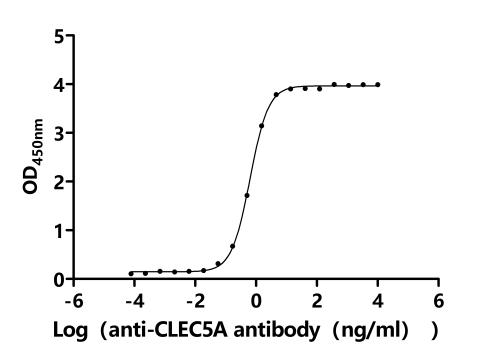
Customer Reviews and Q&A

 Customer Reviews

There are currently no reviews for this product.

Submit a Review here

Target Background

Function
Functions as a positive regulator of osteoclastogenesis. Cell surface receptor that signals via TYROBP. Regulates inflammatory responses.; (Microbial infection) Critical macrophage receptor for dengue virus serotypes 1-4. The binding of dengue virus to CLEC5A triggers signaling through the phosphorylation of TYROBP. This interaction does not result in viral entry, but stimulates proinflammatory cytokine release.
Gene References into Functions
  1. MDL-1 is mainly expressed in atherosclerotic lesional macrophages and increased macrophage MDL-1 expression is associated with early plaque progression and promotes macrophage survival. PMID: 29126450
  2. this study shows association of rs1285933 single nucleotide polymorphism in CLEC5A gene with dengue severity PMID: 28764923
  3. CLEC5A is critical for dengue virus-induced osteoclast activation and bone homeostasis PMID: 27033255
  4. Mannose Receptor and CLEC5A on Macrophage first attracts the Dengue Virus with high avidity, and the virus concurrently interacts with CLEC5A in close proximity to form a multivalent hetero-complex and facilitate CLEC5A-mediated signal transduction. Dengue Virus Infection Is through a Cooperative Interaction between a Mannose Receptor and CLEC5A on Macrophage as a Multivalent Hetero-Complex. PMID: 27832191
  5. The results suggest that CLEC5A-mediated enhancement of the inflammatory response in myeloid cells contributes to influenza pathogenicity in vivo and may be considered a therapeutic target in combination with effective antivirals. PMID: 27795434
  6. Concordant overexpression of MDL-1 and DAP12 were correlated with increased production of proinflammatory cytokines in rheumatoid arthritis patients. PMID: 24465901
  7. Blockade of CLEC5A inhibits NLRP3 inflammasome activation and pyrotopsis in dengue-virus-infected inflammatory macrophages. Thus, DV can activate NLRP3 inflammasome via CLEC5A. PMID: 23152543
  8. No significant associations were noted between the genotypes and allele frequency of the 4 CLEC5A tSNPs between controls and Kawasaki disease patients. PMID: 22536019
  9. CLEC5A is homodimeric at the cell surface and binds to dengue virus serotypes 1-4. PMID: 21566123
  10. CLEC5A expression in monocyte/macrophage and granulocytes is regulated by PU.1. PMID: 21094529
  11. The crystal volume per unit weight (VM) was calculated to be 2.34 A3 Da-1, with nine molecules per asymmetric unit and a solvent content of 47.38%. CLEC5A plays an important role in the pathophysiology of dengue-virus-induced disease. PMID: 20057064
  12. blockade of CLEC5A-mediated signalling attenuates the production of proinflammatory cytokines by macrophages infected with Dengue virus (either alone or complexed with an enhancing antibody) PMID: 18496526

Show More

Hide All

Subcellular Location
Cell membrane; Single-pass type II membrane protein.
Tissue Specificity
Highly expressed in bone marrow with lower levels in synovium, lung and bronchus. Expressed in peripheral blood monocytes and in the monocyte/macrophage cell lines U-937 and Mono-Mac-6, but not in cell lines of other origins. Expression is down-regulated
Database Links

HGNC: 2054

OMIM: 604987

KEGG: hsa:23601

STRING: 9606.ENSP00000449999

UniGene: Hs.446235

icon of phone
Call us
301-363-4651 (Available 9 a.m. to 5 p.m. CST from Monday to Friday)
icon of address
Address
7505 Fannin St., Ste 610, Room 7 (CUBIO Innovation Center), Houston, TX 77054, USA
icon of social media
Join us with

Subscribe newsletter

Leave a message

* To protect against spam, please pass the CAPTCHA test below.
CAPTCHA verification
© 2007-2026 CUSABIO TECHNOLOGY LLC All rights reserved. 鄂ICP备15011166号-1
Place an order now

I. Product details

*
*
*
*

II. Contact details

*
*

III. Ship To

*
*
*
*
*
*
*

IV. Bill To

*
*
*
*
*
*
*
*