Recombinant Human Troponin I, slow skeletal muscle (TNNI1)

Code CSB-EP024011HU
Abbreviation Recombinant Human TNNI1 protein
MSDS
Size $256
Order now
Image
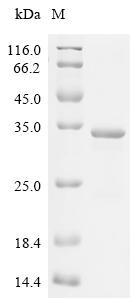
  • (Tris-Glycine gel) Discontinuous SDS-PAGE (reduced) with 5% enrichment gel and 15% separation gel.
Have Questions? Leave a Message or Start an on-line Chat

Product Details

Purity
Greater than 85% as determined by SDS-PAGE.
Target Names
TNNI1
Uniprot No.
Research Area
Signal Transduction
Alternative Names
Troponin I, slow-twitch isoform
Species
Homo sapiens (Human)
Source
E.coli
Expression Region
2-187aa
Target Protein Sequence
PEVERKPKITASRKLLLKSLMLAKAKECWEQEHEEREAEKVRYLAERIPTLQTRGLSLSALQDLCRELHAKVEVVDEERYDIEAKCLHNTREIKDLKLKVMDLRGKFKRPPLRRVRVSADAMLRALLGSKHKVSMDLRANLKSVKKEDTEKERPVEVGDWRKNVEAMSGMEGRKKMFDAAKSPTSQ
Note: The complete sequence may include tag sequence, target protein sequence, linker sequence and extra sequence that is translated with the protein sequence for the purpose(s) of secretion, stability, solubility, etc.
If the exact amino acid sequence of this recombinant protein is critical to your application, please explicitly request the full and complete sequence of this protein before ordering.
Mol. Weight
28.5 kDa
Protein Length
Full Length of Mature Protein
Tag Info
C-terminal 6xHis-tagged
Form
Liquid or Lyophilized powder
Note: We will preferentially ship the format that we have in stock, however, if you have any special requirement for the format, please remark your requirement when placing the order, we will prepare according to your demand.
Buffer
If the delivery form is liquid, the default storage buffer is Tris/PBS-based buffer, 5%-50% glycerol. If the delivery form is lyophilized powder, the buffer before lyophilization is Tris/PBS-based buffer, 6% Trehalose, pH 8.114.
Reconstitution
We recommend that this vial be briefly centrifuged prior to opening to bring the contents to the bottom. Please reconstitute protein in deionized sterile water to a concentration of 0.1-1.0 mg/mL.We recommend to add 5-50% of glycerol (final concentration) and aliquot for long-term storage at -20℃/-80℃. Our default final concentration of glycerol is 50%. Customers could use it as reference.
Troubleshooting and FAQs
Storage Condition
Store at -20°C/-80°C upon receipt, aliquoting is necessary for mutiple use. Avoid repeated freeze-thaw cycles.
Shelf Life
The shelf life is related to many factors, storage state, buffer ingredients, storage temperature and the stability of the protein itself.
Generally, the shelf life of liquid form is 6 months at -20°C/-80°C. The shelf life of lyophilized form is 12 months at -20°C/-80°C.
Lead Time
Basically, we can dispatch the products out in 3-7 working days after receiving your orders. Delivery time may differ from different purchasing way or location, please kindly consult your local distributors for specific delivery time.
Datasheet & COA
Please contact us to get it.
Customer Reviews and Q&A

 Customer Reviews

There are currently no reviews for this product.

Submit a Review here

Target Background

Function
Troponin I is the inhibitory subunit of troponin, the thin filament regulatory complex which confers calcium-sensitivity to striated muscle actomyosin ATPase activity.
Gene References into Functions
  1. Ultrasensitive troponin I was detectable in almost all individuals of a study sample reflecting middle-aged to elderly European general population. Ultrasensitive troponin concentrations exhibit an independent, graded, positive relation with incident CHD [coronary heart disease]. PMID: 28585121
  2. Measuring mean platelet volume in conjunction with troponin I levels improves the diagnostic value of troponin I in acute coronary syndrome. PMID: 27524214
  3. CT-1 was found to be associated with Tn-I, which is used to detect myocardial damage after OPCAB surgery. CT-1 may also be used to detect myocardial damage. PMID: 26334851
  4. TNNI3K is a cardiac-specific gene, encoding a cardiac troponin I-interacting MAP kinase. In mice, Tnni3k is shown to play an important role in the regulation of cardiac differentiation and cardiac contractility PMID: 25791106
  5. sTnI as a sensitive marker of skeletal muscle injury. PMID: 22323298
  6. Elevations of troponin I and N-terminal pro-B-type natriuretic peptide (NT-proBNP) are common in patients with atrial fibrillation and independently related to increased risks of stroke and mortality. PMID: 22374183
  7. Elevated post-operative troponin 1 levels predict long-term mortality in older patients undergoing emergency orthpedic surgery. PMID: 19811558
  8. Evaluated the prevalence of TNN13 gene mutations in sudden death caused by cardiomyopathy (CM); in dilated CM cases, a new missense mutation Pro16Thr was detected. A single nucleotide polymorphism at -8 position of intron 3 was identified. PMID: 20817590
  9. troponin I phosphorylation has a role in protein kinase C-mediated enhanced contractile performance of myocytes PMID: 12815045
  10. MEF2 activation of the troponin I slow enhancer is repressed by hMusTRD1alpha1 PMID: 12857748
  11. Low expression of ssTnI was found in 60% of patients in sinus rhythm or paroxysmal AF and in 8% of patients with chronic AF. Relative ssTnI mRNA expression was significantly lower in patients with AF than in those in sinus rhythm. PMID: 15289369
  12. A biological marker of myocardial injury, but may also be increased after a grand mal seizure. PMID: 15367881
  13. These results suggest that this R21C mutation in TnI affects the Ca(2+)-sensitizing effect of Tn, the ability of TnI to be readily phosphorylated by PKA and the stability of TnI to calpain. PMID: 16005017
  14. Relationship between myocardial injury, assessed by cardiac troponin I (cTnI) levels, and outcome in selected critically ill patients without acute coronary syndromes or cardiac dysfunction PMID: 16236952
  15. This marker in paatients with heart failure and anemia identifies patients at particularly high risk mortality. PMID: 16338262
  16. Increased serum levels of troponin I is associated with calcinosis and coronary Artery Stenosis PMID: 16358990
  17. The plasma levels of CRP and troponin I were also significantly higher in this group of nine patients, and correlated with urinary protein excretion. PMID: 16916777
  18. A revised method of troponin exchange in pemeabilized cardiac trabeculae using vanadate: functional consequences of a HCM-causing mutation in troponin I. PMID: 17051347
  19. a localized N-terminal region of TnI comprised of amino acids 33-80, which interacts with C-terminal regions of cTnC and cTnT, is of particular significance in transducing signaling of thin filament activation by strong cross-bridges PMID: 17099250

Show More

Hide All

Protein Families
Troponin I family
Tissue Specificity
Highest levels observed in human skeletal muscle (e.g. gastrocnemious muscle), differentiated cultures of primary human muscle cells and rhabdomyosarcoma cells cultured in low serum medium. Expressed in C2 muscle cell myoblasts and myotubes.
Database Links

HGNC: 11945

OMIM: 191042

KEGG: hsa:7135

STRING: 9606.ENSP00000337022

UniGene: Hs.320890

icon of phone
Call us
301-363-4651 (Available 9 a.m. to 5 p.m. CST from Monday to Friday)
icon of address
Address
7505 Fannin St., Ste 610, Room 7 (CUBIO Innovation Center), Houston, TX 77054, USA
icon of social media
Join us with

Subscribe newsletter

Leave a message

* To protect against spam, please pass the CAPTCHA test below.
CAPTCHA verification
© 2007-2026 CUSABIO TECHNOLOGY LLC All rights reserved. 鄂ICP备15011166号-1
Place an order now

I. Product details

*
*
*
*

II. Contact details

*
*

III. Ship To

*
*
*
*
*
*
*

IV. Bill To

*
*
*
*
*
*
*
*



